

 By
How to potty train a puppy: start the day your puppy comes home, take them to the same spot through the same door, and go out every 1 to 2 hours while they’re awake, plus after every nap, meal and play session. Go with them, wait a few minutes, and reward with praise and a small treat the moment they finish. Between trips, keep your puppy in sight or in a crate or pen, clean accidents with an enzyme cleaner, and never punish. That’s the method VCA’s veterinary behaviorists, the AKC and Ohio State’s veterinary medical center all describe.
Ohio State’s Indoor Pet Initiative boils puppy potty training down to two principles: reward your puppy every time they go in the right place, and prevent mistakes. Everything below is one of those two ideas in practice. This guide on how to potty train a puppy is also the hub for every potty post on ThePawCompass, so you’ll find links to the deeper guides as you go.
Table of Contents
- What You Need Before Day One
- How to Potty Train a Puppy: 7 Steps
- When to Take Your Puppy Out
- Signs Your Puppy Needs to Go
- Accidents: What to Do and What Never to Do
- Crate Training for Potty Training
- Night Potty Breaks
- Puppy Pads, Apartments and Bad Weather
- Poop Training
- How Long Does Potty Training Take?
- Puppy Potty Training Problems and Fixes
- When to Call the Vet
- Track It So You Can See the Pattern
- Puppy Potty Training FAQ
- How to Potty Train a Puppy: The Short Version
What You Need Before Day One
- A crate that fits. Big enough to stand, turn around and lie down, and no bigger, says VCA. Our dog crate size chart has the sizes, and a crate with a divider lets one crate grow with your puppy.
- A baby gate or exercise pen for times you can’t watch your puppy and they’ve been in the crate long enough (VCA).
- A leash. Ohio State recommends taking your puppy out on leash for every potty trip during training, so you’re right there to reward.
- Small treats that are easy to digest, so you can reward often without overfeeding (AKC).
- An enzyme cleaner. VCA and the AKC both say leftover smell pulls puppies back to the same spot, and enzyme cleaners break it down.
- Pads or artificial turf, only if you’ll need an indoor spot (more on that below).
The full shopping list lives in our new puppy checklist.
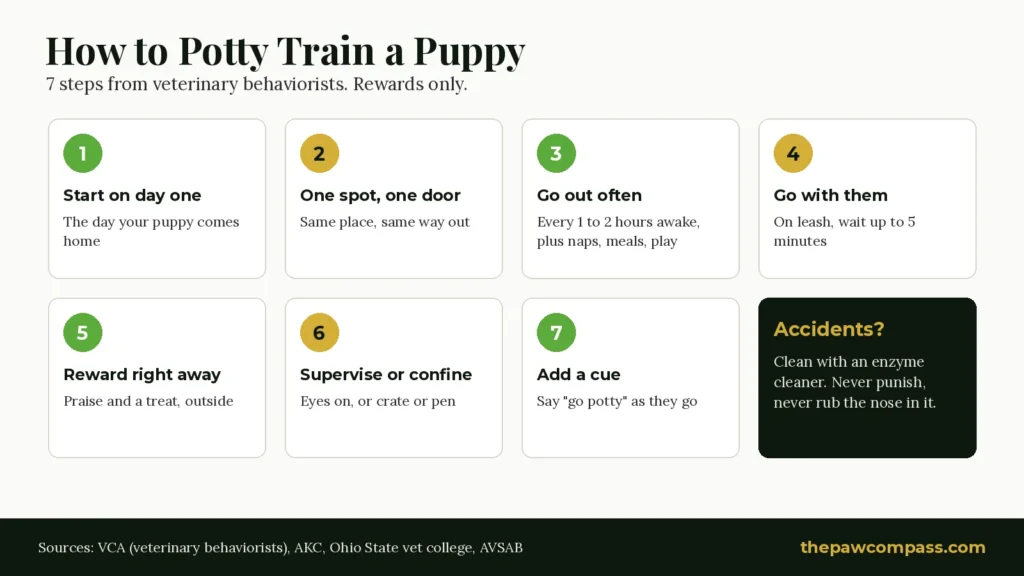
How to Potty Train a Puppy: 7 Steps
1. Start on Day One
Both VCA and the AKC say potty training starts the day your puppy comes home. The AKC points out that most puppies arrive at about 8 weeks old, which is when their bladder control is at its weakest, so expect a lot of trips at first. That’s normal, and it gets easier as they grow.
2. Pick One Spot and One Door
Take your puppy to the same potty spot every time, through the same door. Ohio State explains why: your puppy links the place with the job by sight, and over time by smell too. VCA adds that using one door helps your puppy learn to go to that door when they need out. If you don’t have a yard, Ohio State suggests picking a potty spot right next to your building and heading there as soon as you step outside.
3. Go Out Often, on a Schedule
Young puppies need a lot of breaks. VCA’s veterinary behaviorists list every 1 to 2 hours while awake, plus after meals, naps and play, and every 4 hours even if your puppy has been resting. The AKC says that can add up to a dozen or more trips a day. The full list of triggers is in the table below.
4. Go With Them, on Leash
Don’t send your puppy out alone. VCA says most puppies left outside by themselves get distracted and then go once they’re back indoors. Stand with your puppy in the potty spot and be patient for a few minutes. If nothing happens after about 5 minutes, VCA says to go back in, watch your puppy closely, and head straight back out at the first sign of restlessness. Dr. Meghan Herron, a veterinary behavior specialist at Ohio State’s veterinary medical center, suggests giving 2 to 3 minutes per trip.
5. Reward Right Away, Outside
The second your puppy finishes, praise them and give a small treat while you’re still in the potty spot, not back in the kitchen (VCA). Ohio State says to wait until your puppy has finished, not reward halfway, so they don’t stop early. The AKC goes further: make a big deal of it. Save playtime and walks for after the job is done. That teaches your puppy to go quickly, and the fun part becomes a reward too.
6. Supervise or Confine
This is the step that prevents most accidents. VCA says your puppy should always be either directly supervised (in your line of sight, within about 10 feet, or on a leash beside you) or safely confined. Dr. Herron at Ohio State puts it plainly: during training, never leave your puppy loose and unattended in the house, even while you cook dinner or use the bathroom. Put your puppy in the crate with a treat or chew bone, tether them nearby, or take them with you.
7. Add a Cue
Once you can tell your puppy is about to go, say a short cue like “go potty” just as they start. Ohio State suggests saying it only while your puppy is actually going for the first week or two, then slowly moving it earlier, to the moment you step outside. A cue is handy when you’re short on time or traveling. Ohio State notes that dogs can learn to pee on cue much more easily than they can poop on cue.
When to Take Your Puppy Out
A potty training puppy needs to go out at these moments. Most of them come from VCA’s veterinary behaviorists, with the rest from the AKC.
| Moment | When to go out | Source |
|---|---|---|
| First thing in the morning | Right away | AKC |
| Waking up from a nap | Immediately | VCA |
| After a meal or a big drink | Soon after | VCA, AKC |
| Running and playing | Every 30 minutes | VCA |
| Coming out of the crate | Right away | VCA, AKC |
| After chewing a toy or bone | Soon after | AKC |
| Awake and calm | Every 1 to 2 hours | VCA |
| Resting | At least every 4 hours | VCA |
| Last thing at night | Right before bed | AKC |
| Overnight | Until about 5 months old | VCA |
How long can your puppy wait between trips? The common rule is about one hour per month of age. VCA says to go out every 2 hours at 6 to 8 weeks and add an hour for each month, so about 3 hours at 3 months. Ohio State says one hour per month, give or take an hour, and Dr. Herron caps it at about 10 hours for older puppies. Our guide on how long a puppy can hold its pee has the full chart by age, awake and asleep. For an hour by hour day with every potty trip built in, use the 8 week puppy schedule.
Signs Your Puppy Needs to Go
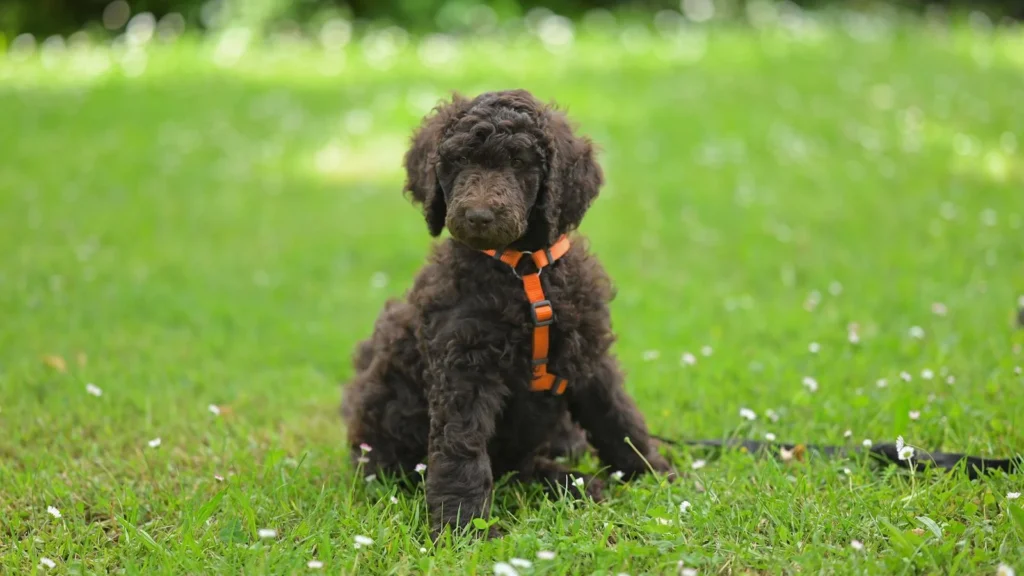
Puppies don’t always ask. It can take a while before they’re able to hold it and even longer to learn to tell you (VCA). Watch for:
- Sniffing the ground or circling
- Suddenly stopping play, or pausing and quickly squatting
- Restlessness
- Whining or scratching at the door
These come from the AKC and VCA. If you see one, calmly but quickly take your puppy to the potty spot. Once your puppy can hold it reliably, VCA says many learn to ask on their own, by barking or going to the door. Some people teach a bell on the door, but VCA warns that some dogs ring it just to go play.
Accidents: What to Do and What Never to Do
Accidents will happen. How you handle them decides whether they set training back.
If You Catch Your Puppy in the Act
VCA suggests a gentle interruption that gets attention without scaring: an odd noise, or a light tap on your leg or the table. When your puppy looks up, take them to the right spot and praise them if they finish there. The AKC says to calmly pick your puppy up and carry them outside.
If You Find It Later
Clean it up quietly, ideally with your puppy in another room, and don’t react (VCA). Use an enzyme cleaner, because any leftover smell tells your puppy this is a potty spot. Then tighten up supervision for the next few days.
What Never to Do
- Never rub your puppy’s nose in it, and never hit or scold them (VCA).
- Don’t punish after the fact. Dr. Herron at Ohio State says your puppy won’t connect it to the accident, and the “guilty” look is really fear of your reaction. VCA’s behaviorists agree the look means worried, not guilty.
- Don’t scold even when you catch them mid pee. Dr. Herron and Ohio State’s Indoor Pet Initiative both say puppies punished for going in front of people can learn to sneak off and go out of sight, behind the couch or in another room, and may refuse to go outside while you’re watching.
The American Veterinary Society of Animal Behavior recommends reward based training for every kind of behavior and advises against aversive methods, which it links to stress and to later aggression and anxiety. Potty training is no exception.
Is an older or fully trained dog suddenly having accidents? Our guide on how to stop a dog from peeing in the house covers marking, excitement peeing and the other common causes.
Crate Training for Potty Training
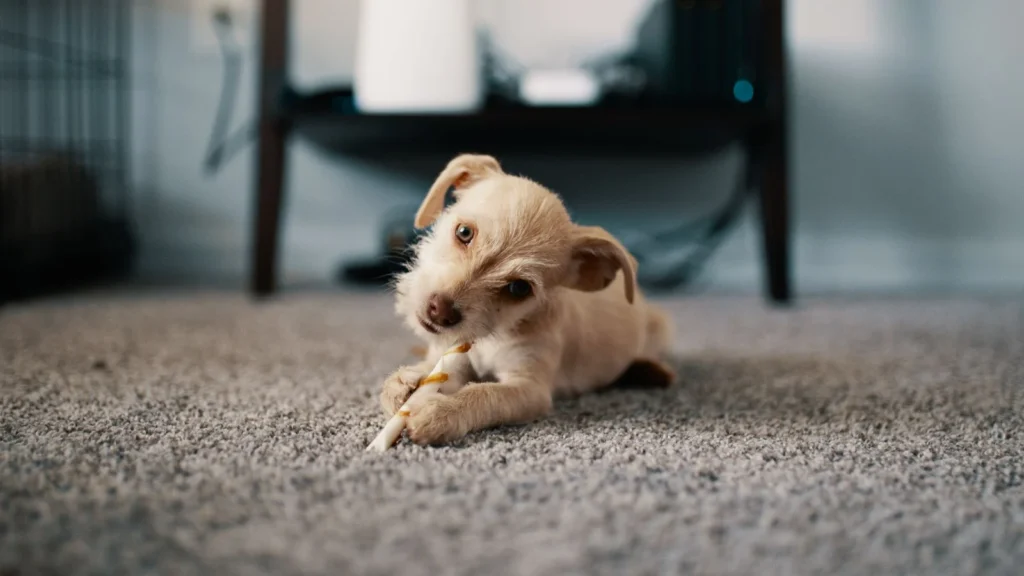
A crate works because most puppies avoid going where they sleep. VCA, the AKC and Ohio State all give the same size rule: room to stand, turn around and lie down, and no more. Too much space and your puppy can use one end as a bathroom. If your puppy will grow a lot, Dr. Herron says you can use a bigger crate and block off most of it. Our dog crate size chart and crate with a divider guides walk through both.
- Out of the crate means straight outside. VCA says your puppy will be ready to go the moment they come out, which makes it an easy win.
- Keep stretches short. VCA says puppies left alone for no more than about 3 hours usually do well in a crate. Longer than that, your puppy needs a potty break, a friend or sitter, or a bigger pen with a bed on one side and a pad or turf on the other.
- Never past what your puppy can hold. Ohio State says if you’ll be gone longer than your puppy can hold it, use a pen or a puppy proofed small room instead of the crate.
- Watch for crate accidents after short stays. Ohio State says that can point to separation or confinement anxiety and is worth a call to your vet.
If your puppy cries at night, it might be a potty call, or something else. Our guide on puppy crying in the crate covers how to tell the difference and what to do.
Night Potty Breaks
Expect to get up at night for a while. VCA says puppies need overnight potty breaks at 6 to 8 weeks, and VCA’s behaviorists say some puppies need them until about 5 months old. A few things help:
- Take your puppy out last thing before bed and first thing in the morning, every day (AKC).
- Keep night trips calm and short: out to the spot, quiet praise and a treat when they go, then back to bed. Play waits for the morning, the same way VCA says to save play until after your puppy has gone during the day.
- Use the chart in our guide on how long a puppy can hold its pee for overnight hold times by age, and the 8 week puppy schedule for when to set alarms.
Puppy Pads, Apartments and Bad Weather
Here’s where the experts don’t all agree. VCA’s veterinary behaviorists say dogs can be taught to go outdoors, indoors on pads, or in any other set area, so pads are a fair choice if they suit your life. Dr. Mary Burch of the AKC is more cautious: pads reinforce two different options for your puppy, and the AKC adds that they can slow the move to going outside. She sees them as useful if you can’t get home often during the day, or for very small dogs in places with harsh winters. Ohio State says paper training can be skipped altogether if you can take your puppy out often, and warns that switching from pads to outdoors doesn’t always go smoothly.
If you live in an apartment, VCA gives two options: carry your puppy outside so they can’t go in the hallway on the way, or train them to use pads in one spot inside. If you use pads, VCA suggests not lining the crate with them, so your puppy isn’t confused about where to go.
Plan to switch to outdoors later? Dr. Herron at Ohio State describes a simple handoff: once your puppy reliably uses a mat or pad, bring that mat outside to the potty spot for their breaks, then make it smaller and smaller until it’s gone. Our full guide to potty training puppies using pads walks through every step.
Poop Training
Poop follows the same rules, with a couple of twists. Ohio State notes that some dogs need to walk around a bit before they poop, and some don’t go at regular times, so a slow stroll on leash inside the potty area can help. Dogs often poop shortly after a meal (VCA), which makes the trip after breakfast and dinner your best chance.
Feeding matters too. The AKC says most puppies do best on several small meals, and that overfeeding can cause diarrhea, which makes house training much harder. For how many poops are normal at each age, and what a healthy one looks like, see how often puppies poop.
How Long Does Potty Training Take?
Less than a lifetime, more than a weekend. VCA says most puppies should be learning to ask to go out by about 4 months old and are fully potty trained by about 6 months. The AKC says some puppies build reliable habits within days while others take several months, depending on age, past routines and how consistent the training is. For milestones by age, see how long it takes to potty train a puppy.
Don’t hand over the run of the house too soon. VCA suggests waiting until your puppy has gone 8 to 12 weeks without a mistake before giving more freedom, and then adding it a little at a time. If you’re not seeing progress by 4 to 6 months, VCA recommends talking to your vet.
Puppy Potty Training Problems and Fixes
| Problem | Likely cause | What to try |
|---|---|---|
| Pees right after coming back in | Too distracted outside to finish | Go out with your puppy, wait up to 5 minutes, then watch closely and try again soon |
| Keeps going in the same spot inside | Leftover smell | Clean with an enzyme cleaner |
| Accidents after getting more freedom | Freedom came too fast | Go back to supervision and add rooms slowly |
| Soils the crate | Crate too big, too long inside, or stress | Use a divider, shorten stretches, and ask your vet if it continues |
| Dribbles when greeting people or nervous | Excitement or worry, not a training lapse | Talk to your vet or a behavior professional |
| Hides to pee, or won’t go while you watch | Past scolding | Reward outside every time and never punish |
| Was doing well, now has accidents | Possible medical problem | Book a vet visit |
When to Call the Vet
If your puppy is house soiling, especially if it starts suddenly, VCA’s veterinary behaviorists say to have your vet check for a physical problem. Call if you notice:
- Drinking and peeing a lot more than usual. VCA lists infections, diabetes and kidney disease among the causes.
- Diarrhea or loose stools that keep coming back, which VCA links to parasites, food problems and other gut issues.
- Signs of discomfort when peeing or pooping, like straining or stopping before they finish. VCA lists bladder inflammation and stones among the causes.
- Accidents in a puppy who was doing well, or no progress at all by 4 to 6 months (VCA).
The AKC adds that if your puppy is still hard to house train after consistent work, a vet visit comes first. Once health problems are ruled out, a trainer or behaviorist can help. For poop red flags specifically, see how often puppies poop.
Track It So You Can See the Pattern
VCA recommends keeping a training journal: how many times your puppy pees and poops each day, plus any changes in health or diet. VCA says a journal can reveal patterns, including ones that point to a physical or behavioral problem, and it gives your vet real numbers if something seems off.
Paper works. If you’d rather tap than write, The First 30 Days Puppy OS has a one tap potty button on its dashboard and an accidents page with its own tracker, so you can log trips and accidents as they happen.
Puppy Potty Training FAQ
-
How do you potty train a puppy?
Start the day your puppy comes home. Take them to the same spot through the same door every 1 to 2 hours while awake, plus after naps, meals and play. Go with them, reward with praise and a small treat the moment they finish, and keep them supervised or in a crate or pen between trips. Clean accidents with an enzyme cleaner and never punish. That’s the method VCA, the AKC and Ohio State’s vet school describe.
-
What age should you start potty training a puppy?
The day your puppy comes home. VCA and the AKC both say to start on day one. The AKC notes that most puppies go home at about 8 weeks, when bladder control is at its weakest, so expect frequent trips at first.
-
How often should you take a puppy out to pee?
VCA’s veterinary behaviorists say every 1 to 2 hours while awake, every 30 minutes during active play, right after naps and meals, and at least every 4 hours while resting. The AKC says that can mean a dozen or more trips a day for a young puppy.
-
Should I use puppy pads?
It depends on your situation. VCA says dogs can be trained to use pads as a set potty area. The AKC’s Dr. Mary Burch says pads give your puppy two options and can slow outdoor training, but can help if you can’t get home often or have a very small dog in a cold climate. If you can take your puppy out often, Ohio State says you can skip pads.
-
What should you do when your puppy has an accident?
If you catch it, interrupt gently with a small noise and take your puppy to the right spot, then praise them if they finish there. If you find it later, clean it quietly with an enzyme cleaner. Never rub your puppy’s nose in it, scold or hit. VCA and Ohio State’s vet school both warn that punishment can teach puppies to hide when they go.
-
Do puppies need to go out at night?
Yes, for a while. VCA says puppies need overnight potty breaks at 6 to 8 weeks, and some need them until about 5 months old. Keep night trips calm and short, with no play, then back to bed.
-
When can you give a puppy more freedom in the house?
VCA suggests waiting until your puppy has gone 8 to 12 weeks without a mistake, then adding one room at a time. The AKC lists giving freedom too quickly as a common reason accidents start again.
How to Potty Train a Puppy: The Short Version
- Start on day one, with one spot and one door.
- Go out every 1 to 2 hours while awake, plus after naps, meals, play and crate time.
- Go with your puppy, on leash, and reward the moment they finish.
- Between trips, eyes on your puppy or a crate or pen.
- Clean accidents with an enzyme cleaner. Never punish.
- Expect night trips for a while and full reliability around 6 months.
- Call your vet if accidents start suddenly or nothing improves by 4 to 6 months.
Over to you: what’s the trickiest part of potty training at your house right now? Tell us in the comments.

4 Comments