

 By
How long can a puppy hold its pee? Not long, at first. Vets quoted by Rover put it at about 1 to 2 hours at 8 to 10 weeks, 3 to 4 hours at 3 to 4 months, and around 6 hours by 6 months. Asleep at night, puppies can usually go longer: a 2 to 3 month old may manage 4 to 5 hours. Awake and playing, it’s a very different story, and a young puppy may need to go every hour or two. A healthy adult dog can hold it 8 to 10 hours, but that’s a limit, not a schedule.
Table of Contents
- Why Your Puppy Peed Right After Coming Inside
- How Long Can a Puppy Hold Its Pee? Chart by Age
- Months Plus 1 or 1 Hour per Month? Which Rule to Trust
- Awake, Asleep or Crated: Why the Numbers Change
- A Puppy Potty Schedule by Age (and How to Handle a Workday)
- How Long Can Dogs Hold Their Pee as Adults?
- When to Call the Vet (and What Doesn’t Work)
- Puppy Bladder FAQ
- Puppy Bladder Control by Age: The Quick Recap
Why Your Puppy Peed Right After Coming Inside
You know the scene. Ten minutes on the lawn, a lot of sniffing, zero pee. You carry the puppy back inside, set them on the rug, and they squat like they’ve been saving it just for you.
They weren’t being sneaky. A puppy’s bladder is tiny, and play, excitement, a drink of water or simply waking up can all make the need go from “later” to “right now” in minutes. That’s why the hold times you see online feel so wrong in real life. Most of them describe a puppy who is resting quietly, not one who just did zoomies around the kitchen.
So the real answer depends on three things: age, whether your puppy is awake or asleep, and what they’ve just been doing. Here’s how it all fits together.
How Long Can a Puppy Hold Its Pee? Chart by Age
| Age | Daytime hold | Overnight (asleep) |
|---|---|---|
| 8 to 10 weeks | 1-2 hours | About 4-5 hours |
| 10 to 12 weeks | 2-3 hours | About 4-5 hours |
| 3 to 4 months | 3-4 hours | May still need 1 break |
| 4 to 6 months | 4-6 hours | Usually all night |
| 6 to 12 months | About 6 hours | All night |
| Adult dog | 6-8 hours | All night |
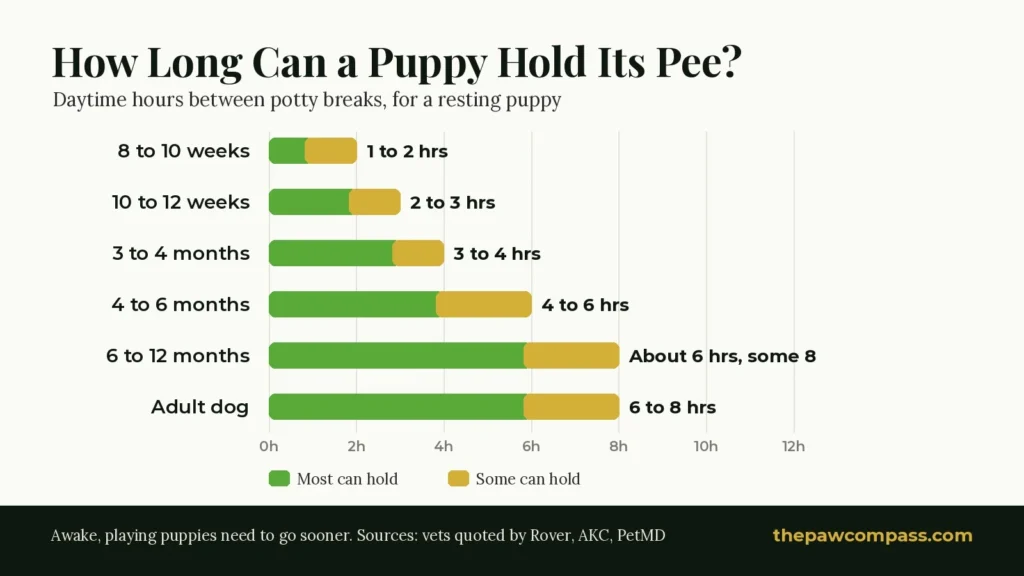
Two details make this chart work in real life. Puppies hold it longer at night because their body slows down while they sleep, which Rover’s vets point out too. And most puppies stop needing a nighttime potty trip at around 4 months. If you want the full picture of nights and naps, my guide to how much puppies sleep covers it by age.
Months Plus 1 or 1 Hour per Month? Which Rule to Trust
Ask three sources and you’ll get three rules of thumb. Here’s what each one says for a 3 month old puppy:
| Rule | Who uses it | At 3 months |
|---|---|---|
| Hours = age in months | AKC | About 3 hours |
| Age in months plus 1 | PetMD | About 4 hours |
| Vet chart by age | Rover’s vets | 3-4 hours |
The AKC’s potty training guide says puppies can generally hold it for about the same number of hours as their age in months, up to about 9 months to 1 year. PetMD’s vet-written guide adds an hour. The difference matters most when you’re planning a crate stretch or a workday.
My take: plan on the lower number. Every one of these rules describes the most a calm, resting puppy can manage. None of them is a goal. And the rules stop working once your puppy is grown, because no dog’s bladder keeps adding an hour a month forever.
Awake, Asleep or Crated: Why the Numbers Change
- Asleep: the longest stretch. A quiet, sleeping puppy holds it far longer than an awake one, which is why nights get easier before days do.
- Awake and active: the shortest stretch. The AKC says very young puppies often need to go after waking up, eating, drinking and playing, and before bed, which can mean a trip outside every 1 to 2 hours while they’re awake. PetMD suggests every 30 to 60 minutes for the first two weeks at home.
- Crated during the day: use the daytime number in the chart as the absolute limit, then come in under it. A crate isn’t a bladder extender.
Signs Your Puppy Needs to Go Right Now
PetMD lists the most common signals. Some are obvious. Some are easy to miss when you’re busy:
- Crying or whimpering
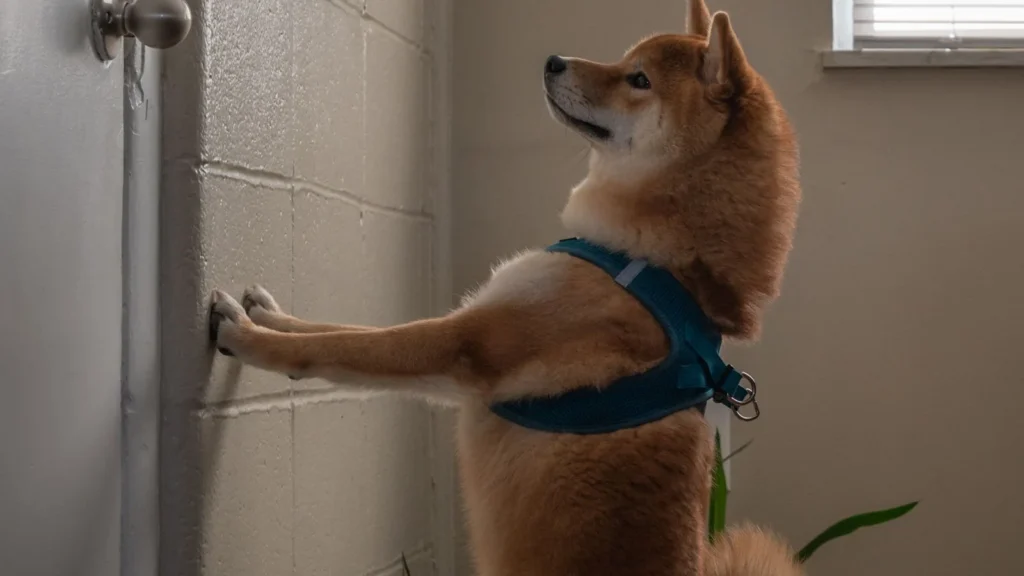
- Pawing at the door or waiting next to it
- Pacing
- Jumping around where you keep the leash
- Sniffing the floor or circling
- Squatting (go now, not in a minute)
- Barking, or any sudden change in what they’re doing
A Puppy Potty Schedule by Age (and How to Handle a Workday)
| Age | Potty break at least every |
|---|---|
| 2 months | 2-3 hours |
| 3 months | 3-4 hours |
| 4 months | 4-5 hours |
| 6 months | About 6 hours |
For a younger puppy’s whole day mapped out hour by hour, my 8 week puppy schedule has it, overnight trips included.
The Workday Math
Say you’re out of the house for 9 hours (an 8 hour shift plus the commute). Here’s how many breaks your puppy needs while you’re gone, based on the hold times above:
| Age | Breaks needed in 9 hours |
|---|---|
| 2 months | 3 or more |
| 3 months | 2 |
| 4 months | 1-2 |
| 6 months | 1 |
| Adult dog | 1 is kind |
What Midday Help Really Costs
| Option | Typical cost | Best for |
|---|---|---|
| Come home at lunch | Free | Short commutes |
| Friend or neighbor | Free, or cookies | Reliable helpers |
| Dog walker, 30 min | About $21 a walk | Most weekdays |
| Dog walker, 60 min | $29-$38 a walk | Big, busy dogs |
One 30 minute walk every weekday at Rover’s average of $21.45 comes to about $450 a month over 21 workdays. A 3 month old who needs two visits doubles that, to roughly $900. The good news is it doesn’t last: by 6 months, one break usually covers it.
Whatever your setup, write down when your puppy actually pees for a few days. Real gaps beat any chart. If you’re using my First 30 Days Puppy OS Notion template, its potty log buttons make that a one tap job.
How Long Can Dogs Hold Their Pee as Adults?
According to Mills Animal Hospital, a healthy adult dog can typically go 8 to 10 hours without urinating, and they’re quick to add that this doesn’t mean they should. Rover’s vets put the daytime figure for dogs over a year at 6 to 8 hours. Overnight, most healthy adults sleep straight through.
Senior dogs are a different story. Mills notes that older dogs may need to go more often because of reduced muscle tone or health changes, so the adult numbers won’t apply. If your older dog suddenly needs more trips, that’s worth mentioning at the next vet visit.
So how long can a dog go without peeing before it’s a real problem? Mills Animal Hospital’s advice is clear: if your dog hasn’t peed in 12 to 24 hours, is straining, or seems uncomfortable, don’t wait.
When to Call the Vet (and What Doesn’t Work)
Call Your Vet If You Notice
- No pee in 12 to 24 hours
- Straining, or only a few drops coming out
- Blood in the urine
- Peeing small amounts very often, which can point to a urinary tract infection
- A swollen belly or obvious discomfort
- Repeated accidents in a puppy who was doing well, despite consistent training
- Suddenly drinking and peeing much more than usual
That last one has a long list of possible causes, kidney trouble among them. My post on the signs of kidney failure in dogs covers what to watch for. Mills Animal Hospital also warns that regularly holding urine too long can contribute to urinary tract infections or inflammation, and over time to bladder or kidney problems.
What Doesn’t Work (and What to Do Instead)
- Planning to the maximum on a chart. Use the lower number and come in under it.
- Cutting water to cut down on pee. Puppies need water. Ask your vet before restricting it at any time of day.
- Scolding after the fact. Your puppy can’t connect a scolding to a puddle from ten minutes ago. Clean it up with an enzyme cleaner (it’s on my new puppy checklist for a reason) and take them out sooner next time.
- Crating a young puppy for a whole workday. Their bladder can’t do it, and accidents in the crate undo your progress.
- Treating 10 to 12 hours as normal for an adult. They may manage it, but making a habit of it isn’t kind or healthy.
Puppy Bladder FAQ
-
How long can a puppy hold its pee at night?
Longer than during the day, because their body slows down while they sleep. Vets quoted by Rover say a 2 to 3 month old puppy may hold it for 4 to 5 hours at night. Most puppies sleep through the night without a potty break by about 4 months.
-
How long can an 8 week old puppy hold its pee?
About 1 to 2 hours during the day, and less when they’re awake and playing. PetMD suggests a potty trip every 30 to 60 minutes for the first two weeks at home. Overnight, while asleep, many can manage around 4 to 5 hours.
-
How long can a 3 month old puppy hold its pee?
About 3 to 4 hours during the day, according to both PetMD and vets quoted by Rover. Plan on the lower end, and add trips after naps, meals and play.
-
How long can a 6 month old puppy hold its pee?
Around 6 hours. The AKC gives about 6 hours at 6 months, and Rover’s vets say some puppies between 6 and 12 months can manage up to 8.
-
How long can a dog go without peeing?
A healthy adult dog can typically go 8 to 10 hours, according to Mills Animal Hospital, but shouldn’t be made to do it regularly. If a dog hasn’t peed in 12 to 24 hours, or is straining, call your vet.
-
Is the age in months plus one rule accurate?
It’s a rough maximum for a calm, resting puppy, not a schedule. The AKC uses a slightly lower rule of about one hour per month of age. Plan on the lower number, and expect an awake, playing puppy to need to go much sooner.
-
How long can a puppy stay in a crate during the day?
No longer than they can hold their bladder. That’s roughly 1 to 2 hours at 8 to 10 weeks and 3 to 4 hours at 3 to 4 months, and less is better. Longer stretches lead to accidents in the crate.
Puppy Bladder Control by Age: The Quick Recap
Young puppies can hold it for about 1 to 2 hours, 3 month olds for 3 to 4, and 6 month olds for around 6. Nights are easier than days, and awake puppies always need to go sooner than any chart says. Plan on the low number, add a trip after every nap, meal and play session, and the puddles fade faster than you’d think.
Now I want to hear from you: what’s the longest your puppy has surprised you by holding it? Or the fastest they’ve proved this post right? Tell me in the comments.
