

 By
The right crate lets your dog stand up without ducking, turn around without bumping the walls, and lie flat on their side with their legs stretched out. Not much more than that. To find it, measure your dog from the nose to the base of the tail and from the floor to the top of the head, then add 2 to 4 inches to each number. By adult weight, the quick version goes like this: 13 to 25 lbs fits a 24 inch crate, 26 to 40 lbs a 30 inch, 41 to 70 lbs a 36 inch, 71 to 90 lbs a 42 inch, and 90 to 110 lbs a 48 inch. The full dog crate size chart is below, with sizes by breed and a divider timeline for puppies.
Table of Contents
- Why Crate Size Matters More Than It Looks
- The Dog Crate Size Chart: All 8 Sizes
- How to Measure Your Dog for a Crate (2 Minutes, 1 Treat)
- Why Every Dog Crate Size Chart Online Says Something Different
- Wire vs Plastic Crates: The 3.5 Inch Trap
- Puppy Crate Size: Buy the Adult Size, Then Use a Divider
- What Size Crate for My Dog? Sizes by Breed
- Signs Your Dog’s Crate Is the Wrong Size (and Mistakes to Skip)
- Dog Crate Size FAQ
- Before You Buy: The 2 Minute Recap
Why Crate Size Matters More Than It Looks
Picture the crate aisle at a big pet store on a Saturday. Someone is holding a 10 lb Golden Retriever puppy in one arm and squinting at two boxes. The 24 inch crate looks cozy and sensible. The 42 inch one looks ridiculous, like buying a puppy a studio apartment.
If they pick the cozy one, they’ll be back in that same aisle in about four months. By 6 months old, a large breed puppy is already around 60% of their adult size, according to the AKC. That’s a 33 to 45 lb dog trying to fold itself into a crate built for a Shih Tzu.
Going big with nothing to block off the space causes its own mess. Dogs don’t like to soil where they sleep, and that instinct is what makes crate training work. Give a puppy a crate twice their size and they’ll find a corner that doesn’t count as the bedroom. A crate that’s too small is no better, because an uncomfortable crate is one your dog learns to avoid.
The fix for both problems is the same. Size the crate for the adult dog, then shrink it with a divider. Everything below is about getting that one number right.
The Dog Crate Size Chart: All 8 Sizes
Crates in the US are sold by length, so a “36 inch crate” is about 36 inches long. The weights are adult weights. Find your dog’s weight first, then check the length column against your tape measure. If the two disagree, the tape wins.
| Crate size | Typical size (L x W x H) | Adult dog weight | Fits a dog up to this long* | Example breeds |
|---|---|---|---|---|
| 18 inch | 18 x 12 x 14 in | Up to 6 lbs | 14 in | Toy breed puppies, small Chihuahuas |
| 22 inch | 22 x 14 x 16 in | Up to 12 lbs | 18 in | Chihuahua, Yorkie, Pomeranian, Toy Poodle |
| 24 inch | 24 x 18 x 20 in | 13 to 25 lbs | 20 in | Shih Tzu, Cavalier, Miniature Schnauzer, Boston Terrier |
| 30 inch | 30 x 20 x 23 in | 26 to 40 lbs | 26 in | Beagle, French Bulldog, Corgi, Cocker Spaniel |
| 36 inch | 36 x 24 x 26 in | 41 to 70 lbs | 32 in | Border Collie, Bulldog, Australian Shepherd, Siberian Husky |
| 42 inch | 42 x 28 x 30 in | 71 to 90 lbs | 38 in | Labrador, Golden Retriever, Boxer, Standard Poodle |
| 48 inch | 48 x 30 x 32 in | 90 to 110 lbs | 44 in | German Shepherd, Rottweiler, Bernese Mountain Dog, Doberman |
| 54 inch | 54 x 37 x 45 in | 110 lbs and up | 50 in | Great Dane, Mastiff, Saint Bernard |
Notice that Labs and Goldens sit in the 42 inch row even though plenty of them weigh under 71 lbs. That’s not a typo. It’s the most confusing thing about crate charts, and it gets its own section further down.
How to Measure Your Dog for a Crate (2 Minutes, 1 Treat)
Grab a soft tape measure and something tasty. A treat held at nose level buys you a few seconds of a dog standing still, which is all you need. Mostly.
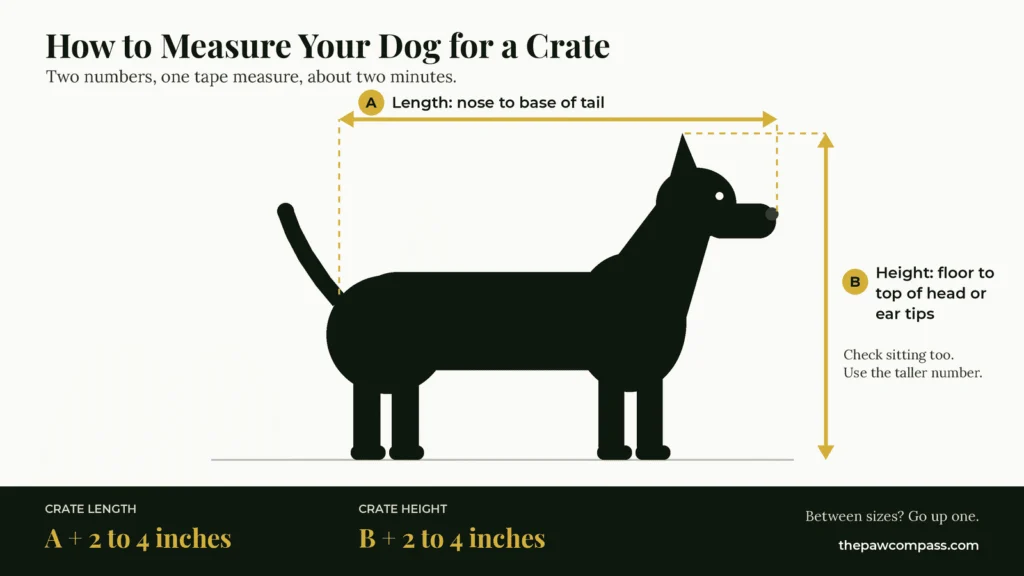
- Length: with your dog standing, measure from the tip of the nose to the base of the tail, where the tail meets the body. Add 2 to 4 inches.
- Height: measure from the floor to the top of the head, or to the tips of the ears if they stand up. Check it with your dog sitting too, since some dogs sit taller than they stand. Take the bigger number and add 2 to 4 inches.
- Match it to the inside of the crate: those two numbers are the minimum inside length and height. Little dogs are fine with 2 extra inches. Big dogs want the full 4. The American Kennel Club’s crate guide suggests adding 3 to 4 inches, which is the safer end if you’re unsure.
Once the crate is set up, do the real world test. Your dog should stand without ducking, turn around without bumping the sides, and lie on their side with their legs fully stretched out. If any of that fails, go up a size.
Why Every Dog Crate Size Chart Online Says Something Different
Open three crate charts and you’ll get three answers. I read the top ranking guides side by side for this post, and the spread is wide. One well known chart puts dogs up to 40 lbs in a 24 inch crate, while most others stop that size at about 25 lbs. Labs land anywhere from 36 to 42 inches, depending on whose chart you trust. A few things cause the mess:
- Weight ignores body shape. A 25 lb Corgi and a 25 lb Shih Tzu weigh the same and need different crates, because one of them is built like a loaf of bread on short legs. Dachshunds and Basset Hounds break weight charts too.
- Charts measure the dog differently. Most measure to the base of the tail. The AKC’s guide measures to the tip. A few inches of tail can bump you up a size.
- Labels describe the outside. With thin wire walls, that barely matters. With thick plastic it matters a lot, and there’s a whole section on that below.
- Brands don’t size identically. One company’s 30 inch crate can be an inch or two shorter or taller than another’s, so read the actual dimensions before you order.
My rule when the charts fight: trust the tape measure, size up when in doubt, and use a divider to take back the extra space.
The Labrador Problem: 36 or 42 Inches?
The AKC lists Labrador Retrievers at 55 to 80 lbs. By weight alone, a lot of Labs belong in a 36 inch crate. MidWest, on the other hand, rates its 42 inch crate for dogs 71 to 90 lbs. Yet the top crate charts on Google list Labs at 42 inches, with one allowing 36 to 42. The reason is shape. Labs are long and leggy for their weight.
Reviews on MidWest’s own website show both sides of it. One Lab parent wrote that the 42 inch “looked gigantic” when it first went up for their 4 month old puppy. Another bought a 42 for a Lab puppy who grew up on the small side, switched to a 36, and added that the 36 would be too small for most Labs.
Both stories teach the same lesson. Buy for the adult dog and measure before you commit. For most Labs and Goldens that’s a 42 inch crate. If your adult dog measures under 32 inches from nose to tail base, a 36 inch will do.

Wire vs Plastic Crates: The 3.5 Inch Trap
Wire crates are named by their length, and because the walls are thin wire, the inside is close to the number on the box. Plastic kennels are a different story. Their thick walls and domed roof eat into the space, and the size on the label is usually the outside.
Petmate lists both numbers for its Vari Kennel, which makes it a handy example:
| Kennel | Outside (L x W x H) | Inside (L x W x H) | Petmate’s weight range |
|---|---|---|---|
| 28 inch | 28 x 20.5 x 21.5 in | 24.25 x 18.25 x 19.5 in | 25 to 30 lbs |
| 32 inch | 32 x 22.5 x 24 in | 29.5 x 19.75 x 23.5 in | 30 to 50 lbs |
| 36 inch | 36 x 25 x 27 in | 32.5 x 22.25 x 26 in | 50 to 70 lbs |
| 40 inch | 40 x 27 x 30 in | 36.25 x 24.75 x 28.8 in | 70 to 90 lbs |
So a “36 inch” plastic kennel gives your dog 32.5 inches of floor. That’s 3.5 inches gone, which is the entire safety margin from the measuring step. When you shop plastic, compare your dog’s numbers to the inside dimensions, never the name on the box.
As for which type to choose: wire is the easiest to size, has the best airflow, and usually comes with a divider, so it’s the usual pick for puppies and flat faced breeds. Plastic feels more den like and doubles as a car crate. Airlines set their own kennel rules, so check with the airline before you fly.
Puppy Crate Size: Buy the Adult Size, Then Use a Divider
If you’re bringing home a puppy, buy the crate your dog will need as an adult and shrink it with a divider panel. Slide the divider back as your puppy grows. The AKC recommends exactly this, and it means one crate instead of three.
The catch is that you actually have to move the divider. Here’s how fast puppies grow into the space, based on the AKC’s puppy growth chart:
| Adult size | 6 months | 9 months | 12 months | 15 months | 18 months |
|---|---|---|---|---|---|
| Small (up to 20 lbs) | 75% | 90% | 100% | 100% | 100% |
| Medium (21 to 50 lbs) | 66% | 85% | 95% | 100% | 100% |
| Large (51 to 100 lbs) | 60% | 75% | 85% | 95% | 100% |
| Extra large (100+ lbs) | 50% | 65% | 80% | 90% | 100% |
In plain English: a Lab puppy is only about 60% grown at 6 months and still filling out at a year. A Great Dane or a Mastiff can take up to two years to reach full size.
How to Move the Divider as Your Puppy Grows
| Age | What’s happening | What to do with the divider |
|---|---|---|
| 8 to 10 weeks | New home, tiny bladder, overnight potty trips | Give just enough room to stand, turn and lie flat, plus a couple of inches. No spare corner. |
| 3 to 6 months | Fast growth for most breeds | Re-check every 2 weeks. Slide the divider back when your puppy can’t lie stretched out with room to spare. |
| 6 to 12 months | Small breeds are close to adult size (about 90% by 9 months) | Small dogs: take the divider out once they’re reliably clean in the crate. |
| 12 to 18 months | Large breeds reach 85% to 100% of adult size | Open it up fully once your dog is grown or reliably clean in the crate. |
| 18 to 24 months | Giant breeds finish growing | Full crate. |
Two signals tell you the divider is in the wrong spot. A puddle at the back means there’s too much room, so pull it forward a notch for a week. A puppy who always sleeps curled up tight, even when the room is warm, may be asking for more space, so slide it back.
For how crate time fits into a young puppy’s day, my 8 week puppy schedule maps it out hour by hour, overnight potty trips included.
I’d also write down your puppy’s weight every time you re-check the divider. A jump on the scale is the easiest early warning that the crate is about to get tight. If you use my First 30 Days Puppy OS Notion template, its weight log was made for this.
The Crate I’d Point Most Lab and Golden Parents To
Heads up: ThePawCompass uses affiliate links. If you buy something through a link on this page, I may earn a small commission at no extra cost to you. I only recommend products I’d genuinely suggest to a friend.
For big retriever puppies, the MidWest 42 inch Double Door iCrate is the one on our Shop page. It’s a plain folding wire crate with a divider panel in the box, which a growing puppy needs. Two doors help more than you’d expect when the crate has to squeeze beside a bed or into a corner. It folds flat, and the plastic pan pulls out for cleaning, which you’ll appreciate during the potty training months. MidWest rates the 42 inch size for dogs 71 to 90 lbs, which matches the 42 inch row in the chart. If your dog is heading past 90 lbs, look at a 48 inch crate instead.
One honest note: some reviewers say the latches aren’t the most secure and the frame can bend under a determined chewer. If your puppy is an escape artist, a couple of snap clips on the door latches add peace of mind. See the MidWest 42 inch iCrate on Amazon.
What Size Crate for My Dog? Sizes by Breed
Most common breeds land in these sizes. Weights are the AKC’s adult breed ranges. Treat this as a starting point and measure your own dog, especially if you have a mixed breed or a big male.
| Breed | Adult weight (AKC) | Crate size | Watch out for |
|---|---|---|---|
| Chihuahua | Up to 6 lbs | 18 to 22 inch | The smallest ones fit an 18 inch |
| Pomeranian | 3 to 7 lbs | 22 inch | The fluff makes them look bigger than they are |
| Yorkshire Terrier | About 7 lbs | 22 inch | Size by length, not by the coat |
| Shih Tzu | 9 to 16 lbs | 24 inch | Flat face, so keep airflow good |
| Cavalier King Charles Spaniel | 13 to 18 lbs | 24 inch | Go 30 inch if yours loves to sprawl |
| Miniature Schnauzer | 11 to 20 lbs | 24 inch | Measure height to the top of the head |
| Boston Terrier | 12 to 25 lbs | 24 inch | Flat face, so keep airflow good |
| Miniature Dachshund | 11 lbs and under | 24 inch | Long body, size by length not weight |
| Standard Dachshund | 16 to 32 lbs | 30 inch | Long body, size by length not weight |
| French Bulldog | Under 28 lbs | 30 inch | Wide chest and flat face, needs width and airflow |
| Beagle | Under 20 lbs (13 inch) or 20 to 30 lbs (15 inch) | 24 inch or 30 inch | Size by which height variety you have |
| Pembroke Welsh Corgi | Up to 30 lbs | 30 inch | Long and low, size by length |
| Border Collie | 30 to 55 lbs | 36 inch | Leggy, check sitting height |
| Bulldog | 40 to 50 lbs | 36 inch | Flat face, wire beats plastic for airflow |
| Australian Shepherd | 40 to 65 lbs | 36 inch | Large males may need a 42 |
| Siberian Husky | 35 to 60 lbs | 36 inch | Tall males may need a 42 |
| Labrador Retriever | 55 to 80 lbs | 42 inch | A 36 only if your adult measures under 32 inches |
| Golden Retriever | 55 to 75 lbs | 42 inch | Long bodies, don’t size down |
| Boxer | 65 to 80 lbs (females about 15 lbs less) | 42 inch | Tall and deep chested |
| Standard Poodle | 40 to 70 lbs | 42 inch | Tall for their weight |
| German Shepherd | 50 to 90 lbs | 42 to 48 inch | Upright ears add height, measure to the tips |
| Doberman Pinscher | 60 to 100 lbs | 48 inch | Tall, so check the height |
| Rottweiler | 80 to 135 lbs | 48 inch | Big males may need a 54 |
| Bernese Mountain Dog | 70 to 115 lbs | 48 inch | Heavy coat, they run warm |
| Great Dane | 110 to 175 lbs | 54 inch | Height is the problem, not length |
| Mastiff | 120 to 230 lbs | 54 inch or larger | Measure, the biggest males outgrow standard crates |
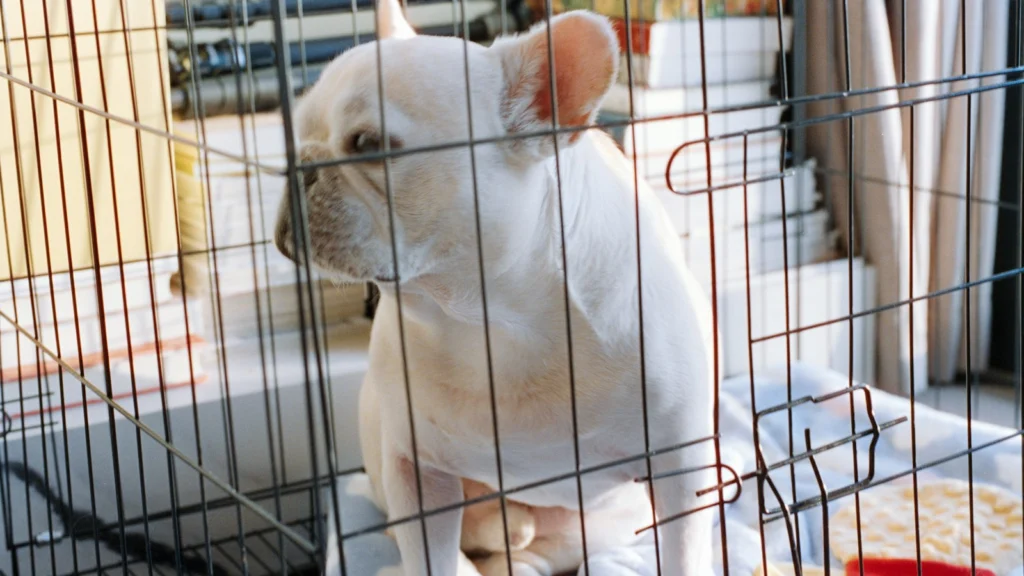
If you share your home with a flat faced breed (Frenchies, Pugs, Bulldogs, Boston Terriers), keep the crate out of direct sun and skip full covers on warm days. It’s worth knowing the early heatstroke warning signs too.
Signs Your Dog’s Crate Is the Wrong Size (and Mistakes to Skip)
Your dog will tell you when the crate is wrong. You just have to know what you’re looking at.
Signs the Crate Is Too Small
- Ducks their head to stand up, or their ears brush the roof when sitting
- Can’t turn around without bumping the sides
- Can’t lie on their side with legs stretched out
- Starts refusing to go in after happily walking in before. This has other causes too, but size is the easiest one to rule out
Signs the Crate Is Too Big
- Accidents in the crate, usually in a back corner, while the bed stays dry
- Sleeping at one end and using the other end as a play area
Mistakes to Skip
- Buying for the puppy in your arms. Buy for the dog you’ll have in a year.
- Going by weight alone for long or tall breeds like Dachshunds, Corgis, Standard Poodles and Great Danes.
- Comparing a plastic kennel’s label to a wire crate chart. Check the inside dimensions.
- Forgetting the bed. A thick bed eats height, so check the head clearance with the bed in place.
- Setting the divider once and forgetting it. A phone reminder every 2 weeks fixes this.
- Covering the whole crate for a flat faced dog on a warm day. Leave at least one side open.
Dog Crate Size FAQ
-
What size crate does my dog need?
Measure your dog from the nose to the base of the tail and from the floor to the top of the head, then add 2 to 4 inches to each. Those are the minimum inside length and height. By adult weight, most dogs from 13 to 25 lbs fit a 24 inch crate, 26 to 40 lbs a 30 inch, 41 to 70 lbs a 36 inch, 71 to 90 lbs a 42 inch, and 90 to 110 lbs a 48 inch.
-
Is it better for a dog crate to be too big or too small?
Slightly too big, as long as you block off the extra space with a divider while your dog is still potty training. A crate that’s too small is uncomfortable, and the only fix is buying another one.
-
What size crate does a Lab need?
Most Labrador Retrievers need a 42 inch crate. The AKC lists Labs at 55 to 80 lbs, and their length and height push most of them past a 36 inch crate. If your adult Lab measures under 32 inches from the nose to the base of the tail, a 36 inch can work.
-
What size crate for a 50 lb dog?
Usually a 36 inch crate, which suits most dogs from 41 to 70 lbs. Tall or long dogs at that weight, like a young Lab or a Standard Poodle, may need a 42 inch, so measure to be sure.
-
Should my dog be able to stand up in the crate?
Yes. Your dog should stand without ducking, turn around without bumping the sides, and lie flat on their side with legs stretched out. When sitting, there should be a couple of inches above the head or ear tips.
-
Can I use the same crate for my puppy's whole life?
Usually, yes. Buy the size your puppy will need as an adult and use a divider panel to shrink the space while they grow. Re-check the fit every 2 weeks and slide the divider back as needed. Giant breeds are the exception when they outgrow standard sizes and need a 54 inch crate.
-
Are dog crate sizes measured inside or outside?
The size name is usually close to the outside length. On wire crates the inside is nearly the same because the walls are thin. Plastic kennels lose more: Petmate’s 36 inch Vari Kennel measures 32.5 inches long inside. Always compare your dog’s measurements to the inside dimensions.
Before You Buy: The 2 Minute Recap
Bookmark this dog crate size chart, then grab the tape measure tonight and write down two numbers. Add a few inches, buy for the dog your puppy is going to be, and move that divider every couple of weeks. Your floors will thank you. If you’re still building your shopping list, the crate is just one piece of the new puppy checklist.
Now I’m curious. What size did you end up with, and did your dog agree with the chart? Tell me in the comments. Labs who broke the rules are especially welcome.
