


 By
When can puppies leave their mom? Not before 8 weeks. The Merck Veterinary Manual says puppies are best adopted at about 8 to 10 weeks, and Cornell’s Riney Canine Health Center calls 8 weeks a good minimum, with 8 to 12 weeks as the ideal window. Toy breeds often stay with the litter until 12 weeks.
Those weeks with mom and littermates aren’t just about milk. They’re when puppies learn to play gently, read other dogs and handle new things. Here’s what happens week by week, why 6 weeks is too early, what the law says, and how to tell a puppy is ready.
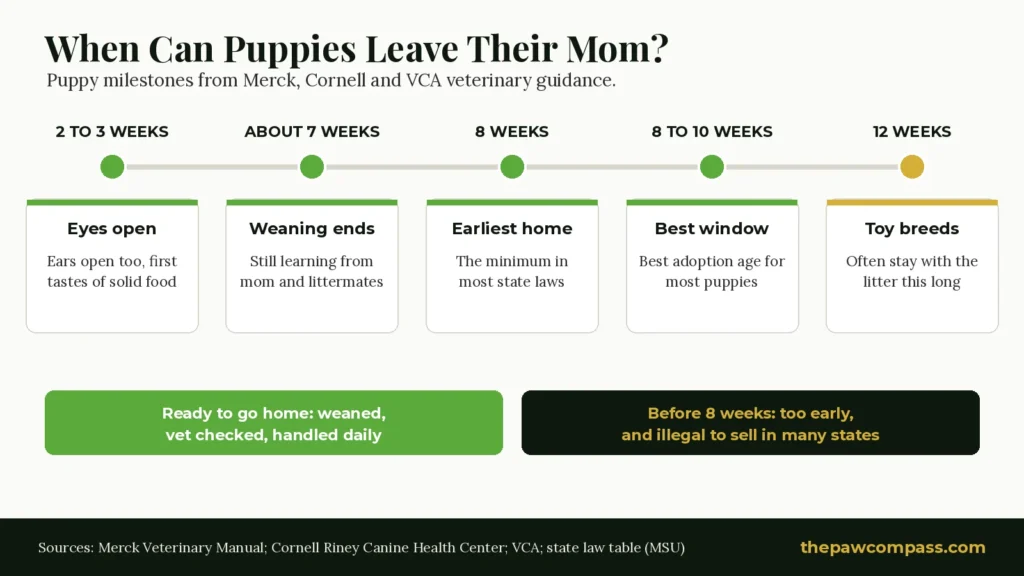
Table of Contents
- When Can Puppies Leave Their Mom? Age by Age
- What Puppies Learn From Mom and Littermates
- Can Puppies Leave Their Mother at 6 Weeks?
- Is 7 Weeks Too Early?
- Is It Illegal to Sell a Puppy Before 8 Weeks?
- Can a Puppy Stay With Mom Too Long?
- Why Toy Breeds Often Stay Until 12 Weeks
- How to Tell a Puppy Is Ready to Leave Mom
- Bringing Your Puppy Home at 8 Weeks
- What If Your Puppy Came Home Too Early?
- When Can Puppies Leave Their Mom: FAQ
- When Can Puppies Leave Their Mom: The Short Version
When Can Puppies Leave Their Mom? Age by Age
| Age | Ready to leave? | Why | Source |
|---|---|---|---|
| Under 6 weeks | No | Still nursing and learning basic dog skills | Merck, Cornell |
| 6 to 7 weeks | No | Linked to more behavior problems later. Illegal to sell in many states | Veterinary Record study, state laws |
| 8 weeks | Yes, the minimum | Weaned, eating solid food, ready to bond | Cornell, VCA |
| 8 to 10 weeks | Best for most puppies | Time with the litter plus time to settle in with you | Merck |
| 10 to 12 weeks | Common for toy breeds | Small and fragile, so breeders often wait | Cornell |
What Puppies Learn From Mom and Littermates
The Merck Veterinary Manual, written by veterinary behaviorist Dr. Stephanie Borns-Weil of Tufts, says a puppy’s experiences with mom and littermates in the first 7 to 8 weeks play an important role in building social skills. Here’s how those weeks unfold.
Birth to 2 Weeks: Total Dependence
Merck describes the newborn stage as birth to 13 days. Eyes and ears are closed, and puppies rely on mom for everything. Cornell notes her first milk, colostrum, is rich in nutrients and antibodies.
2 to 3 Weeks: Eyes and Ears Open
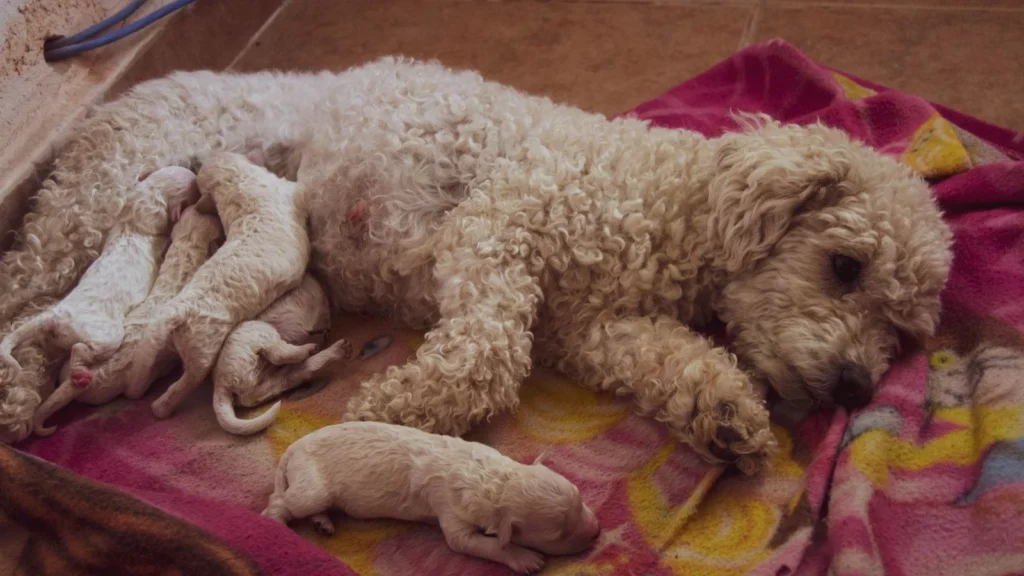
Between 13 and 19 days, Merck says, eyes and ears open, puppies start to eliminate without mom’s help, and they begin interacting with littermates. From about 3 weeks, Cornell says, puppies start learning to go potty away from where they sleep, a habit that helps with house training later. They also take their first tastes of solid food.
3 to 8 Weeks: Learning to Be a Dog
This is where the litter does its real teaching. Cornell explains that when a puppy bites a sibling too hard, the sibling yelps, and mom corrects rough play. That’s how puppies learn bite inhibition, the skill of softening their bite. VCA’s veterinary behaviorists, Dr. Debra Horwitz and Dr. Gary Landsberg, say puppies start learning to limit the force of their bite while with their littermates. Puppies also learn dog body language and watch how mom reacts to new people and things.

About 7 Weeks: Weaning Ends
Merck says weaning ends at about 7 weeks. Cornell gives a wider range: most puppies are fully weaned between 7 and 10 weeks, and moms can keep producing milk for up to 10 weeks. For what to feed once your puppy is home, see our puppy feeding chart.
8 Weeks and Beyond: Ready to Bond
By 8 weeks, Cornell says, a puppy eats solid food, has learned from mom and littermates, and is ready to bond with a new family. The socialization window is still open, so the learning continues in your home.
Can Puppies Leave Their Mother at 6 Weeks?
No. A 6 week old puppy is still nursing and still in the middle of learning dog manners. The best evidence comes from a 2011 study in the Veterinary Record by researchers at the University of Milan’s veterinary faculty. They compared 140 dogs taken from the litter at 30 to 40 days, roughly 5 to 6 weeks, with dogs adopted at 60 days, about 8 to 9 weeks. Owners filled in questionnaires when the dogs were 18 months to 7 years old.
The dogs separated early had significantly higher odds of:
- Destructive behavior
- Excessive barking
- Fearfulness on walks
- Reactivity to noises
- Possessiveness over toys and food
- Attention seeking
Cornell lists similar risks for puppies separated too early: fear, aggression, anxiety, resource guarding, reactivity and inappropriate play biting. VCA’s behaviorists say puppies should not go to new homes until 7 to 8 weeks of age.

Is 7 Weeks Too Early?
It’s borderline. Merck says weaning ends at about 7 weeks, and VCA’s behaviorists give 7 to 8 weeks as the earliest. But most US state laws that set a minimum use 8 weeks, and Merck puts the best adoption age at about 8 to 10 weeks. If a breeder offers a 7 week old puppy, it’s reasonable to ask to wait one more week.
Is It Illegal to Sell a Puppy Before 8 Weeks?
In many states, yes. The Animal Legal and Historical Center at Michigan State University College of Law tracks these laws. Its table lists about 27 states plus Washington, D.C. with a minimum age for selling or transferring puppies:
- 8 weeks in most of those states, including California, Florida, New York, Pennsylvania, Texas and Ohio.
- 7 weeks in Virginia and Wisconsin. Maine bars sales until the end of the seventh week.
- Who it covers varies. Some laws apply only to pet stores and licensed breeders. Others apply to any person, and some cover giving a puppy away or adopting it out.
Laws change, so check your own state’s rules. Even where there’s no law, the vet guidance above still points to 8 weeks at the earliest.
Can a Puppy Stay With Mom Too Long?
A few extra weeks are fine if the breeder raises the litter well. Cornell says some breeders keep puppies until 10 or 12 weeks, and that the extra time can benefit both the puppy and the new family when the breeder provides good care.
The catch is socialization. Merck places the socialization period at 19 days to 12 weeks, and Purdue’s Canine Welfare Science group says it lasts until about 12 to 16 weeks. After that, dogs become more fearful of new things. If your puppy will come home later than 10 weeks, ask the breeder how they’re meeting new people, sounds and places in the meantime. Our puppy socialization plan lists what to cover once your puppy is home.
Why Toy Breeds Often Stay Until 12 Weeks
Cornell notes that toy breeds are often kept with the litter until 12 weeks because they’re so small and fragile. The extra weeks give them more time to grow while still leaving enough time to bond with their new family. If you’re getting a Chihuahua, Yorkie, Maltese or other toy breed, don’t be surprised if a careful breeder says 12 weeks.
How to Tell a Puppy Is Ready to Leave Mom
When should a puppy leave its mom? When it checks every box below.
- At least 8 weeks old, or older for toy breeds.
- Fully weaned and eating solid puppy food on their own.
- Seen by a vet, with health records and any vaccines given so far. Our puppy shot schedule explains the timing.
- Handled by people every day. Purdue’s Canine Welfare Science group says puppies need many brief, positive interactions with people during the sensitive period.
- Raised with littermates, so they’ve had time to practice gentle play.
Getting a puppy as a gift? The same rules apply. Our puppy for Christmas guide covers timing over the holidays.
Bringing Your Puppy Home at 8 Weeks
Purdue’s Canine Welfare Science group notes a fear period that starts around 8 weeks, and says traumatic experiences around 8 to 9 weeks can be especially harmful. That’s exactly when many puppies change homes, so keep the first days calm and positive: a quiet car ride, a few calm visitors rather than a crowd, and lots of rest.
Merck suggests starting socialization as soon as possible and enrolling in a puppy class before 12 weeks. An indoor class can start at 8 weeks. For the first days, our 8 week puppy schedule covers feeding, sleep and potty breaks hour by hour, our puppy crate training schedule covers naps, and our new puppy checklist lists what to buy before pickup day.

Want a printed routine on the fridge from day one? The Print & Go Pack includes a Fridge Schedule:
If you’d rather track it on your phone, The First 30 Days Puppy OS has one tap buttons for naps and potty on its dashboard, so you can see your new puppy’s rhythm from day one.
What If Your Puppy Came Home Too Early?
It happens, and it doesn’t mean your puppy is doomed to problems. Cornell says dogs of any age can bond with new families if they’ve had positive contact with people. A few things help fill the gap:
- See your vet soon for a health check and a vaccine plan.
- Teach bite inhibition yourself. VCA’s behaviorists explain how puppies learn to soften their bite, and our guide on how to get a puppy to stop biting shows how to carry that on at home.
- Start safe socialization early. Merck recommends a puppy class before 12 weeks. Before vaccines are done, see when puppies can go outside for lower risk options.
- Get help early from your vet or a qualified trainer if you see fear, guarding or rough play.
When Can Puppies Leave Their Mom: FAQ
-
When can puppies leave their mom?
At 8 weeks at the earliest. The Merck Veterinary Manual says puppies are best adopted at about 8 to 10 weeks, and Cornell’s Riney Canine Health Center calls 8 to 12 weeks the ideal window. Toy breeds often stay until 12 weeks.
-
Can puppies leave their mother at 6 weeks?
No. A 2011 Veterinary Record study found dogs taken from the litter at 30 to 40 days had higher odds of destructiveness, excessive barking, fearfulness, noise reactivity, possessiveness and attention seeking than dogs adopted at 60 days. Selling puppies that young is also illegal in many states.
-
How long should puppies stay with their mom?
At least 8 weeks. Cornell says 8 to 12 weeks is ideal, and Merck puts the best adoption age at about 8 to 10 weeks. Toy breeds often stay until 12 weeks because they’re small and fragile.
-
Is it illegal to sell a puppy before 8 weeks?
In many states, yes. Michigan State University’s Animal Legal and Historical Center lists about 27 states plus Washington, D.C. with a minimum age, most often 8 weeks. Virginia and Wisconsin use 7 weeks. Some laws cover only pet stores and breeders, so check your state.
-
Is 7 weeks too early for a puppy to leave its mom?
It’s borderline. VCA’s veterinary behaviorists say puppies should not go home before 7 to 8 weeks, and Merck says weaning ends at about 7 weeks. Most state laws and Merck’s advice point to 8 weeks or later, so waiting one more week is the safer choice.
-
When are puppies fully weaned?
Merck says weaning ends at about 7 weeks. Cornell says most puppies are fully weaned between 7 and 10 weeks, and that moms can keep producing milk for up to 10 weeks.
-
Is 12 weeks too old to bring a puppy home?
No. Cornell says some breeders keep puppies until 10 or 12 weeks, and toy breeds often stay that long. Just ask how the breeder is socializing the puppy, since Merck places the socialization period at up to 12 weeks.
When Can Puppies Leave Their Mom: The Short Version
- Never before 8 weeks. Merck says 8 to 10 weeks is best for most puppies.
- Toy breeds often stay until 12 weeks.
- Leaving at 5 to 6 weeks is linked to more behavior problems later.
- Many states make selling a puppy under 8 weeks illegal.
- A ready puppy is weaned, vet checked and handled by people every day.
- Keep the first days home calm, then start socializing right away.
Over to you: how old was your puppy when they came home? Tell us in the comments.

3 Comments