

 By
When do puppies lose their baby teeth? Most start at around 12 to 16 weeks old, which is 3 to 4 months. The small front teeth go first, then the fangs and the teeth behind them. By 6 to 7 months, most puppies have all 42 adult teeth and every baby tooth is gone. That timing comes from VCA’s veterinarians, the American Kennel Club and the Merck Veterinary Manual.
So if you just found a tiny white tooth on the rug, or a pink smear on a chew toy, your puppy is right on schedule. Below you’ll find the timeline by age, which teeth go first, what’s normal, the one thing to check every week, and which chews are safe for a sore mouth.
Table of Contents
- Puppy Teething Timeline by Age
- Which Teeth Fall Out First?
- Do Puppies Lose Teeth? What’s Normal
- When Do Puppies Stop Teething?
- Retained Baby Teeth: When the Vet Needs to Look
- The Weekly Mouth Check (Until 7 to 8 Months)
- Normal or Call the Vet?
- Safe Chews for Teething Puppies (and What to Skip)
- Teething, Nipping and Chewing the Furniture
- Start Brushing Now
- Puppy Teeth FAQ
- When Do Puppies Lose Their Baby Teeth: The Short Version
Puppy Teething Timeline by Age
| Age | What’s happening | What you may notice |
|---|---|---|
| 2 to 6 weeks | Baby teeth come in. All 28 are usually in by 6 weeks | Your puppy is still with mom. Tiny, needle sharp teeth |
| 12 to 16 weeks (3 to 4 months) | Baby teeth start falling out. Adult incisors (front teeth) come in first | Tiny teeth on the floor, lots of mouthing and chewing |
| 4 to 5 months | More incisors, the first premolars and the first molars come in | Chewing everything, some drooling, maybe a pink spot on a toy |
| 5 to 6 months | Adult fangs, most premolars and the second molars come in | Check that no baby fang is still sitting next to an adult fang |
| 6 to 7 months | The last molars come in. Most puppies now have all 42 adult teeth | Teething winds down, chewing doesn’t |
| Up to 7 to 8 months | Keep checking the mouth every week | Any baby tooth still there needs a vet visit |
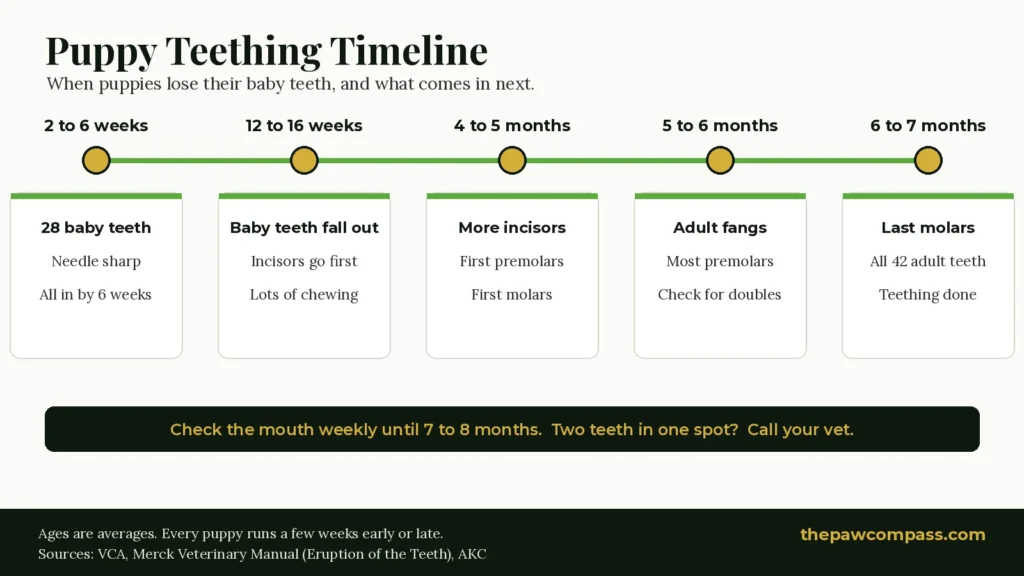
Every puppy runs on their own clock, give or take a few weeks. The AKC says baby teeth can start showing up as early as 2 weeks, and VCA says they’re normally all in by 6 weeks. The swap starts at about 3½ to 4 months, when the baby incisors begin to be replaced, and by 6 to 7 months most puppies have their full adult set. What matters most is the order and the finish line: baby teeth out, adult teeth in, nothing doubled up.
Which Teeth Fall Out First?
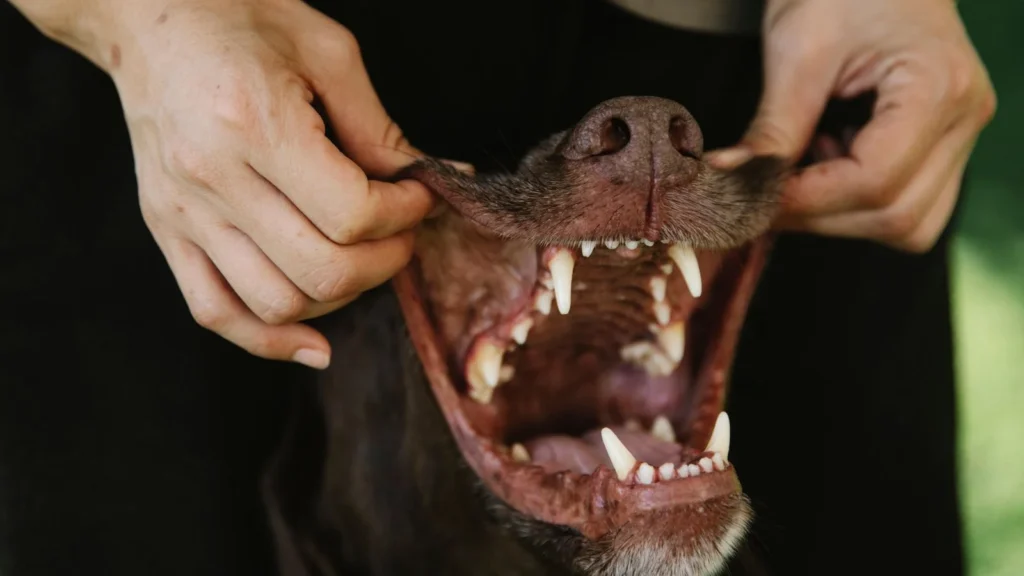
So when do puppies lose their teeth, tooth by tooth? It goes roughly front to back. Dogs have 28 baby teeth and 42 adult teeth, according to the Merck Veterinary Manual. The 14 extra teeth are all back teeth: 4 more premolars and 10 molars. That’s because, as VCA’s vets point out, dogs don’t have any baby molars. Every molar your puppy gets is a brand new adult tooth.
| Tooth | Baby tooth comes in | Adult tooth comes in | Adult teeth |
|---|---|---|---|
| Incisors (small front teeth) | 3 to 5 weeks | 4 to 5 months | 12 |
| Canines (the fangs) | 3 to 4 weeks | 5 to 6 months | 4 |
| Premolars (behind the fangs) | 4 to 6 weeks | 4 to 6 months | 16 |
| Molars (back teeth) | None. Puppies have no baby molars | 4 to 7 months | 10 |
The fangs are the ones to watch. The Merck eruption table puts adult canines at 5 to 6 months, and VCA says the baby canines, the upper ones most of all, are the teeth most likely to hang on when they should have fallen out. More on that below.
Do Puppies Lose Teeth? What’s Normal
Yes, every puppy loses all 28 baby teeth. Plenty of dog parents never see a single one fall out, and that’s normal too. Here’s what you can expect while it happens:
- Finding tiny teeth. The AKC describes them as crumb to rice sized. VCA says they’re hollow shells, because the adult tooth pushing up has already dissolved the baby tooth’s root.
- Your puppy swallowing them. VCA’s vets say most baby teeth are swallowed while a puppy eats, with no ill effect.
- Small spots of blood. VCA says some bleeding is normal, but the amount is tiny, usually just mild red staining on a chew toy. The AKC mentions little spots of blood on toys too.
- Drooling, eating a bit less and acting cranky. VCA lists all three as signs of a tender mouth during teething.
- Puppy breath. VCA says that distinctive smell is linked to teething, is normal, and lasts as long as teething does.
- Chewing everything. Almost all puppies have the urge to chew while teething, according to VCA.
If your puppy is eating a little less than usual while their mouth is sore, that fits what VCA describes. Keep offering regular meals (the puppy feeding chart has amounts by age and weight), and call your vet if your puppy stops eating. The AKC advises talking to your vet about anything that seems unusual, because drooling and bleeding can also point to other problems.
When Do Puppies Stop Teething?
Most puppies stop teething at around 6 to 7 months, once the last molars are in. VCA puts it at 6 to 7 months, the Merck Veterinary Manual says all adult teeth are present by 7 months, and the AKC says most puppies finish by about 6 months.
How long do puppies teethe? VCA’s puppy guide says teething begins at around 3½ to 4 months and lasts until about 6 months, so expect roughly 2 to 3 months of active tooth swapping.
The chewing doesn’t stop when the teething does, though. VCA’s vets say heavy chewing tends to ease at around 18 months, and some chewing is normal for a dog’s whole life. Plan on safe chew toys for the long haul.
Retained Baby Teeth: When the Vet Needs to Look
This is the one real problem to watch for. Sometimes a baby tooth stays put after the adult tooth comes in. Vets call it a retained or persistent deciduous tooth. VCA’s article on it, co-written by two board certified veterinary dentists, sums up the rule in one line: no two teeth should be in the same place at the same time.
What It Looks Like
Look for what seems like two teeth in one spot. VCA suggests checking for exactly that at home. The most common spot is the upper fangs, then the lower fangs, then the front incisors, according to VCA. A thin, sharp baby fang sitting right next to a thicker adult fang is the classic picture.
Which Puppies Get Retained Teeth?
Any puppy can, but VCA says it’s more common in small breeds and short nosed breeds like Chihuahuas, bulldogs, pugs, Boston terriers and boxers. VCA’s dental team adds that it often runs in families.
Why It Matters
- The baby tooth takes the adult tooth’s spot, so the adult tooth comes in crooked. That can crowd the teeth and cause a bad bite (malocclusion).
- Food and plaque get trapped between the two teeth, which can lead to gum disease and, over time, early tooth loss.
- A retained lower baby fang can force the adult fang to grow on the inside, pointing toward the roof of the mouth. VCA says that can cause real pain and make eating uncomfortable.
What Your Vet Will Do
Call your vet as soon as you spot a doubled tooth. According to VCA’s veterinary dentists, a retained baby tooth usually needs to be removed promptly, under general anesthesia, and early removal usually lets the adult tooth move into its proper position. In most cases they don’t recommend waiting until the spay or neuter appointment. Leave it too long and the fix can mean orthodontic treatment with a veterinary dental specialist.
The Weekly Mouth Check (Until 7 to 8 Months)
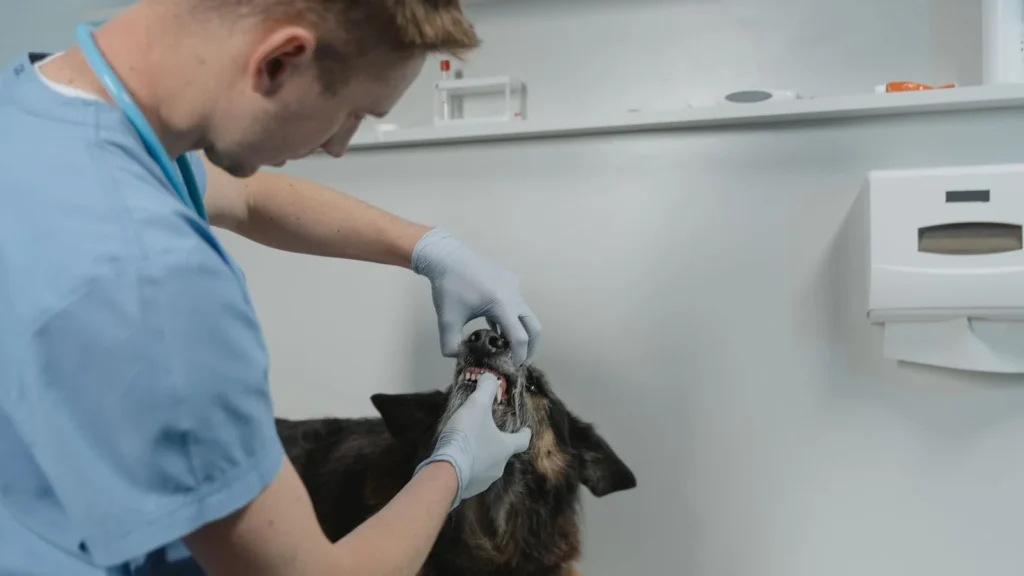
VCA’s vets recommend checking your puppy’s mouth every week until about 7 to 8 months old. It takes a minute, and it gets your puppy used to having their mouth handled, which the AKC says sets you up for easier tooth brushing later.
- Pick a calm moment, like after a walk, and have a small treat ready.
- Gently lift the upper lip on one side. Look at the fang and the teeth just behind it.
- Check the same spot on the lower jaw, then switch sides.
- Look at the front teeth for doubles: two teeth sharing one spot.
- Check the lower fangs. If one points in toward the roof of the mouth, call your vet.
- Give the treat, and jot down anything odd with the date so you can show your vet.
If you’re using the First 30 Days Puppy OS Notion template, the vet visit manager is a handy place for that note.
Normal or Call the Vet?
| What you see | Normal or not? | What to do |
|---|---|---|
| A tiny tooth on the floor or in the bed | Normal | Nothing. Most get swallowed with food anyway |
| A small pink spot on a chew toy | Normal | Nothing, if it’s just light staining |
| Drooling, a sore mouth, eating a bit less | Normal while teething | Offer soft, safe chews. Call your vet if your puppy stops eating |
| Two teeth in one spot | Not normal | Book a vet visit soon. Don’t wait for the spay or neuter |
| A lower fang poking toward the roof of the mouth | Not normal | Call your vet promptly |
| Baby teeth still there at 6 to 7 months | Not normal | Tell your vet. They may need to come out |
| A broken tooth | Not normal | Call your vet |
Safe Chews for Teething Puppies (and What to Skip)
Teething puppies need to chew, so the goal is to steer it, not stop it. Two quick tests from the vets make it easy. VCA says veterinary dentists often recommend this rule: don’t let your dog chew anything that won’t bend. And AAHA’s thumbnail test says to press your thumbnail into the chew. If you can’t leave a dent, it’s too hard.
| Chew | Verdict | Why |
|---|---|---|
| Rubber teething toys you can chill in the freezer | Good pick | The AKC suggests freezable rubber toys to soothe sore gums |
| Edible puppy teething rings | Good pick, supervised | Listed by the AKC as a teething option |
| Dental chews with the VOHC seal | Good pick, check the age on the label | AAHA and the AKC point to the Veterinary Oral Health Council seal |
| Baby carrots, green beans, apple slices, blueberries | Fine as a small treat | AAHA lists these as healthy chews. Never grapes, which are toxic |
| Bones (cooked or raw), antlers, hooves | Skip | Too hard. They can break teeth (VCA, AAHA) |
| Hard nylon chews and ice cubes | Skip | VCA lists both as hard enough to damage teeth |
| Rawhide, yak milk chews, sticks, rocks | Skip | AAHA lists them as tooth breakers, and VCA notes rawhide has caused blockages |
Whatever you pick, stay close. VCA’s vets put it plainly: no toy is 100% safe, so supervise chewing. The AKC adds a simple habit: check toys often, and toss any your puppy can bite chunks off or pull stuffing from. Keeping only a few toys out and rotating them keeps them interesting, according to VCA.
Teething, Nipping and Chewing the Furniture
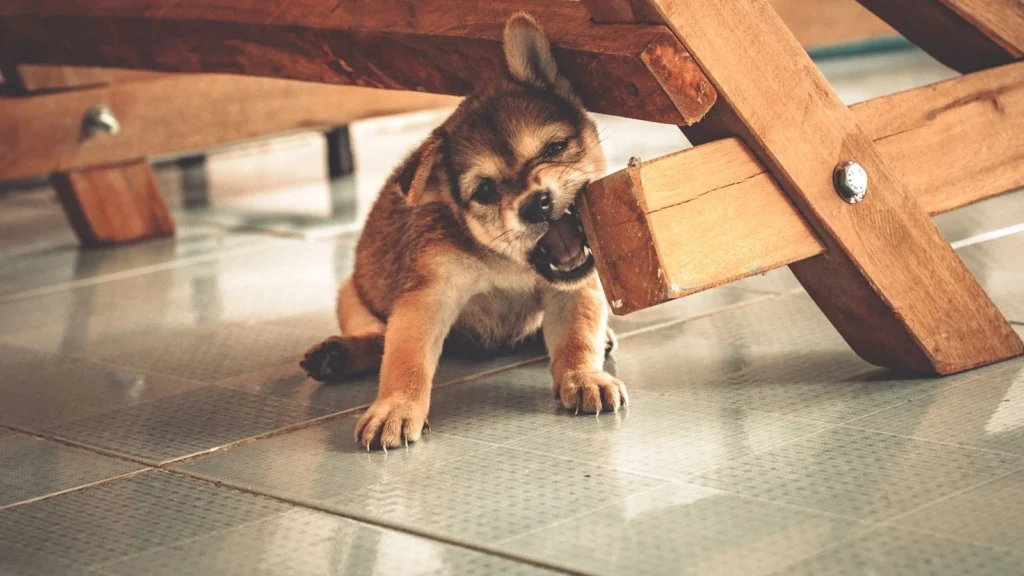
Teething and nipping go together. Puppies explore the world with their mouths, and VCA’s vets note that chewing seems to ease teething discomfort. That doesn’t make your hands, shoes or chair legs fair game. A few habits from the AKC and VCA help:
- Keep a toy within reach and swap it in the moment teeth touch skin.
- If your puppy bites hard, a high pitched “ow” and pulling your hand away can help, then praise them for backing off. Some puppies get more worked up by noise. If yours does, turn away quietly instead.
- If the nipping keeps going, end the play session. The AKC also suggests a few minutes in the crate to help an overexcited puppy calm down. A properly sized crate makes that a cozy spot, not a punishment.
- Puppy proof: shoes, clothes and kids’ toys go out of reach, and supervise so your puppy doesn’t get the chance to chew the wrong thing.
- Burn off energy with play, short training sessions and meals from a puzzle toy instead of a bowl.
One more: rough play with kids is a no, even if the kids don’t mind a scratch. VCA warns it teaches a puppy that hands are toys.
Start Brushing Now
VCA’s veterinary dentists say the ideal time to start brushing your puppy’s teeth is as soon as you bring them home. Go gently while new teeth are coming in, because the gums are sensitive. Start by letting your puppy sniff and lick a dog toothbrush and dog toothpaste, and never force it, says VCA.
Use toothpaste made for dogs only. The AKC warns that human toothpaste can contain ingredients like xylitol, which is toxic to dogs, and suggests starting with a soft silicone finger brush. Dog toothpaste, a finger brush and a couple of safe teething toys are worth adding to your shopping list. The new puppy checklist covers the rest of the first week essentials.
Puppy Teeth FAQ
-
When do puppies lose their baby teeth?
Most puppies start losing baby teeth at about 12 to 16 weeks (3 to 4 months), starting with the small front incisors. The fangs and back teeth follow, and most puppies have all 42 adult teeth by 6 to 7 months, according to VCA and the Merck Veterinary Manual.
-
Do puppies lose teeth at 4 months?
Yes. Four months is right in the middle of it. VCA says teething begins at about 3½ to 4 months, when the baby incisors start to be replaced by adult ones.
-
Is it normal for puppies to swallow their baby teeth?
Yes. VCA’s vets say most baby teeth are swallowed while a puppy eats, with no ill effect. Finding one on the floor is a bonus, not a must.
-
Do puppy gums bleed when teeth fall out?
A little. VCA says some bleeding is normal but the amount is tiny, usually just mild red staining on a chew toy. If you see more than that, or anything seems unusual, the AKC suggests checking with your vet.
-
When do puppies stop teething?
Most puppies finish teething at around 6 to 7 months, once all their adult teeth are in, according to VCA and the Merck Veterinary Manual. Chewing lasts longer. VCA says heavy chewing tends to ease at around 18 months.
-
How many teeth do puppies lose?
All 28 baby teeth. They’re replaced by 42 adult teeth. The 14 extra are back teeth, including 10 molars, because puppies have no baby molars (VCA, Merck Veterinary Manual).
-
What if a baby tooth doesn’t fall out?
If a baby tooth is still there after the adult tooth has come in beside it, book a vet visit soon. VCA’s veterinary dentists say retained baby teeth usually need prompt removal under anesthesia so the adult tooth can move into place. They’re more common in small and short nosed breeds.
When Do Puppies Lose Their Baby Teeth: The Short Version
Baby teeth start falling out at 12 to 16 weeks, front teeth first. The fangs and most premolars swap at around 5 to 6 months, and the last molars are in by 6 to 7 months. Tiny teeth on the floor, light pink spots on toys, drooling and puppy breath are all normal. Two teeth in one spot is not, so check your puppy’s mouth every week until 7 to 8 months and call your vet if you see a double. In between, stick to chews that bend, and start brushing.
Over to you: have you found one of those tiny teeth yet, or has your puppy swallowed every single one? Tell me in the comments.

3 Comments