

 By
A puppy feeding chart gives you a starting amount, not a final answer. According to the Merck Veterinary Manual, puppies under 4 months need about 3 times their resting calories, and about 2 times from 4 months until they’re grown. For a 10 lb puppy under 4 months, that’s roughly 650 calories a day, or about 1¾ cups of a food with 400 calories per cup. Your food bag’s chart comes before any chart online. After that, weigh your puppy every week or two and adjust by body shape, not by the bowl.
Table of Contents
- Why Every Puppy Feeding Chart Says Something Different
- Puppy Feeding Chart by Age and Weight
- How Many Times a Day to Feed a Puppy
- Large and Giant Breed Puppies: Slower Growth Wins
- Treats Count Toward the Daily Total
- How to Tell If You’re Feeding the Right Amount
- Signs You’re Feeding Too Much or Too Little
- When to Switch From Puppy Food to Adult Food
- Puppy Feeding Chart FAQ
- Puppy Feeding Chart: The Short Version
Why Every Puppy Feeding Chart Says Something Different
You’ve got the food bag in one hand and your phone in the other. The bag says one amount. The first website says another. The second website says something else again, and your puppy is sitting at your feet looking like they haven’t eaten in a week. Which one is right?
Two things explain most of the mess. Most charts online go by your puppy’s expected adult weight, which is a guess for any mixed breed. And every food packs a different number of calories into a cup. For a puppy heading for 51 to 75 lbs, at 4 to 5 months, one major food maker’s chart suggests 1½ to 4 cups a day, while PetMD’s feeding chart says 4 to 4 2/3 cups. Same puppy, very different bowls.
Calories per cup are the bigger trap. I checked the calorie statements for 6 popular dry puppy foods sold in the US, straight from the makers’ own websites, in October 2026. They ranged from 292 to 456 kcal per cup. Feed the same number of cups of each, and one puppy gets about 56% more food energy than the other. That’s why your own bag’s chart beats any website, and why the number to look for is “kcal/cup” in the calorie statement.
Puppy Feeding Chart by Age and Weight
This puppy feeding chart by age and weight uses your puppy’s weight today, not a guess at their adult size. It’s built on the formula in the Merck Veterinary Manual: resting energy is 70 times body weight in kilograms to the power of 0.75, and healthy growing puppies need 3 times that under 4 months of age and 2 times that from 4 months on. I’ve done the math for you and rounded to the nearest 10 calories.
| Puppy’s weight today | Under 4 months | 4 months and up |
|---|---|---|
| 5 lb | About 390 kcal | About 260 kcal |
| 10 lb | About 650 kcal | About 440 kcal |
| 15 lb | About 880 kcal | About 590 kcal |
| 20 lb | About 1,100 kcal | About 730 kcal |
| 30 lb | About 1,490 kcal | About 990 kcal |
| 40 lb | About 1,850 kcal | About 1,230 kcal |
| 50 lb | About 2,180 kcal | About 1,450 kcal |
| 60 lb | Rare at this age | About 1,670 kcal |
And here’s what that looks like in cups for an example dry puppy food with 400 kcal per cup, which sits in the middle of the range I found:
| Puppy’s weight today | Under 4 months | 4 months and up |
|---|---|---|
| 5 lb | 1 cup | ¾ cup |
| 10 lb | 1¾ cups | 1 cup |
| 15 lb | 2¼ cups | 1½ cups |
| 20 lb | 2¾ cups | 1¾ cups |
| 30 lb | 3¾ cups | 2½ cups |
| 40 lb | 4½ cups | 3 cups |
| 50 lb | 5½ cups | 3¾ cups |
| 60 lb | Rare at this age | 4¼ cups |
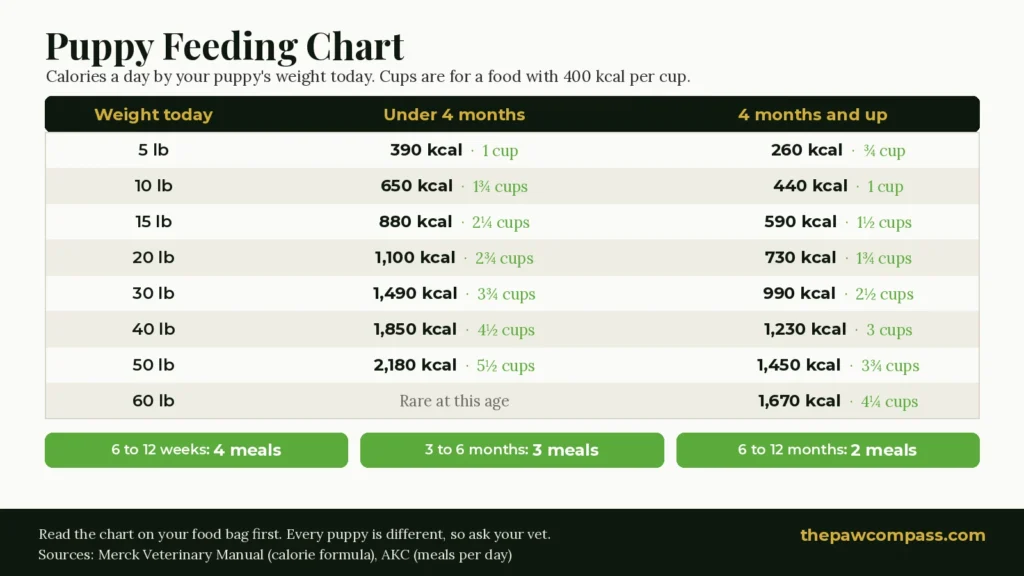
If your food isn’t 400 kcal per cup, divide the calories in the first chart by your food’s kcal per cup. A 10 lb puppy under 4 months needs about 650 kcal a day. That’s about 2¼ cups of a 292 kcal food, or about 1½ cups of a 456 kcal food. Same puppy, same calories, almost a cup apart.
Treat every number here as a first guess. Merck’s manual says any formula for energy needs should be considered a starting point, and it notes that some dogs need 10% to 30% less food than their label recommends. Your puppy’s body shape over the next few weeks is the real answer, and there’s a simple way to check it further down.
Bottle feeding a newborn? This chart isn’t for you. Puppies on formula need a vet’s bottle feeding plan based on their weight.
How Many Times a Day to Feed a Puppy
The daily total gets split into meals, and the number of meals drops as your puppy grows. Here’s the schedule from the AKC’s puppy feeding guide:
| Age | Meals a day | What it looks like |
|---|---|---|
| 6 to 12 weeks | 4 | Breakfast, late morning, midday, early evening |
| 3 to 6 months | 3 | Breakfast, lunch, early evening |
| 6 to 12 months | 2 | Morning and evening |
| Adult | 2 | Most dog parents keep 2 meals |
So a 10 lb puppy under 4 months on 4 meals gets about a quarter of 1¾ cups, a little under ½ cup, at each one. My 8 week puppy schedule shows exactly where those meals fit in a real day. Since puppies sleep 18 to 20 hours a day at 8 to 12 weeks (here’s how much puppies sleep by age), meals usually land between naps.
Two habits make meals easier. Measure each one instead of leaving food out all day, since VCA’s vets warn that free feeding can increase the risk of extra body fat. And plan a potty trip 5 to 30 minutes after every meal, which is when most puppies need to go (more in my guide to how often puppies poop). If your puppy eats in the crate with the door open, as the 8 week schedule suggests, check that the crate fits with my dog crate size chart, and keep the space puppy sized with a crate divider.
Very small puppies need extra care here. The AKC warns that young toy breed puppies, especially under 12 weeks, can run low on blood sugar between meals, particularly when they’re active, cold or stressed. Don’t let a tiny puppy go long stretches without food.
Large and Giant Breed Puppies: Slower Growth Wins
Big breed puppies are the one group where more food is never a shortcut. VCA’s veterinarians explain that growing too quickly can stress developing bones and joints and cause skeletal malformations. Their guide on feeding growing puppies adds that moderate energy and food restriction during growth in large breed dogs can decrease the risk of hip dysplasia.
- Pick a food made for large breed growth. Look for a growth food whose label covers large size dogs, meaning 70 lb or more as an adult. VCA notes these foods have different calcium and phosphorus levels than other puppy foods.
- Skip the calcium supplements. The Merck Veterinary Manual says excess calcium is more of a problem for growing large and giant breed dogs, from weaning to 1 year. A complete puppy food already has what they need.
- Measure meals. VCA warns that free feeding can raise the risk of skeletal problems in large breed puppies.
- Keep them lean. Aim for the ideal body shape in the check below, with a visible waist.
- Expect a longer puppyhood. VCA says large and giant breeds could be on puppy food for up to two years.
Labrador Puppies
Labs have a reputation for acting starved, and for some of them it’s partly genetic. A University of Cambridge study found that around 25% of Labradors carry a POMC gene mutation. Affected dogs get hungry between meals sooner and use around 25% less energy at rest. The researchers’ advice is to be strict about portions, and to spread food out with puzzle feeders or by scattering kibble in the yard. Whether your Lab needs a large breed formula depends on their expected adult weight, so ask your vet at the next puppy visit.
Treats Count Toward the Daily Total
VCA’s guidance is that no more than 10% of your puppy’s daily calories should come from treats or snacks. For a 10 lb puppy under 4 months, that’s only about 65 kcal of treats a day. Training days can blow through that before lunch.
The AKC suggests keeping training treats as small as possible and trimming meal portions on heavy training days. An easy trick: set aside part of the day’s kibble and use it as training treats. Your puppy works for their breakfast, and the daily total stays the same.

How to Tell If You’re Feeding the Right Amount
The AKC’s rule is short and good: watch the dog, not the dish. Vets use a 9 point body condition score for this, and the WSAVA body condition chart puts the ideal at 4 to 5. Here’s how to check your puppy at home:
| What you see and feel | Score | What to do |
|---|---|---|
| Ribs easy to see or feel with no fat cover, bones showing at the spine or hips | 1 to 3 (too thin) | Call your vet, then feed a little more |
| Ribs easy to feel under a thin layer, waist seen from above, belly tucks up | 4 to 5 (ideal) | Keep going and re-check every 2 weeks |
| Ribs hard to feel, waist barely visible or gone, no tuck | 6 to 9 (too heavy) | Trim portions and treats, and ask your vet |
Pair the body check with regular weigh-ins. VCA’s vets recommend tracking your puppy’s weight and body condition over time, and they mention the Waltham Puppy Growth Charts, which your vet can use to see if your puppy is growing at a steady rate. Every time the scale moves, find the new row in the chart above.
Writing it down makes patterns easy to spot. My First 30 Days Puppy OS Notion template has a one tap feeding button on its daily dashboard and a printable weight log, so meals and weigh-ins live in one place.
Signs You’re Feeding Too Much or Too Little
Too Much
- A body score of 6 or more: ribs getting hard to feel and the waist fading
- Weight climbing faster than your vet’s growth curve
- Softer or more frequent poops after a portion increase (my guide to puppy poop has the normal counts by age)
- In large and giant breeds, any rapid growth, since VCA links excess calories to skeletal problems
Too Little
- A body score of 3 or less: ribs, spine or hip bones easy to see
- Weight stalling or falling off your vet’s growth curve
When to Call the Vet
- Your puppy skips meals or stops eating, especially a young toy breed puppy. The AKC lists drowsiness, weakness, trembling, wobbliness and seizures as signs of low blood sugar, which needs a vet right away.
- Diarrhea that lasts more than 24 hours, vomiting and diarrhea together, or any blood in the poop. Don’t wait if your puppy is young or not fully vaccinated, since parvo is a real risk.
- Weight loss, or a body score that keeps sliding even after you feed more.
- Suddenly drinking and peeing far more than usual (one of the red flags in my guide to how long a puppy can hold its pee).
- Before adding any supplement, especially calcium for a large or giant breed.
When to Switch From Puppy Food to Adult Food
| Adult size | Fully grown around | Switch to adult food |
|---|---|---|
| Small breeds | 10 to 12 months | 7 to 9 months |
| Medium breeds | 10 to 12 months | Around 12 months |
| Large breeds | 18 to 24 months | 12 to 14 months |
| Giant breeds | 18 to 24 months | Up to 2 years |
Make the change gradually, mixing a little more of the new food into the old one over several days, so your puppy’s stomach can keep up. VCA also notes that a food formulated for all life stages is appropriate for growth, so if your puppy already eats one, there may be nothing to switch. Your vet can confirm the timing at your puppy’s 6 month or 1 year visit.
Puppy Feeding Chart FAQ
-
How much should I feed my puppy?
Start with the chart on your food bag. As a cross-check, the Merck Veterinary Manual formula gives a 10 lb puppy under 4 months about 650 calories a day, which is about 1¾ cups of a food with 400 kcal per cup. Then adjust every week or two based on your puppy’s weight and body condition.
-
How many cups of food should a puppy eat a day?
It depends on your puppy’s weight, age and the calories per cup in your food. For an example food with 400 kcal per cup, a puppy under 4 months needs about 1 cup a day at 5 lb and about 5½ cups at 50 lb. Foods range from about 292 to 456 kcal per cup, so always check your bag.
-
How often should I feed my puppy?
The AKC recommends 4 meals a day from 6 to 12 weeks, 3 meals from 3 to 6 months and 2 meals from 6 to 12 months. Most adult dogs stay on 2 meals a day.
-
Should I feed my puppy by age or by weight?
Both. Your puppy’s weight today sets how many calories they need, and their age sets the multiplier: about 3 times resting energy under 4 months and 2 times from 4 months on, according to the Merck Veterinary Manual. Age also decides how many meals to split it into.
-
Should large breed puppies eat less?
They shouldn’t go hungry, but they should grow slowly and stay lean. VCA’s vets recommend a food formulated for large breed growth, measured meals instead of free feeding, and no extra calcium. Moderate food restriction during growth can lower the risk of hip dysplasia.
-
When should I switch my puppy to adult food?
The AKC says small breeds can switch at 7 to 9 months and larger breeds at 12 to 14 months. VCA notes large and giant breeds may stay on puppy food for up to two years. Ask your vet to confirm the timing.
-
How do I know if my puppy is eating enough?
Feel and look. On the WSAVA body condition chart, the ideal is ribs you can easily feel under a thin layer of fat, a waist you can see from above and a belly that tucks up from the side. Steady weight gain on your vet’s growth curve is the other sign. Call your vet if your puppy skips meals or loses weight.
Puppy Feeding Chart: The Short Version
Start with your bag, then cross-check it with the puppy feeding chart above: about 3 times resting calories under 4 months, about 2 times after that, divided by your food’s kcal per cup. Feed 4 meals a day until 12 weeks, 3 until 6 months and 2 after that. Keep treats under 10% of the day, keep big breeds lean, and let the ribs and waist check tell you when to adjust.
Now I’m curious: is your puppy a bowl vacuum or a picky grazer? Tell me in the comments.
