


 By
How long does it take to potty train a puppy? Most puppies are reliable by about 6 months of age, which works out to roughly 4 months of training if your puppy came home at 8 weeks. VCA says most puppies are learning to ask to go out by about 4 months and are fully potty trained by about 6 months. AKC Chief Veterinarian Dr. Jerry Klein says that if training starts early, a 6 month old puppy can usually be trusted to go outside most of the time (AKC). Small breeds, puppies with a rough start and inconsistent routines often take longer.
That’s the honest range. Below is how long it takes to potty train a puppy in different situations, plus what changes it: your puppy’s age, size and history, what slows training down, and when slow progress is a reason to call the vet. For the step by step method itself, see our guide on how to potty train a puppy.
Table of Contents
- What “Potty Trained” Really Means
- How Long Does It Take to Potty Train a Puppy? Milestones by Age
- How Long Potty Training Takes in Different Situations
- What Slows Potty Training Down
- Can You Potty Train a Puppy in 7 Days?
- Regression: When a Trained Puppy Starts Having Accidents Again
- When Slow Progress Means Call the Vet
- Track Progress So You Can See It
- Potty Training Timeline FAQ
- How Long Does It Take to Potty Train a Puppy: The Short Version
What “Potty Trained” Really Means
Part of the confusion is that “potty trained” can mean very different things. VCA’s veterinary behaviorists point out that a dog may reliably go when you take them outside, yet still not understand that sometimes they have to wait for the door to open. It helps to think in stages:
- Goes outside when you take them. This can happen within days or weeks of a good routine.
- Holds it between trips. This depends on bladder control, which grows with age (see how long a puppy can hold its pee).
- Asks to go out. VCA says most puppies are learning this by about 4 months.
- Reliable with freedom. VCA suggests your puppy has gone 8 to 12 weeks without a mistake before you trust them with more of the house.
VCA adds a useful test: if your dog has had accidents indoors since you brought them home, even now and then, they’re probably not fully house trained yet.
How Long Does It Take to Potty Train a Puppy? Milestones by Age
Every puppy is different, but these are the milestones vets and the AKC describe for a puppy who comes home at about 8 weeks and follows a steady routine.
| Age | Typical milestone | Source |
|---|---|---|
| About 8 weeks | Bladder control at its weakest. Many trips a day, plus night breaks | AKC, VCA |
| About 3 months | Can often wait about 3 hours while awake (about 4 by the “months plus one” rule) | VCA, AKC |
| About 4 months | Starting to ask to go out | VCA |
| About 5 months | Overnight trips may still be needed up to about now | VCA |
| About 6 months | Reliable most of the time, if training started early | VCA, AKC (Dr. Jerry Klein) |
| After 8 to 12 accident free weeks | Ready for more freedom, a little at a time | VCA |
| 4 to 6 months with no progress | Time to talk to your vet | VCA, AKC |
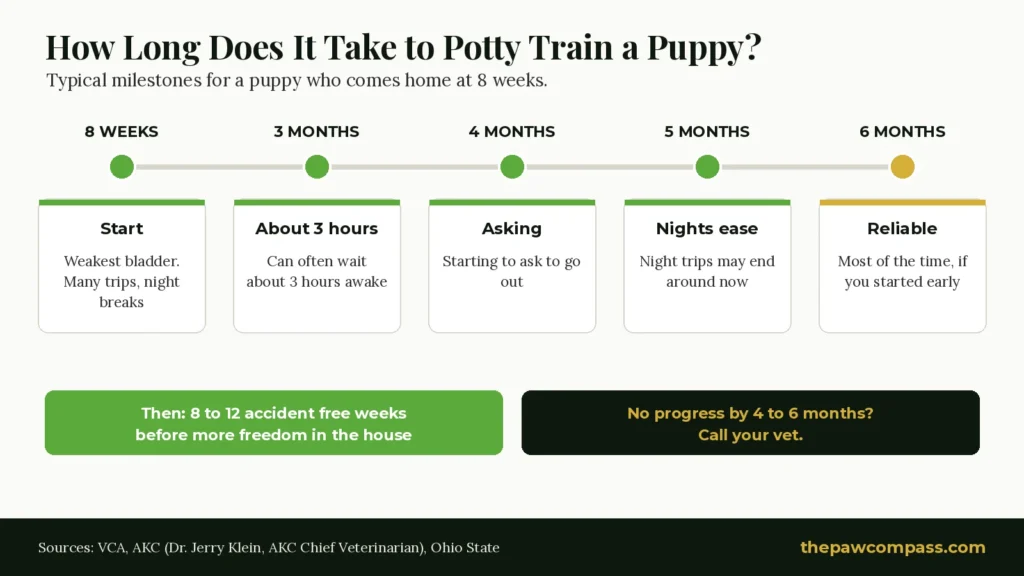
Why does it take months, not days? Mostly biology. The AKC notes that most puppies go home at about 8 weeks, when bladder control is at its weakest, and the common guide is that puppies can hold it about one hour per month of age. Ohio State’s veterinary medical center caps that at about 10 hours for older puppies. The two common rules (one hour per month, or months plus one) give slightly different numbers. Our guide on how long a puppy can hold its pee compares them by age.
How Long Potty Training Takes in Different Situations
Age is only part of it. The AKC says age, past experiences, consistency and training methods all change the timeline, and that some puppies build reliable habits within days while others need several months.
| Situation | What to expect | Why | Source |
|---|---|---|---|
| Home at 8 weeks, steady routine | Reliable most of the time by about 6 months | Bladder control catches up with the habit | VCA, AKC |
| Older puppy, 4 to 6 months | Can hold it longer, but past routines matter | Inconsistent routines before coming home can add months | AKC |
| Small and toy breeds | Often slower. Plan for more trips and patience | A 2020 study found large dogs were more likely to be fully house trained than small dogs | Journal of Veterinary Behavior, AKC |
| Long confinement in the past | Often slower. May soil the crate | Learned to go where they eat and sleep | AKC (Dr. Mary Burch), Ohio State |
| Pads first, outdoors later | Expect an extra switching phase | Pads reinforce two different options | AKC, Ohio State |
| Long days alone | Slower without midday breaks | Accidents from holding too long undo progress | VCA, Ohio State |
| Adult dog | Start over as if with a young puppy | Same steps, close supervision | VCA |
Are Small Dogs Really Harder to Potty Train?
Vets have long said so, and there’s now some data. A 2020 study in the Journal of Veterinary Behavior surveyed the owners of 735 dogs and found that large dogs were more likely than small dogs to be fully house trained. It also found a link between the level of training and how complete house training was. The researchers say more work is needed on why. Some experts have suggested small dogs’ higher metabolism and smaller bladders, but that isn’t proven. The AKC notes accidents around the house are a common complaint with toy breeds, and that some trainers recommend indoor potty spots for them. If you go that route, here’s how to potty train puppies using pads, including how to move to outdoors later.
The practical takeaway: with a small puppy, expect more trips, keep supervision tight a little longer, and don’t judge progress against a Labrador down the street.

What Slows Potty Training Down
If training seems stuck, one of these is usually involved:
- Inconsistency. Different family members doing different things, or skipped trips. Dr. Meghan Herron at Ohio State puts it plainly: every mistake is a step back.
- Freedom too soon. The AKC says many accidents start after a puppy gets the run of the house too quickly. VCA’s 8 to 12 accident free weeks is a good guide.
- Sending the puppy out alone. VCA says most young puppies left outside on their own get distracted and then go once they’re back inside.
- Punishment. Ohio State says dogs scolded for going in front of people may learn to hide to go, and refuse to go while you watch outside.
- Leftover smell. Odor pulls puppies back to the same indoor spot (AKC, VCA).
- Puppy pads. Dr. Mary Burch of the AKC says pads reinforce two options, and the AKC says they can slow the move outdoors.
- Loose stools. The AKC notes overfeeding can cause diarrhea, which makes house training much harder.
- Fear outside. VCA says a dog who’s frightened by something outdoors may be too distracted to go.
- A medical problem. Dr. Klein of the AKC says a urinary tract infection or another health issue can delay house training.
Many of these come down to the method. The full routine, from supervision to crate size, is in our guide on how to potty train a puppy.
Can You Potty Train a Puppy in 7 Days?
You can build the routine in a week, and you may see far fewer accidents. What you can’t do in a week is grow an 8 week old bladder. VCA says the basic rules can house train a puppy in a short time, sometimes as little as a few days to a few weeks, but that doesn’t mean the puppy can be trusted yet. The AKC agrees some puppies build reliable habits within days, while others need months.
So treat any “7 day” or “48 hour” plan as a strong start, not a finish line. Keep supervising, keep the schedule, and use VCA’s 8 to 12 accident free weeks before you relax.

Regression: When a Trained Puppy Starts Having Accidents Again
A puppy who was doing well and suddenly isn’t needs a closer look. VCA says if a previously well trained dog starts house soiling, always talk to your vet first. VCA’s behaviorists group the causes into four kinds (VCA House Soiling):
- House training that isn’t finished yet. The AKC notes this often shows up after freedom came too fast.
- A physical illness, from bladder infections to conditions that make dogs drink and pee more.
- Fear, anxiety or frustration, for example something scary outside.
- Marking, which VCA says is more likely in intact dogs.
One more wrinkle from VCA: a puppy who had accidents while sick may keep having them after recovering, because going indoors brought relief. Once your vet has treated the cause, go back to the basics for a while.
When Slow Progress Means Call the Vet
A slow puppy is usually just a young puppy. But call your vet if:
- There’s no real progress by 4 to 6 months (VCA), or you feel you’re not getting anywhere despite a steady routine (AKC).
- Accidents start suddenly in a puppy who was reliable (VCA).
- Your puppy soils the crate even after short stays. Ohio State says that can point to anxiety. Check the crate size too: a crate divider helps if there’s too much room.
- Accidents come with drinking more, loose stools or straining (VCA).
For poop changes that need a vet, see how often puppies poop. The full list of warning signs is in our guide on how to potty train a puppy.
Track Progress So You Can See It
Progress is easy to miss when you’re mopping up. VCA suggests a simple training journal: how many times your puppy pees and poops each day, plus any changes in health or diet. Over a few weeks you’ll see accidents thin out, or spot a pattern worth showing your vet.
If you’d rather tap than write, The First 30 Days Puppy OS has a one tap potty button on its dashboard and an accidents page with its own tracker.
Potty Training Timeline FAQ
-
How long does it take to potty train a puppy?
Most puppies are reliable by about 6 months of age, roughly 4 months of training if they came home at 8 weeks. VCA says puppies are usually learning to ask to go out by about 4 months and fully potty trained by about 6 months. AKC Chief Veterinarian Dr. Jerry Klein says a 6 month old puppy can usually be trusted most of the time if training started early.
-
Can you potty train a puppy in a week?
You can set up the routine and cut accidents a lot in a week, but young puppies don’t have the bladder control to be reliable yet. VCA says basic house training can take as little as a few days to a few weeks, but that doesn’t mean the puppy can be trusted. Wait for 8 to 12 accident free weeks before giving more freedom.
-
At what age are most puppies fully potty trained?
Around 6 months. VCA says most puppies are fully potty trained by about 6 months, and the AKC’s Dr. Jerry Klein says a 6 month old puppy who started training early is usually reliable most of the time. Small breeds and puppies with a rough start can take longer.
-
Why is a 6 month old puppy still having accidents?
Common reasons are freedom given too soon, gaps in supervision, leftover smells, pads, or a small breed that needs more trips. A health problem is also possible: the AKC’s Dr. Klein mentions urinary tract infections. VCA recommends talking to your vet if there’s no progress by 4 to 6 months.
-
Are small dogs harder to potty train?
Often, yes. A 2020 study in the Journal of Veterinary Behavior of 735 dogs found large dogs were more likely than small dogs to be fully house trained, and that more training went with more complete house training. Plan for more frequent trips and closer supervision with a small puppy.
-
How long does it take to potty train an older dog or rescue?
There’s no fixed timeline. VCA recommends starting over as if your dog were a young puppy, with close supervision and a set potty spot. Dogs who were confined for long stretches in the past may take longer, and the AKC notes they sometimes soil their crate at first.
-
When will a puppy stop needing to pee at night?
VCA says puppies may need overnight potty trips until about 5 months old. The AKC notes puppies can usually hold it longer while asleep than while awake. Our guide on how long a puppy can hold its pee has the overnight numbers by age.
How Long Does It Take to Potty Train a Puppy: The Short Version
- Most puppies are reliable by about 6 months, roughly 4 months of training from 8 weeks.
- Asking to go out usually starts around 4 months. Night trips may last until about 5 months.
- Wait for 8 to 12 accident free weeks before giving more freedom.
- Small breeds, rescues with a rough past and pads first can all add time.
- No progress by 4 to 6 months, or sudden accidents? Call your vet.
Over to you: how old is your puppy, and where are you on the timeline? Tell us in the comments.

1 Comment