


 By
Puppy socialization means gently introducing your puppy to the people, places, animals and everyday things they’ll meet as an adult dog, while they’re young enough to accept them easily. The most important window runs from about 3 weeks to 12 weeks of age, and closes by around 16 weeks. That’s before the vaccine series is done, which is why the American Veterinary Society of Animal Behavior (AVSAB) says socializing puppies before they’re fully vaccinated should be the standard of care, done safely and at your puppy’s pace.
This guide on how to socialize a puppy puts the whole plan in one place: why it matters, what to expose your puppy to, a week by week plan, how to read fear, how to pick a puppy class, and how to keep your puppy safe before the shots are done. It’s based on AVSAB, VCA’s veterinary behaviorists, Ohio State’s veterinary college and the AKC.
Table of Contents
- Why Puppy Socialization Matters So Much
- The Puppy Socialization Window: When It Opens and Closes
- How to Socialize a Puppy: The Ground Rules
- What to Expose Your Puppy To: People, Places, Animals and New Things
- Puppy Socialization by Week
- Signs Your Puppy Is Scared, and What to Do
- Socializing Safely Before Vaccines Are Done
- Puppy Socialization Classes: How to Pick a Good One
- After 16 Weeks: Keep Going
- Keep Track of What Your Puppy Has Met
- Puppy Socialization FAQ
- Puppy Socialization: The Short Version
Why Puppy Socialization Matters So Much
VCA compares socialization to vaccines: just as shots protect against disease, safe early experiences protect against fear. Without well timed socialization, VCA says puppies face a real risk of lasting fear or anxiety. Ohio State adds that early socialization helps prevent avoidance and fear based aggression toward other dogs, people and new places later in life.
The stakes are high. AVSAB says behavior problems are the number one reason dogs are surrendered to shelters, and puts it bluntly: “Behavioral issues, not infectious diseases, are the number one cause of death for dogs under three years of age.” Ohio State’s veterinary college calls poor socialization in the first 12 weeks arguably the most common reason for major behavior problems in adult dogs.
The Puppy Socialization Window: When It Opens and Closes
Every major source agrees the window starts at about 3 weeks. They differ a little on when it closes:
- AVSAB: the first three months of life are the primary and most important time (position statement).
- Ohio State: 3 weeks to 12, possibly 14, weeks (Dr. Meghan Herron, DACVB, and Dr. Jason Stull).
- VCA: 3 to 16 weeks, which VCA calls the sensitive period for socialization (VCA).
The practical takeaway is the same: start as soon as your puppy settles in at home, and treat the weeks before 12 to 16 weeks as the time that counts most. Part of this window happens with the breeder or foster. The AKC notes that puppies may start approaching people at about 3 weeks, and VCA says puppies handled from birth to 5 weeks tend to be more confident and social. VCA also recommends puppies stay with their mother and littermates until 7 to 10 weeks. For the full timeline, see when can puppies leave their mom.
The window closing doesn’t mean learning stops. It means new things get harder to accept, so the work you do now goes further than the same work later.
How to Socialize a Puppy: The Ground Rules
How you introduce new things matters more than how many you tick off. These rules come from VCA, AVSAB, Ohio State and the AKC:
- Let your puppy set the pace. Start at a distance where your puppy is calm and curious. If they’re relaxed, move a little closer. If they look worried, back off and give more space (VCA).
- Pair every new thing with something good. Small, tasty treats and praise turn “new” into “fun” (AKC). Ohio State says positive experiences build a stronger sense of safety than neutral ones.
- Keep it short and small. The AKC suggests baby steps: a few family members first, then one new person, then two, rather than a big party or a crowded place on day one.
- Let your puppy approach. VCA says strangers shouldn’t reach for your puppy. Hand them a treat and let your puppy come to them.
- Stay calm yourself. The AKC notes dogs read our emotions, so a nervous handler can make a nervous puppy.
- Never force it. VCA warns that pushing a scared puppy to “face their fears” can make the fear worse.
- Use rewards, not corrections. AVSAB says classes and home training should be based on positive reinforcement, which is linked to fewer behavior problems than punishment based methods.
- Mix in quiet time. AVSAB recommends scheduled time alone with a favorite toy or a nap in a crate or pen, which helps prevent over attachment.
Want everyone in the house involved? The AKC suggests treating socialization like a scavenger hunt, and letting kids keep a list of every new thing your puppy met that day.
What to Expose Your Puppy To: People, Places, Animals and New Things
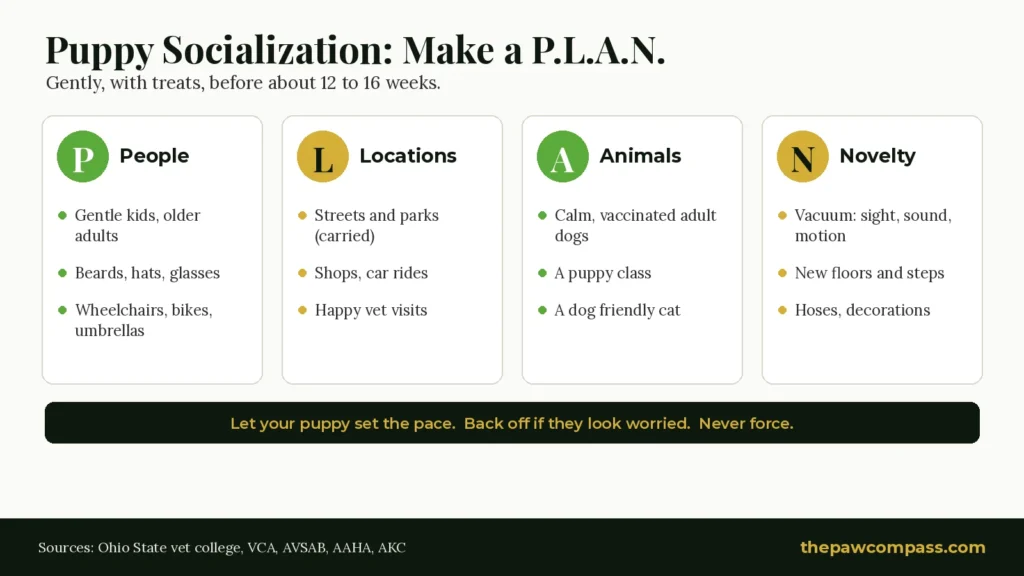
Ohio State’s veterinary college sums it up as a P.L.A.N.: people, locations, animals and novelty, all without causing fear. Think about the life your puppy will live as an adult dog, and introduce those things now. Ohio State suggests doing it before about 12 weeks when you can.
People
Aim for friendly new people every week (VCA). Ohio State and the AKC suggest variety:
- Children (old enough to be gentle) and older adults
- Men and women of all sizes, ages and colors
- Men with beards, people in hats, hoods, sunglasses or uniforms
- People using wheelchairs, walkers or canes
- People on bikes, skateboards or rollerblades, and someone opening an umbrella
Ohio State suggests teaching your puppy to sit for every greeting, so meeting people starts polite. How many people? A behavior guide from Ohio State’s veterinary medical center passes on Dr. Ian Dunbar’s suggestion of 100 positive meetings with people before 16 weeks. If sit is still new, start with how to teach a puppy to sit.

Locations
VCA recommends taking your puppy somewhere new at least twice a week. Good options from VCA and Ohio State include city streets, open parks, pet friendly shops, home improvement stores, outdoor sports events (watching from a blanket) and neighborhoods unlike your own. AVSAB adds car trips, as many as possible. And make the vet a happy place: Ohio State notes most puppies are in their first fear period, around 8 to 10 weeks, at their first vaccine visit, so bring treats.
Animals
Your puppy’s best teacher is often another dog. Ohio State says the ideal play pal is a mature, friendly adult dog that enjoys play but won’t put up with too much mouthing or jumping. An occasional bark or air snap to say “too rough” is fine. Anything beyond that isn’t, and if the adult dog growls, avoids your puppy or plays too rough, take your puppy away right away. VCA warns that a growl or snap from an unfamiliar adult dog can leave a lasting mark on a sensitive puppy.
Cats and other species count too. VCA suggests a visit with a calm, dog friendly cat (with your puppy on leash so they can’t chase), and a look at animals like cows or horses. Ohio State says to skip animals who are afraid of dogs, because a bad meeting can backfire. For dog playdates and play biting, see how to stop puppy biting.

Novelty: Everyday Things and Sounds
Ohio State points out that ordinary things, like a rake leaning on a wall or a lawn mower starting up, can terrify a dog who never met them as a puppy. Think ahead to things you only use in some seasons: snow shovels, winter coats, holiday decorations, a running hose. AAHA suggests something new at home every day, like a hair dryer, popping popcorn or a different chair. The AKC adds different floors: carpet, hardwood, tile and linoleum. AVSAB lists steps, tunnels and other surfaces to explore.
For things that move and make noise, like the vacuum, Ohio State suggests introducing them in stages: let your puppy get used to the sight of it first, then the sound, then the movement. VCA describes the same approach for a coffee grinder: short, quiet bursts in another room while a helper plays with your puppy, then slowly longer and closer.
Puppy Socialization by Week
Every puppy is different, so treat this as a guide, not a deadline. Ages are approximate.
| Age | What’s going on | What to focus on | Source |
|---|---|---|---|
| 3 to 7 weeks | With mom, littermates and the breeder | Gentle handling, household sounds, new surfaces, car rides | AKC, VCA, AVSAB |
| 7 to 10 weeks | Most puppies go home. First fear period around 8 to 10 weeks | Settle in, calm visitors, handling, happy vet visits, something new at home daily. Puppy class from 7 to 8 weeks, a week after the first shots, if your vet agrees | VCA, Ohio State, AAHA, AVSAB |
| 10 to 12 weeks | Prime time for new experiences | New places twice a week (carried or on a blanket), new people every week, known vaccinated dogs, a calm cat | VCA, Ohio State |
| By 12 weeks | Ohio State’s target | Introduce the people, places, animals and objects of your future life, including seasonal ones | Ohio State |
| 12 to 16 weeks | The window is closing | Keep going. Puppy classes are best before 4 months | VCA, Ohio State |
| 16 weeks and up | Vaccine series done around 16 to 20 weeks. Adolescence from about 6 to 18 months | Dog parks once your vet says go. Keep new experiences calm and positive. A vet check at 8 to 10 months | AKC, VCA, Ohio State |
For how socialization fits into a real day alongside naps, meals and potty breaks, see the 8 week puppy schedule.
Signs Your Puppy Is Scared, and What to Do
Socialization only works if your puppy feels safe. VCA says getting used to something can’t happen while a puppy is frightened, and lists these signs of fear:
- Trembling
- Refusing to play or take treats
- Trying to escape or pulling away
- Taking a treat from a stranger and then backing away
If you see them, calmly take your puppy somewhere they feel safe and let them relax. Next time, start farther away or with something less intense. Don’t keep coaxing a nervous puppy closer, since VCA says that can make fear grow. AVSAB and VCA both say a puppy who shows a lot of fear should get help early, from your vet or a veterinary behaviorist, who can build a custom plan.
Socializing Safely Before Vaccines Are Done
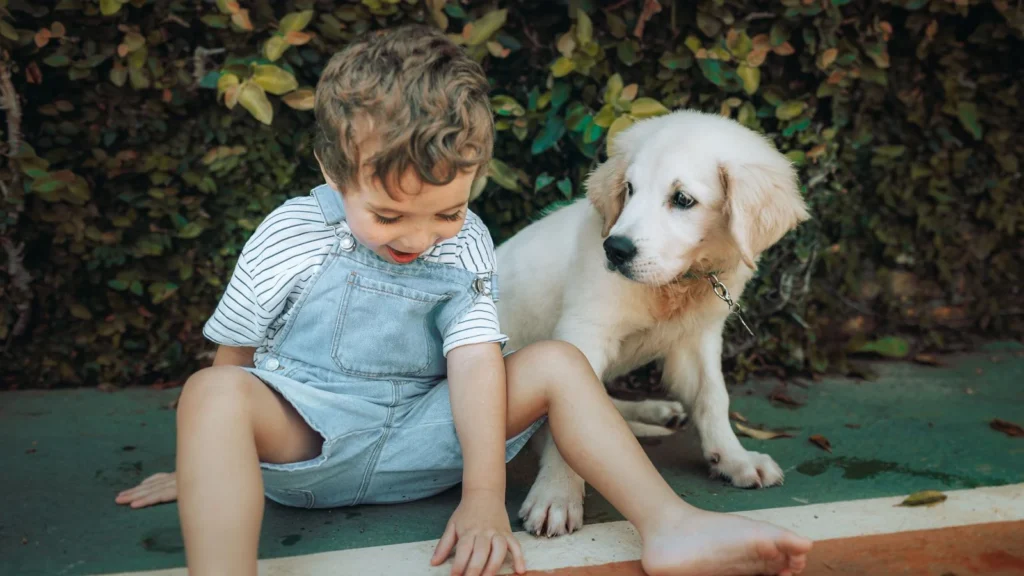
This is where many dog parents get stuck: the window closes before the vaccine series is done. Ohio State’s veterinary college says puppies aren’t fully protected until about 16 to 20 weeks. VCA calls it a misconception that puppies must finish their shots before being socialized, and says the benefits of early experiences usually outweigh the risk of illness. The answer is to socialize in low risk ways:
- Keep paws off risky ground. Carry your puppy, use a sling or stroller, or set them on a blanket or tarp where unknown dogs may have been (Ohio State).
- Choose sidewalks over shared grass where dog traffic is unknown (Ohio State).
- Skip dog parks and groups of unknown dogs until the series is done (VCA, AVSAB). The AKC says dog parks are fine 7 to 10 days after the full series.
- Pick dog friends you know: healthy, vaccinated and on parasite prevention (Ohio State).
- Ask visitors about recent visits to shelters or dog parks, and have them wash their hands. Ohio State suggests a change of shoes or clothes if they’ve been somewhere risky.
- Stay on schedule with vaccines and deworming. Ohio State says puppies should be on parasite prevention before and during socialization.
- Ask your vet about local risk. VCA suggests talking to your vet about infectious disease risk in your area and following their vaccine schedule.
For a place by place guide (your yard, quiet public spots, pet stores, dog parks), see when puppies can go outside. For the shots themselves and when each one is due, see the puppy shot schedule.
Puppy Socialization Classes: How to Pick a Good One
A well run class gives your puppy safe time with other puppies and new people, and gets you help from a trainer. AVSAB says puppies can start socialization classes as early as 7 to 8 weeks and recommends enrolling before 3 months. Ohio State adds that classes should be for puppies under 4 months. Not every class is equal, so check these before you sign up:
| What to check | What good looks like | Source |
|---|---|---|
| Vaccines and deworming | At least one set of shots 7 or more days before the first class, plus a first deworming, kept up to date | AVSAB, Ohio State |
| Health rules | Puppies free of intestinal parasites, home for at least 10 days and healthy. Sick puppies stay home | VCA |
| A vet’s OK | Each puppy has a clean bill of health from a vet | Ohio State |
| Age | From 7 weeks, and only puppies under 4 months | Ohio State |
| Floors | Easy to clean and disinfect, often indoors | VCA, AVSAB |
| Training methods | Positive reinforcement: treats, praise, play | AVSAB |
| Play time | Supervised, with small and big puppies managed so little ones don’t get scared | Ohio State, AKC |
| Class size | About 7 or 8 dogs per instructor | AKC |
| The instructor | Gives every puppy time, has more than one way to teach, stays upbeat | AKC |
AKC trainer Kathy Santo suggests watching a class or two without your puppy before you enroll. Do the students look like they’re having fun, or bored and stressed? For recommendations, VCA suggests asking your vet. VCA also notes that good classes teach puppies to ignore people and dogs politely, not just to greet them. The AKC offers a S.T.A.R. Puppy title after a 6 week class, open to dogs up to 1 year old. Class is also a good, safe place to practice coming when called; here is how to train a dog to come step by step.
A note on timing: AVSAB and Ohio State support classes before the series is done, but some vets prefer you wait. Our guide on when puppies can go outside covers both views.

After 16 Weeks: Keep Going
Missed part of the window? It’s not too late to help. VCA says to keep giving regular social experiences after 16 weeks, and to keep them calm and positive through adolescence, from about 6 to 18 months. AVSAB encourages continuing with as many people, pets and places as is practical, and says ongoing variety in the first year helps prevent separation problems. Ohio State recommends a “teenage tune up” vet visit at 8 to 10 months to check both health and behavior.
Older puppies may take longer to warm up, so go even slower. If your puppy shows a lot of fear, AVSAB says to get veterinary guidance rather than pushing through.
Keep Track of What Your Puppy Has Met
A simple list helps you spot gaps, like a puppy who has met lots of adults but no children, or has never heard a vacuum. Write down each new thing and how your puppy reacted: relaxed, curious or worried. Worried items get a slower, gentler second try.
If you’d like a ready made list, The First 30 Days Puppy OS includes 100 socialization opportunities in its Your First 30 Days section. For something you can carry on walks, the Print and Go Pack below has a pocket socialization list.
Puppy Socialization FAQ
-
What is puppy socialization?
It’s gently introducing your puppy to the people, places, animals, sounds and objects they’ll meet as an adult, in a way that feels safe and positive. VCA compares it to a vaccine against fear: safe early experiences help prevent fearful behavior later.
-
When is the puppy socialization window?
It starts at about 3 weeks. AVSAB calls the first three months the most important time, Ohio State’s veterinary college puts the end at 12, possibly 14, weeks, and VCA says the sensitive period runs to about 16 weeks. Start as soon as your puppy settles in at home.
-
Can you socialize a puppy before vaccinations are done?
Yes. AVSAB says socialization before full vaccination should be the standard of care. Keep it low risk: carry your puppy or use a blanket in public, meet only healthy, vaccinated dogs you know, and skip dog parks and groups of unknown dogs until your vet says the series is done.
-
When can puppies start puppy socialization classes?
AVSAB says as early as 7 to 8 weeks, with at least one set of vaccines 7 days before the first class and a first deworming. Ohio State’s veterinary college says classes should be for puppies under 4 months, held somewhere easy to clean.
-
How many people should a puppy meet?
A behavior guide from Ohio State’s veterinary medical center passes on Dr. Ian Dunbar’s suggestion of 100 positive meetings with people before 16 weeks. VCA suggests friendly new people every week, of all ages, sizes and looks. Quality matters more than numbers: each meeting should be calm and positive.
-
Is it too late to socialize a 4 or 5 month old puppy?
No. VCA says to keep up regular, positive social experiences after 16 weeks and through adolescence, from about 6 to 18 months. Older puppies may need a slower pace. If your puppy shows a lot of fear, AVSAB recommends getting veterinary guidance.
-
What should you do if your puppy is scared?
Calmly move your puppy farther away or take them somewhere they feel safe, and let them relax. Next time, start at a greater distance or with something milder. VCA warns that forcing a scared puppy closer can make the fear worse. If fear is frequent or strong, talk to your vet or a veterinary behaviorist.
Puppy Socialization: The Short Version
- The window opens at about 3 weeks and the most important part closes by about 12 to 16 weeks.
- Introduce people, places, animals and new things, a little at a time, with treats.
- Let your puppy set the pace. Never force a scared puppy.
- Socialize before the shots are done, in low risk ways: carried, on a blanket, with known vaccinated dogs.
- Pick a puppy class with clear vaccine rules, clean floors and reward based training.
- Keep going after 16 weeks, all the way through adolescence.
Over to you: what’s the newest thing your puppy met this week? Tell us in the comments.

1 Comment