


 By
To train a dog to come, pick one recall word, say it once in a happy voice from a few feet away, and reward your dog with something they love the moment they reach you. Then add distance, distractions and a long line little by little, and never call your dog for something unpleasant.
The AKC calls a reliable recall potentially lifesaving, and it’s built the same way for puppies and adult dogs. Below are the 7 steps, the mistakes that undo a recall, a stage by stage plan and what to do when your dog won’t come, based on guidance from the AKC, VCA’s veterinary behaviorists, Best Friends Animal Society and PetMD.
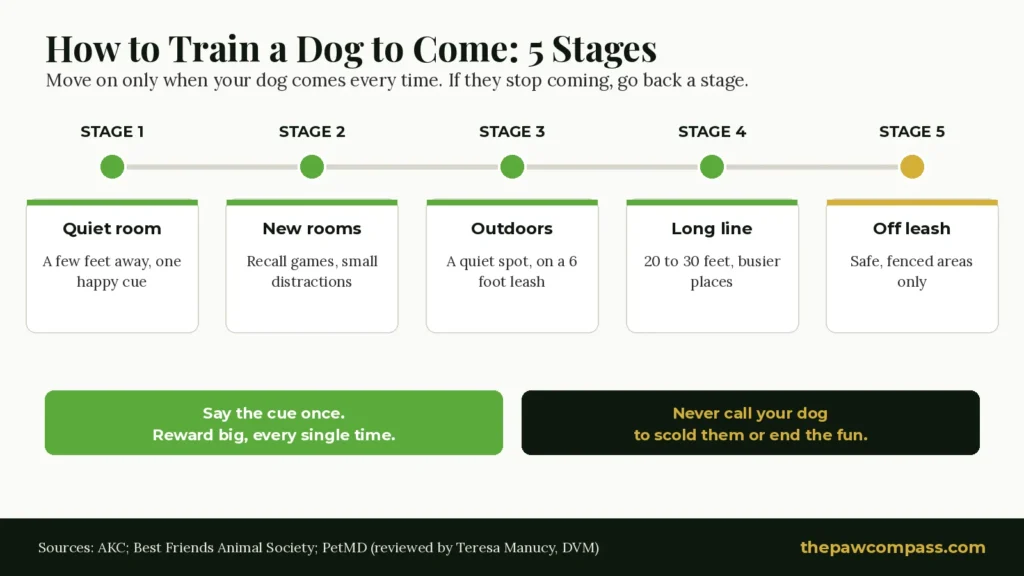
Table of Contents
- Before You Start: Your Recall Word and Gear
- How to Train a Dog to Come: 7 Steps
- Recall Training Plan by Stage
- 7 Mistakes That Ruin a Recall
- Why Won’t a Dog Come When Called?
- Puppies, Adult Dogs and Rescue Dogs
- Emergency Recall: A Backup for Real Danger
- How to Train a Dog to Come: FAQ
- How to Train a Dog to Come: The Short Version
Before You Start: Your Recall Word and Gear
Pick one recall word. VCA’s veterinary behaviorists say it should be a unique word your dog won’t hear in other contexts. “Come” and “here” are both common. PetMD advises against using your dog’s name as the cue, and suggests switching to a new word such as “here” if your dog has already learned to ignore “come”.
Gather your gear:
- Small, soft treats your dog loves. Best Friends Animal Society suggests pea sized treats in a pouch you wear, or a favorite toy in your pocket.
- A regular leash for early outdoor practice. The AKC starts outdoor work on a 6 foot leash.
- A long line for later stages. The AKC suggests a 20 or 30 foot line, and Best Friends a leash of 20 to 30 feet.
- A helper, if you can. Two people make recall games much easier.
How to Train a Dog to Come: 7 Steps
Step 1: Teach the Collar Grab First
Your dog should love being caught. The AKC’s “gotcha” game is simple: say “gotcha”, hold your dog’s collar, then give a treat. Practice it in different places until a hand on the collar predicts something good.
Step 2: Start Close in a Quiet Room
Begin a few feet away indoors, with no distractions. Crouch or kneel, since the UC Davis Clinical Animal Behavior Service handout recommends an inviting, non threatening posture. Say your cue once, in a clear and happy voice. The AKC suggests running backwards as you call, which makes coming to you more fun.

Step 3: Reward Big and Right Away
The moment your dog reaches you, give a treat and lots of praise. The AKC’s advice is to make it so worth their while they’d never consider not coming, with rewards such as a piece of chicken or a game of tug. The UC Davis handout adds that you can start praising as soon as your dog commits to coming toward you.
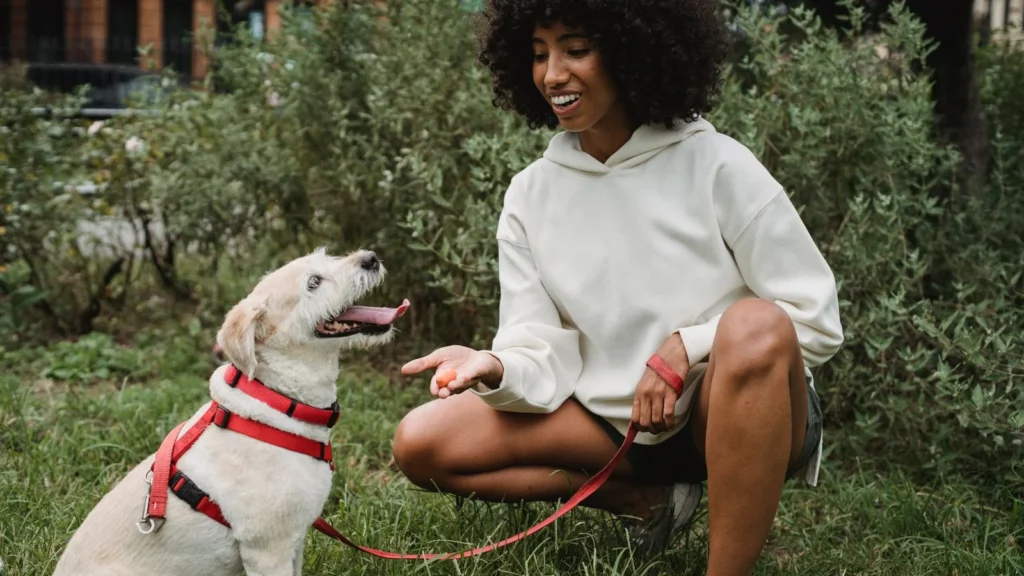
Step 4: If Your Dog Doesn’t Come, Don’t Repeat the Cue
Saying “come, come, come” teaches your dog the word is optional. Best Friends says not to repeat the cue: wait for your dog to come, reward, and start again. If your dog doesn’t respond at all, the UC Davis handout suggests calmly walking over and bringing them back to the starting spot, with no punishment and no treat, then making the next try easier.
Step 5: Play Recall Games
Games build speed and enthusiasm:
- Round robin: two or more people take turns calling your dog across a room and rewarding (AKC, Best Friends).
- Find me: hide in another room, call once and celebrate when your dog finds you (AKC, PetMD).
- Run away: call and jog backwards so your dog chases you in (AKC, UC Davis).
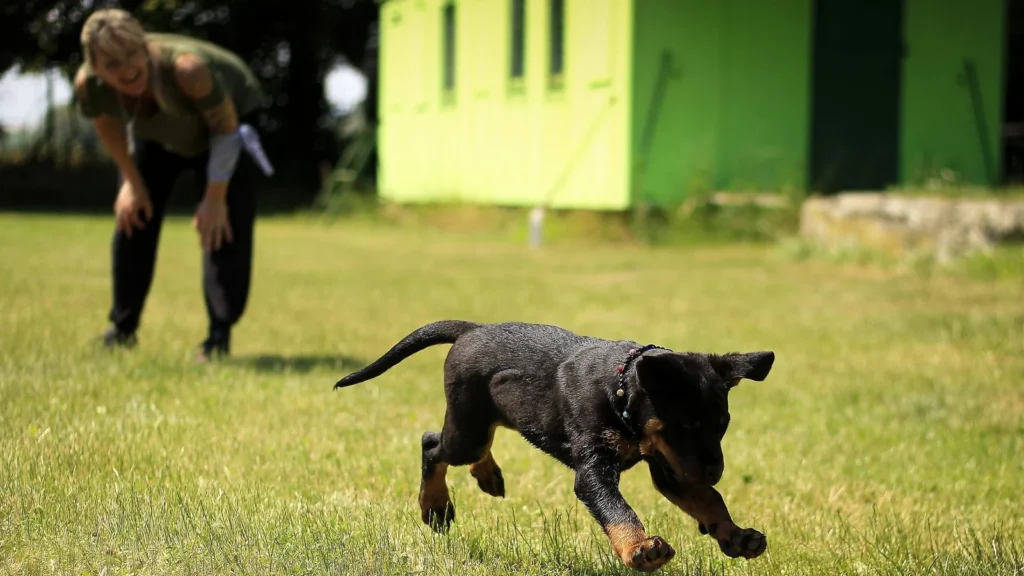
Step 6: Add Distance and Distractions Slowly
Practice in different rooms, then add small distractions such as another pet nearby or someone cooking, as the AKC suggests. After that, go outdoors to a quiet spot on a leash, then use a long line in busier places. The AKC says the line isn’t for reeling your dog in, but for controlling the situation.
If your dog stops responding, go back to an easier step. VCA’s behaviorists note that a recall can take many weeks or months to become reliable around distractions.
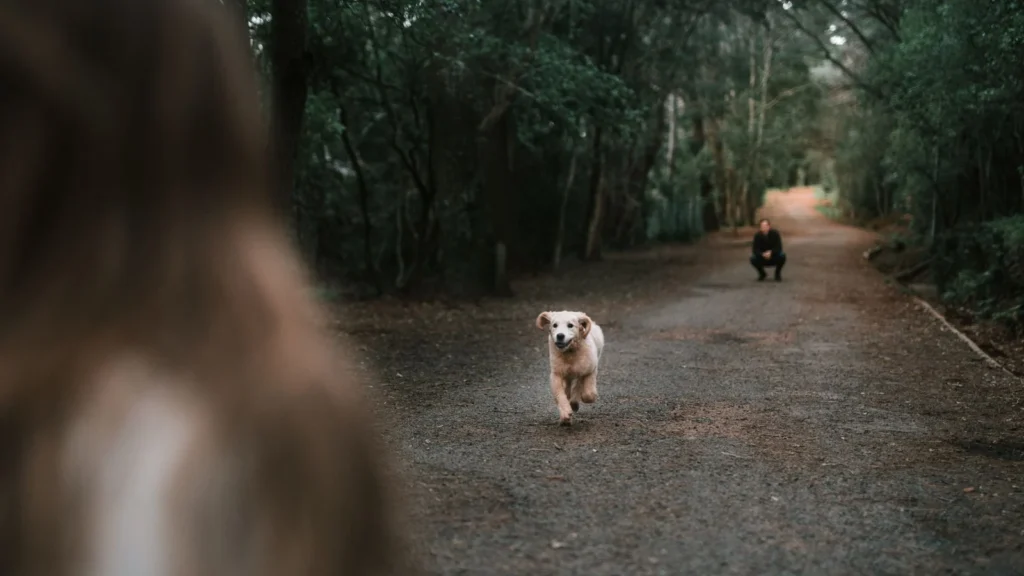
Step 7: Finish With a Sit and a Collar Touch
Once your dog comes reliably, ask for a sit when they arrive, then touch the collar before the reward. The AKC adds the sit as a final step, and the UC Davis handout’s goal is a dog who sits at your feet and lets you take the collar. This turns “come” into “come and stay with me”, which matters most in an emergency. If sit is still new, here’s how to teach a puppy to sit. To build that hold, here is how to train a dog to stay.
Recall Training Plan by Stage
| Stage | Where | Distance and gear | Move on when |
|---|---|---|---|
| 1 | A quiet room indoors | A few feet, a helper if you can | Your dog runs to you every time |
| 2 | Other rooms, small distractions | Across the room, recall games | Your dog finds you from another room |
| 3 | Outdoors, a quiet spot | A 6 foot leash | Your dog comes right away on leash |
| 4 | Busier places | A 20 to 30 foot long line | Your dog comes reliably on the line |
| 5 | Safe, fenced areas only | Off leash | Only after near perfect recall on leash |
7 Mistakes That Ruin a Recall
- Calling your dog to scold them. VCA’s behaviorists say never call and then scold, for any reason. The UC Davis handout adds: never punish your dog for coming, even if they were slow.
- Calling only to end the fun. If “come” always means leaving the park or the end of play, your dog learns to avoid it. Call for good things often, and sometimes let your dog go back to playing.
- Calling to interrupt something. Best Friends warns against using the cue to stop unwanted behavior, like yelling it at a dog barking at a cat.
- Using the cue casually. Best Friends says it should become a reliable reflex, so save it for training and real recalls.
- Sounding angry or boring. The AKC says a harsh or even just boring voice makes your dog less interested in coming.
- Clipping the leash on every time. The UC Davis handout advises against putting your dog back on leash right after every recall.
- Testing it off leash too soon. PetMD warns against testing recall off leash in unfenced areas, where a dog could run away or get hurt.
Why Won’t a Dog Come When Called?
Most recall problems come down to a few causes:
- The word has a bad meaning. If “come” has been followed by baths, scolding or the end of play, pick a new word and start over at Stage 1.
- The reward isn’t worth it. A dry biscuit can’t compete with a squirrel. Use better rewards outdoors, as PetMD suggests.
- Too much, too soon. Jumping straight to the park skips the stages. Go back a step.
- It was never really learned. Puppies and newly adopted dogs need to start with the basics, no matter how smart they are.
Puppies, Adult Dogs and Rescue Dogs
PetMD says recall training can start as early as 8 weeks of age. Until your vet says your puppy can go to public places, practice indoors or in your own yard; our guide to when puppies can go outside explains why. Recall games also fit well into early puppy socialization and a daily 8 week puppy schedule.
Adult and rescue dogs can learn too. Start at Stage 1 indoors, even if your dog seems to know the word, and keep the first weeks low pressure. Our rescue dog nighttime routine covers the first days with a newly adopted dog. If your puppy nips during excited recall games, see how to stop puppy biting.
Short practice sessions spread through the day are easier to keep up with a routine everyone in the house can see. The Print & Go Pack includes a Fridge Schedule:
Emergency Recall: A Backup for Real Danger
Some trainers teach a second, special recall word kept only for emergencies. VCA’s behaviorists describe practicing it so it’s always followed by a jackpot, such as a big handful of treats scattered on the ground, and using it rarely so it keeps its power. Even with a great recall, keep your dog leashed near streets and heavy traffic, as the UC Davis handout advises.
How to Train a Dog to Come: FAQ
-
How do you train a dog to come when called?
Pick one recall word, say it once in a happy voice from a few feet away, and reward with a treat and praise the moment your dog arrives. Then add distance, distractions and a long line slowly. Never call your dog to scold them.
-
How long does it take to train a dog to come?
It varies. VCA’s veterinary behaviorists say a recall can take many weeks or months to become reliable around distractions, so expect steady progress rather than a quick fix.
-
At what age can you start recall training?
PetMD says recall training can start as early as 8 weeks of age. Practice indoors or in your own yard until your vet says your puppy can go to public places.
-
Why won’t a dog come when called?
Common reasons are a recall word that has been followed by unpleasant things, rewards that can’t compete with distractions, or moving to busy places too soon. Pick a new word if needed, use better rewards and go back to an easier step.
-
Should you use your dog’s name or a word like come?
Use a separate word. PetMD advises against using your dog’s name as the cue, and VCA’s behaviorists say the recall word should be unique and not used in other contexts. Come and here are both common choices.
-
How long should a recall training line be?
The AKC suggests a 20 or 30 foot long line, and Best Friends Animal Society suggests 20 to 30 feet. Use it to keep your dog safe, not to reel them in.
-
When can a dog be trusted off leash?
Only after a near perfect recall on a leash and long line, and then only in safe, fenced areas at first. PetMD warns against testing recall off leash in unfenced areas.
How to Train a Dog to Come: The Short Version
- One unique recall word, said once, in a happy voice.
- Start with the collar grab, then call from a few feet away indoors.
- Reward big, every time, the moment your dog arrives.
- Play round robin and find me to build speed.
- Add distance and distractions slowly, using a long line outdoors.
- Never call your dog to scold them or only to end the fun.
Over to you: what’s your dog’s favorite recall reward? Tell us in the comments.
