


 By
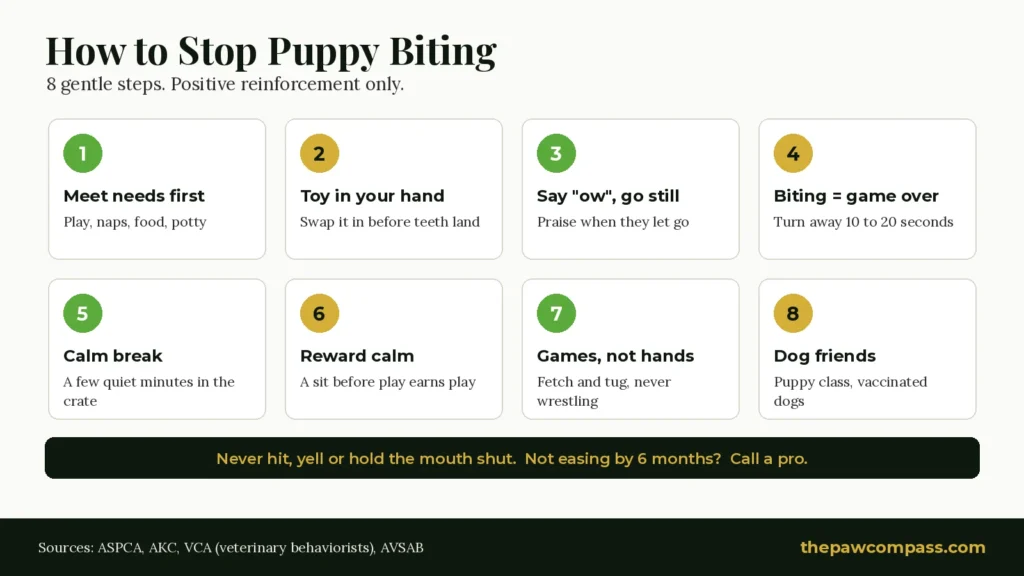
Wondering how to get a puppy to stop biting? Meet their needs first (play, naps, food and potty breaks), keep a toy in your hand to swap in, and make every bite end the fun: say “ow,” go still, and step away for 10 to 20 seconds. Reward calm, gentle play. That plan comes from the ASPCA, the American Kennel Club and VCA’s board certified veterinary behaviorists, who say that when the whole family is consistent, puppies should quickly learn that biting ends the fun. What you don’t do matters just as much: no hitting, no yelling and no holding the mouth shut.
If you’ve typed “how can I stop puppy biting” with a fresh scratch on your hand, you’re in good company. The AKC describes a puppy’s mouth as full of about 28 tiny razors. Here’s why the biting happens, the step by step plan, and when it’s time to call in help.
Table of Contents
- Why Do Puppies Bite?
- How to Get a Puppy to Stop Biting: 8 Steps
- Teaching Bite Inhibition: From Hard Bites to Gentle Mouths
- Ankle Biters and Kids
- What Not to Do
- How Long Does Puppy Biting Last?
- When to Call a Trainer, Behaviorist or Vet
- Track the Bites
- Puppy Biting FAQ
- How to Get a Puppy to Stop Biting: The Short Version
Why Do Puppies Bite?
Puppy biting is normal. The ASPCA says puppies spend a lot of their time playing, chewing and exploring with their mouths. VCA’s veterinary behaviorists add that nipping and mouthing in young dogs is generally a form of social play, even though people often blame teething. Teething, they say, is more about gnawing on objects. Knowing which one you’re dealing with tells you what to do.
| What you see | Likely cause | Try this |
|---|---|---|
| Nipping hands, feet and clothes during play, with a loose, wiggly body | Play | End the game the moment teeth touch skin, then offer a toy |
| Gnawing furniture, shoes and toys more than people | Teething | Safe chews for sore gums (see when puppies lose their baby teeth) |
| Wild, bitey and impossible to settle, often after a long play session | Overtired | A nap in a quiet spot or the crate (see how much puppies sleep) |
| Biting that ramps up when a meal or potty break is due | Hungry, thirsty or needs to potty | Meet the need first |
| Still biting after you’ve swapped in a toy several times | Too much energy | Let them run in the yard, or try a short training game |
| Ambushing your ankles as you walk | Chase play | Freeze, then offer a tug toy |
| Stiff or frozen body, lips pulled back, growling, bites that hurt much more, often while being held | Frustration or fear | Stay calm, don’t yelp, and get professional help |
Two habits keep biting going without anyone meaning to. Waving fingers in a puppy’s face or jerking your hands away turns your hands into a game, according to the ASPCA. And yelling can work as a reward, because it’s still a response, says the AKC.

How to Get a Puppy to Stop Biting: 8 Steps
Here’s how to stop a puppy from biting you, step by step. The plan combines the ASPCA’s method with advice from the AKC and VCA. Get everyone at home doing the same thing, because VCA’s behaviorists say consistency from every family member is what makes it work.
- Meet the needs first. VCA’s behaviorists are blunt: play biting won’t stop until your puppy gets enough play, exercise, exploration and attention. The AKC adds that a biting puppy is sometimes just overtired, hungry, thirsty or needs to potty. A predictable day helps, and the 8 week puppy schedule shows one.
- Keep a toy in your hand. The AKC suggests keeping a chew toy within reach at all times, so you can swap it in before teeth reach skin. The ASPCA says to offer a toy whenever your puppy goes for fingers or toes.
- Say “ow” and go still. When your puppy bites hard, give a high pitched “ow” and let your hand go limp. Praise your puppy for stopping or for licking you, then keep playing. The ASPCA suggests doing this no more than 3 times in 15 minutes. The AKC warns that some puppies get even more worked up by the yelp. If yours does, skip it and go straight to step 4.
- Make biting mean game over. If the biting continues, stop playing. Turn away, or tuck your hands into your armpits, as dog trainer and AKC columnist Kathy Santo suggests. Ignore your puppy for 10 to 20 seconds, or leave the room for 30 to 60 seconds if they keep at it, according to the ASPCA. Make sure the room is puppy proofed first. Then come back and play gently again.
- Offer a calm break when they’re wound up. If your puppy can’t settle, the AKC says a few minutes in the crate can help them calm down. Do it calmly, so the crate never feels like punishment. If the crate itself is a struggle, see puppy crying in the crate.
- Reward the calm moments. When your puppy is calm and quiet, the AKC says to reinforce it with a “good dog,” a piece of kibble or a pat. VCA suggests asking for a sit before each play session, so calm behavior is what earns the game. If sit is still new, here is how to teach a puppy to sit.
- Choose games that keep hands out of it. The ASPCA recommends fetch and tug instead of wrestling. VCA’s rules for tug: you start each session, and the game stops the moment teeth touch skin or clothing.
- Let them play with other dogs. Playing with other puppies and friendly, vaccinated adult dogs burns energy, so your puppy is less keen to play rough with you, says the ASPCA. A well run puppy class helps too, according to the AKC. Check with your vet about vaccines first (my puppy shot schedule shows when).
Teaching Bite Inhibition: From Hard Bites to Gentle Mouths
Bite inhibition is a dog’s ability to control the force of their mouth. The AKC explains why it matters: a dog who’s in pain or scared may put their mouth on someone one day, and a dog who has learned bite inhibition knows not to bite down hard. Puppies start learning it from their littermates, who yelp and stop playing when they’re bitten too hard. That’s one reason VCA’s behaviorists say puppies shouldn’t go to new homes before 7 to 8 weeks of age.
The ASPCA teaches it in stages:
- Start with the hardest bites. Yelp and pause play only for those.
- Once the hardest bites stop, respond to moderately hard bites too.
- Keep tightening the rule until your puppy mouths so gently you feel little or no pressure.
- Then change the rule to no teeth on skin at all. Any time you feel teeth, yelp, walk away and ignore your puppy for 30 to 60 seconds.
Expect ups and downs. The AKC notes that a puppy may back off in one play session and come at you teeth first in the next. That’s normal progress, not failure.
Ankle Biters and Kids
Moving feet are hard for a puppy to resist. The ASPCA’s fix: keep a tug toy in your pocket. When your puppy ambushes your ankles, stop moving, wave the toy, and start walking again once they grab it. No toy handy? Freeze until they let go, then praise and reward. The AKC also suggests holding a tasty treat next to your leg as you walk, the same trick used to teach leash walking.
Kids need extra help. VCA’s behaviorists say children’s reactions often aren’t quick or clear enough, so a puppy reads them as an invitation to play harder. Supervise every session, and teach kids not to wave fingers or toes at the puppy. VCA’s teething guide also warns against letting kids play rough, even if they don’t mind a scratch, because it teaches a puppy that hands are toys.
What Not to Do
The American Veterinary Society of Animal Behavior (AVSAB) is clear: reward based methods are the evidence based choice for all dog training, and methods that rely on force, pain or physical or emotional discomfort shouldn’t be used. For puppy biting, that rules out:
- Hitting, slapping, flicking the nose or scruff shaking. The ASPCA says physical punishment can make puppies bite harder, make them afraid of you, and even cause real aggression.
- Holding the mouth shut or pushing fingers down the throat. The ASPCA lists fingers down the throat among the punishments to avoid, and VCA’s behaviorists say physical methods are not recommended. Holding the mouth shut is a force based correction, exactly the kind AVSAB says not to use.
- Yelling. The AKC says it can reward biting, since it’s still a response, and it can make a puppy fearful of being handled.
- Jerking your hands away. It makes your puppy lunge and grab. Let your hands go limp instead, says the ASPCA.
- Starting play with your hands. Waving fingers or slapping at your puppy’s face invites biting, according to the ASPCA. The AKC also warns against roughhousing in ways that make a puppy lose control.
- Sprays, startle devices, shock or pinch collars. AVSAB says there’s no evidence that aversive training is necessary, and research links it to stress during training and to later problems like aggression and anxiety.
- Giving up on play. The ASPCA says play builds your bond. The goal is gentle play, not no play.
VCA’s behaviorists add one more reason to skip punishment: pain can make a puppy anxious, fearful, defensive or even more excited, and some puppies read punishment as rough play, so the biting gets worse.
How Long Does Puppy Biting Last?
It varies, but it should get better month by month. Teething overlaps with the worst of it, and most puppies have all their adult teeth by 6 to 7 months (see when puppies lose their baby teeth). The AKC’s chief veterinarian, Dr. Jerry Klein, says play biting doesn’t mean your puppy is vicious, but if it hasn’t eased by about 6 months, it’s a good idea to consult an experienced trainer or animal behavior specialist.
Chewing lasts longer than biting people. VCA says heavy chewing tends to ease at around 18 months, so keep safe chews around well past puppyhood.
When to Call a Trainer, Behaviorist or Vet
- No real progress by about 6 months. That’s the AKC’s line for calling in a pro.
- Signs of a temper tantrum or fear: a stiff or frozen body, lips pulled back, growling, and bites that hurt much more than play. The ASPCA says these often happen when a puppy is held or handled, and that repeated frustration biting isn’t something a puppy simply grows out of.
- Biting that seems aggressive rather than playful. The AKC says to talk to a vet or trainer if biting seems to come from aggression, not play.
- Biting that starts suddenly, or when you touch one spot. The AKC notes that dogs in pain may put their mouth on people, so check with your vet first.
Who to call: for fear or aggression, the ASPCA recommends a Certified Applied Animal Behaviorist or a board certified veterinary behaviorist (Dip. ACVB), or a Certified Professional Dog Trainer with real experience in those problems. AVSAB says to choose a trainer who uses reward based methods, and that serious problems like aggression, anxiety and fear may need a full treatment plan, sometimes including medication from your vet.
Track the Bites
Write down when biting happens and what came right before it: time of day, how long since the last nap, meal or potty break, and what kind of play. VCA’s behaviorists suggest keeping track of which games get your puppy too excited, so you can avoid them.
If you like tracking on your phone, the First 30 Days Puppy OS Notion template has a biting page with its own tracker in its problem section.
Puppy Biting FAQ
-
How do you get a puppy to stop biting?
Meet your puppy’s needs for play, rest, food and potty breaks, keep a toy handy to swap in, and make biting end the fun: say “ow,” go still, and step away for 10 to 20 seconds. Reward calm, gentle play. That plan comes from the ASPCA, the AKC and VCA’s veterinary behaviorists, who stress that everyone in the family needs to respond the same way.
-
At what age do puppies stop biting?
It eases gradually as teething ends and training sticks. Most puppies have all their adult teeth by 6 to 7 months, according to VCA. The AKC says that if play biting hasn’t eased by about 6 months, it’s a good idea to talk to an experienced trainer or animal behavior specialist.
-
Is it normal for puppies to bite a lot?
Yes. The ASPCA calls mouthing normal puppy behavior, and VCA’s behaviorists say it’s generally a form of social play. It still needs to be taught away, because what’s cute at 7 weeks hurts at 3 or 4 months.
-
Does yelping work when a puppy bites?
Often, yes. The ASPCA suggests a high pitched yelp and a limp hand when a bite is too hard, then praise when your puppy stops. The AKC warns that some puppies get more worked up by the noise, and if that happens, turning away quietly works better. Don’t yelp during a temper tantrum, says the ASPCA. Stay calm instead.
-
Should you punish a puppy for biting?
No. AVSAB, the veterinary society for animal behavior, says training methods that rely on force, pain or discomfort shouldn’t be used. The ASPCA warns that hitting or other physical punishment can make puppies bite harder, fear you, or become truly aggressive.
-
Why do puppies get so bitey in the evening?
Often because they’re overtired. The AKC says a biting puppy is sometimes really an overtired puppy who needs a nap in a quiet space or the crate. Hunger, thirst or a potty need can also be behind it.
-
Is puppy biting teething or play?
Usually play. VCA’s veterinary behaviorists say nipping and mouthing in young dogs is generally a form of social play, while teething shows up more as gnawing on objects. Many puppies do both, so give safe chews and teach gentle play at the same time.
How to Get a Puppy to Stop Biting: The Short Version
Meet the needs first, keep a toy in your hand, say “ow” and go still for hard bites, and make any teeth on skin end the game for a few seconds. Reward calm, play games that keep hands out of it, and get the whole family doing the same thing. Never hit, yell or hold the mouth shut. If it isn’t easing by about 6 months, or you see stiff, growly, frustrated biting, call in a pro.
Over to you: what finally worked on your puppy’s needle teeth? Tell me in the comments.
