


 By
By If your dog is suddenly pacing at night, you need to know one thing before anything else: it’s almost never random. The most common causes are anxiety, pain, cognitive dysfunction in older dogs, an unmet physical need like a bathroom trip, or in rare cases something that needs emergency attention tonight. Which one you’re dealing with changes everything about what you actually do next.
Here’s my honest experience. First time my dog did this, I was on Google at midnight reading about rare tropical parasites by 1am. Three clicks down some forum rabbit hole, completely useless. What I actually needed was a calm breakdown with real numbers. So that’s what this is.
Table of Contents
Why “Suddenly” Is the Key Word Here
A dog who’s always been a little restless at night is probably just wired that way. Fine. Not what we’re talking about.
What we’re talking about is the dog who slept perfectly for years and then, one week, just… didn’t. Started getting up and walking the house at 2am for no obvious reason. If your dog is restless and pacing when they used to sleep straight through, something has shifted. If your dog is restless and pacing when they used to sleep straight through, something has shifted. If your dog is restless and pacing when they used to sleep straight through, something has shifted. If your dog is restless and pacing when they used to sleep straight through, something has shifted. If your dog is restless and pacing when they used to sleep straight through, something has shifted. If your dog is restless and pacing when they used to sleep straight through, something has shifted. If your dog is restless and pacing when they used to sleep straight through, something has shifted. If your dog is restless and pacing when they used to sleep straight through, something has shifted. If your dog is restless and pacing when they used to sleep straight through, something has shifted. That version of pacing is your dog communicating something changed. Could be in their body. Could be their environment. Could be their brain, especially in older dogs. But something changed, and they can’t tell you what in words.
Why Does My Dog Pace at Night Suddenly? The 5 Real Causes
1. Anxiety and Stress
Anxious dogs don’t always look anxious. That’s the part that trips people up. An anxious dog at 2am doesn’t necessarily look scared or upset. They just look like a dog wandering the house for no reason.
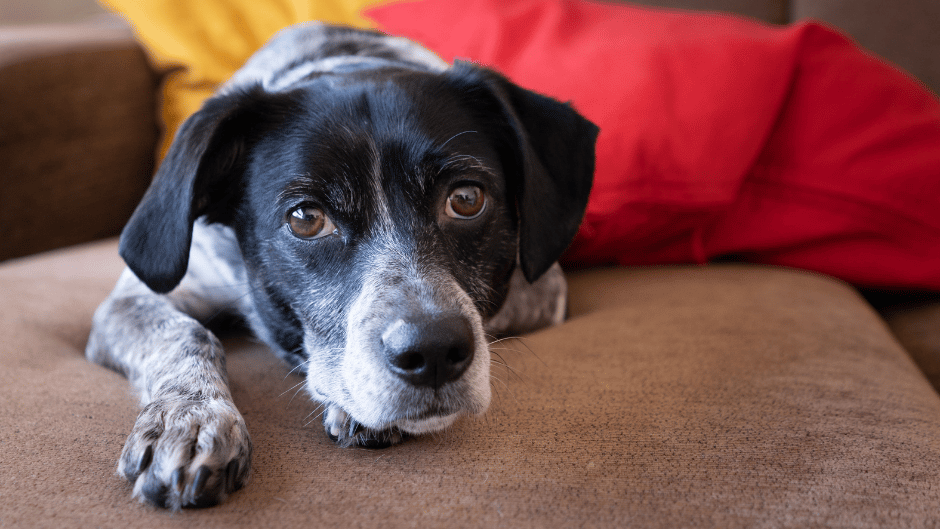
The signs that actually tell you it’s anxiety:
- Dog panting and pacing at night even when it’s not hot, that combo is almost always stress
- Following you room to room but not actually settling even when you’re right next to them
- Random yawning, lip licking, that full-body shake-off dogs do when nothing happened
- It started around the same time as something changed: a new work schedule, a new pet in the house, a move, fireworks season
Anxiety pacing almost always has a trigger. The reason dog parents miss it is that the trigger happened 3 weeks ago and they stopped connecting it. A neighbor got a dog. You started leaving earlier for work. Something moved in the house. Dogs are running on a sensory channel most of us can’t access, and they pick up shifts in routine and environment well before we consciously register them.
Which breeds are most wired for this? Border Collies, Australian Shepherds, German Shepherds, Vizslas, basically anything bred to work hard and think fast. High-drive breeds have more nervous energy to manage and less tolerance for unresolved stress. But genuinely any dog can develop anxiety, especially after a life change. The AKC has a solid breakdown of what separation anxiety actually looks like if you want to cross-reference.
Age matters too. Puppies get anxious settling into a new home, that’s basically universal. Middle-aged dogs usually need a specific trigger to tip into nighttime anxiety. Senior dogs are actually more vulnerable than most people expect because hearing and vision loss makes the world feel less predictable, and a dog whose senses are dulling can become anxious in familiar environments they’d been totally comfortable in for years.
A behavioral vet consultation runs $50-$150. If they send you to a certified veterinary behaviorist, budget $150-$300 for the initial assessment. Situational anxiety tied to one trigger often settles in 1-4 weeks once you address the trigger. Generalized anxiety is longer, 2-3 months of behavioral work, sometimes medication.
Anxiety can also drive paw licking alongside nighttime pacing. Here’s why dogs lick their paws at night and how to tell which cause fits
2. Pain or Physical Discomfort
Pain is sneaky at night. During the day, your dog is moving around, distracted, maybe playing. The movement itself kind of manages the discomfort. Then nighttime comes, everything goes quiet, they try to lie still, and suddenly there’s nowhere for the pain to go. So, they get up. Pace. Lie down. Get up again.
This is actually one of the quieter pains signals most dog parents completely miss. If any of this is sounding familiar, check my post on signs your dog is in pain but not limping because nighttime pacing is sign #5 on that list, and it shows up before the more obvious stuff does.
Joint pain is the most common physical cause, especially past age 6-7. But it’s not the only one. A UTI, a GI issue, an ear infection, even a cracked tooth can produce the same restless, can’t-get-comfortable behavior. And if your dog has also been slow to get up after lying down during the day, that’s almost certainly the same problem showing up in two places. More on the joint pain angle in my post on dogs struggling to get up after lying down.
What this looks like in practice: they pace, circle, lie down, get up, repeat. They might avoid lying on one side. Panting with nothing to explain it. Stiffer in the morning than usual. Licking one specific spot over and over.
Large breeds carry the most joint-related risk. Labs, German Shepherds, Goldens, Rottweilers, Great Danes, all of them have higher rates of arthritis and hip dysplasia that show up as nighttime restlessness well before the limp does. Large and giant breeds generally, once they’re past 6-7 years, are worth watching more closely for this.
For puppies it’s sometimes panosteitis, growing pains basically, most common in large breeds between 5-18 months old. Middle-aged dogs are more likely dealing with an acute injury, GI upset, or dental pain. Senior dogs are back to the joint and degeneration territory, plus internal conditions that become more common with age.
Cost to diagnose: a physical exam runs $50-$150. X-rays if joint or spinal involvement looks likely: $150-$400. Bloodwork to rule out internal causes: $80-$200. Acute issues like minor injuries or GI problems typically resolve in 3-7 days. Arthritis doesn’t resolve, it’s managed, but real improvement in nighttime comfort usually shows up within 3-6 weeks of a consistent management plan.
Honestly, pain-driven pacing is the one that makes me the most frustrated when I see it missed, because it’s often missed for a really long time. There’s something about “no limp, no yelp” that makes dog parents feel like they’re overreacting if they bring it up. I’ve felt that too, that weird guilt about calling the vet over something you can’t quite point to. But pain at night with none of the obvious daytime signals is incredibly common, and the dogs dealing with it quietly are usually the ones who need the vet visit most.
3. Canine Cognitive Dysfunction (Doggy Dementia)
This one’s for the senior dog parents, and I’m going to give it the space it deserves rather than cramming it into a paragraph. Older dog pacing at night is one of the most common presentations of this condition, and it’s the one most frequently written off as just aging. Older dog pacing at night is one of the most common presentations of this condition, and it’s the one most frequently written off as just aging. Older dog pacing at night is one of the most common presentations of this condition, and it’s the one most frequently written off as just aging. Older dog pacing at night is one of the most common presentations of this condition, and it’s the one most frequently written off as just aging. Older dog pacing at night is one of the most common presentations of this condition, and it’s the one most frequently written off as just aging. Older dog pacing at night is one of the most common presentations of this condition, and it’s the one most frequently written off as just aging. Older dog pacing at night is one of the most common presentations of this condition, and it’s the one most frequently written off as just aging. Older dog pacing at night is one of the most common presentations of this condition, and it’s the one most frequently written off as just aging. Older dog pacing at night is one of the most common presentations of this condition, and it’s the one most frequently written off as just aging.
CCD is dementia. Actual dementia, often called dog dementia. It works on the dog brain the way Alzheimer’s works on the human brain: sleep cycles get disrupted, spatial orientation goes, familiar routines stop registering, they get stuck behind furniture or in corners and just… stand there. VCA Animal Hospitals has a thorough breakdown of how CCD is diagnosed and managed if you want the full clinical picture.
Here’s why nighttime is when it’s worst. During the day, there’s light, activity, smells, routine, all of it providing constant environmental cues that help your dog orient themselves. Night strips all of that away. A dog with CCD losing those cues in the dark gets confused in a way that’s genuinely distressing for them. They pace because confusion produces movement. It’s not willful. It’s a brain that can’t find its bearings.
What it looks like at home: pacing specifically at night while being mostly fine during the day. Getting stuck in corners. Staring at walls. Barking or whining for no apparent reason after dark. A dog who’s been housetrained for 9 years suddenly having accidents. Sleeping through the afternoon and then up and restless all night, which vets call the day-night flip and it’s one of the clearest CCD signals there is.
Any dog can get CCD, it’s primarily age-related. German Shepherds and Beagles show up more often in studies but no breed is immune. The numbers are honestly sobering: around 14-35% of dogs over 8 show some signs of cognitive dysfunction, and it rises sharply after 11.
Initial vet workup including physical exam, cognitive assessment, and bloodwork: $150-$350. MRI is reserved for complex cases and runs $1,500-$3,000. CCD can’t be reversed. You’re managing it, not curing it. Most dogs respond to environmental adjustments and dietary supplements within 4-8 weeks of starting a management protocol.
4. An Unmet Physical Need
Before you go deep on behavioral or medical explanations, check the simple stuff. Seriously, because I’ve talked to dog parents who spent two weeks convinced something was wrong and it turned out the water bowl had been moved to a spot their dog found harder to reach.
A dog that needs to go to the bathroom and can’t communicate that will pace near the door or near the spot they usually exit from. A dog that’s too hot, genuinely thirsty, or hungry because the feeding schedule got off will also pace. The way you know this is the cause is simple: you address it and the pacing stops. You let them out and they go immediately. You fill the water bowl and they drink. It’s situational and specific, not a repeating nightly pattern, and that distinction is usually obvious within one or two nights of paying attention.
Puppies are especially prone to this because bladder control genuinely isn’t fully developed until around 6 months, so overnight bathroom needs are real and legitimate, not a training failure. Senior dogs land in the same situation from the other direction, because bladder control decreases with age and conditions like kidney disease or diabetes can increase urgency significantly. If your senior dog has suddenly started needing out in the middle of the night after years of sleeping through, that specific change is worth mentioning to your vet even if everything else seems fine. A urinalysis runs $30-$80, full kidney and metabolic bloodwork $80-$200, and either one can tell you quickly whether there’s something going on beyond just an aging bladder.
5. A Medical Emergency
I’m putting this last in the list but it needs to be the first thing you rule out if you see the specific signs I’m about to describe.
Gastric Dilatation-Volvulus (GDV), bloat, kills dogs within hours. The stomach fills with gas, twists on itself, cuts off blood supply. Sudden restlessness and pacing are one of the first signs. The other signs: a belly that looks visibly distended, and your dog keeps retching or heaving but nothing comes up. That combination, pacing plus bloated belly plus unproductive retching, is a same-hour emergency. Go to the nearest emergency vet. Not tomorrow morning, not after you finish reading this article.
Deep-chested large breeds carry significantly more risk. Great Danes, Standard Poodles, German Shepherds, Weimaraners, Irish Setters, Dobermans. If that’s your dog and they start pacing suddenly at night with any stomach-related sign, don’t Google it. Go.
Other emergencies that can look like nighttime pacing: cardiac events, respiratory distress, severe sudden pain, neurological episodes. The common thread is the combination: pacing PLUS obvious distress, pacing PLUS physical signs like pale gums or a swollen belly, pacing PLUS something that feels acutely wrong rather than a new behavioral pattern.
Emergency GDV surgery: $3,000-$7,000. This is genuinely the scenario where pet insurance pays for itself.
Age Breakdown at a Glance
| Age Stage | Most Likely Cause | What to Do |
|---|---|---|
| Puppy (under 1 year) | Bathroom need, separation anxiety, adjusting to routine | Add a late bathroom break, stay consistent |
| Young adult (1-3 years) | Anxiety, environmental change, excess energy | Find the trigger, add evening exercise |
| Middle-aged (3-7 years) | Anxiety, pain from injury, GI upset | Monitor 3 nights, vet visit if it persists |
| Senior (7+ years) | Joint pain, CCD, bladder issues, internal conditions | Vet visit sooner, never assume it’s just age |
Home vs Vet: The Honest Checklist
Stay home and monitor if:
- Pacing started once or twice, not every night
- Your dog is eating, drinking, and going to the bathroom normally
- No visible distress, no panting at rest, no whimpering
- There was an obvious trigger like a storm or a houseguest
- Your dog is a puppy still settling into your routine
Call your vet this week if:
- Pacing has happened three or more nights in a row
- Your dog seems restless during the day too, not only at night
- Any stiffness, reluctance to lie down, or changes in appetite
- Your dog is over 8 years old and this is new behavior
Go to the emergency vet tonight if:
- Pacing plus a bloated belly and unproductive retching
- Pacing plus visible distress: whimpering, crying, unable to settle at all
- Pacing plus collapse or weakness in the legs
- Pacing plus pale or white gums
- Any sudden neurological signs: walking sideways, falling, head tilting
How to Calm a Pacing Dog: Step-by-Step Home Management Plan
If your dog won’t stop pacing and you’re not sure where to start, work through these steps in order.
Tonight:
- Take your dog out for a calm bathroom break, no play, just business
- Check their water bowl, sleeping area temperature, and bed comfort
- If there was a trigger, stay calm yourself and don’t make the pacing a bigger deal than it is
- A short, gentle walk can help if they have obvious excess energy
This week:
- Lock in a consistent daily schedule: same feeding time, same walk time, same bedtime
- Move the evening walk to 30-45 minutes before bed rather than immediately before
- Feed dinner at least 2-3 hours before sleep, not right at bedtime
- Add a calming supplement if anxiety is the likely cause (look for L-theanine, L-tryptophan, or melatonin, ingredients with actual research behind them)
- If physical discomfort is suspected, try an orthopedic or memory foam bed that properly supports joints overnight
Longer term:
- For anxiety: consider a pheromone diffuser near the sleeping area. Adaptil is the most studied option for dogs and is worth trying before jumping to medication
- For noise-triggered dogs: a calming wrap or anxiety vest can help take the edge off during storms or fireworks
- For senior dogs: talk to your vet about a cognitive support supplement or a melatonin protocol for the sleep-wake flip
Two product categories worth knowing about for this specific issue:
Calming supplements: the ingredients that actually have research behind them are L-theanine (supports calm focus without sedation, typically dosed at 25-50mg for medium dogs), L-tryptophan (precursor to serotonin, look for at least 90mg per serving), and melatonin (useful specifically for the sleep-wake flip in senior dogs, 1-3mg depending on size, always run this one past your vet first). Avoid anything that only lists a “proprietary calming blend” without showing individual ingredient amounts. If it won’t tell you what’s in it or how much, it’s almost certainly underdosed.
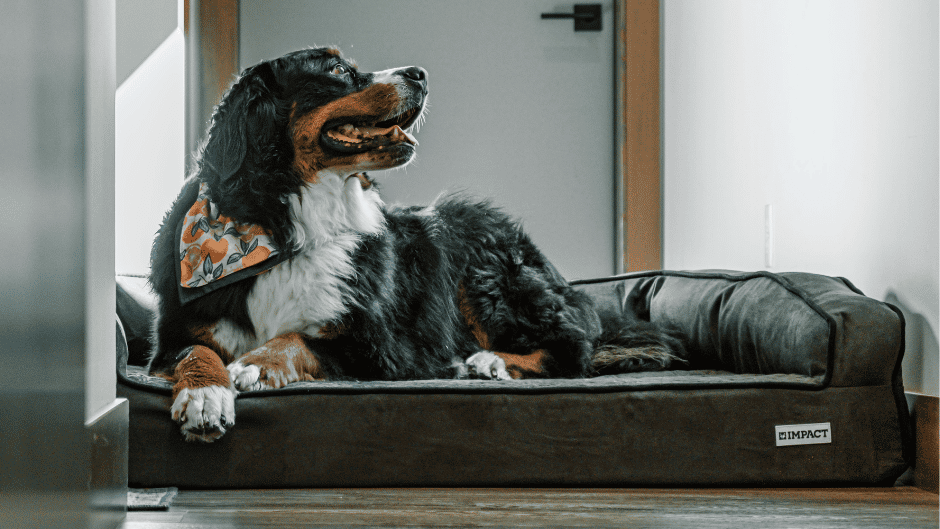
Orthopedic beds: if pain is any part of the picture, the bed matters more than most dog parents realize. A standard cushion compresses flat under a larger dog and offers almost no joint support by morning. Look for a solid memory foam base at least 3-4 inches thick, with a washable cover and raised bolster sides. Egg-crate foam is not the same as memory foam, and it breaks down fast.
What Happened With My Own Dog
My situation wasn’t dramatic. No bloat, no emergency, nothing that ended in a vet visit at midnight. Just a middle-aged dog who started getting up and walking around at 2am three nights in a row and I had absolutely no idea why.
Turned out we’d rearranged the furniture. That’s it. The corner she’d always slept in felt different now. Different air movement, sounds bouncing differently off the walls, and a chair sitting exactly in the spot where she used to circle before lying down. She couldn’t explain any of that. She just paced until I figured it out.
Moved her bed back to a familiar corner, kept everything else consistent, and it stopped within two nights.
Small thing. But it’s a reminder that dogs are tracking environmental details constantly that we never notice, and a disruption that looks invisible to us can feel genuinely unsettling to them. They’re not being dramatic. They’re communicating.
What I Want You to Take Away
Something changed. That’s the through-line here regardless of which cause fits your situation. It might be inside your dog’s body, or their environment, or their brain. But nighttime pacing out of nowhere is not a personality quirk and it’s not nothing.
Most of what’s on this list is either fixable at home or manageable with a vet visit. The emergency one is the only one where timing is genuinely the difference between okay and not okay. Know those signs, keep them separate from the rest, and trust yourself to act on them if you see them.
Your dog is trying to tell you something. You just needed someone to translate.
FAQ
-
How long should I wait before calling the vet about nighttime pacing?
Once or twice with an obvious trigger, watch it for a few days. Three consecutive nights with no clear cause, call this week. Emergency signs present, go tonight
-
Can a dog suddenly develop anxiety at any age?
Yes, absolutely. Years of being calm doesn’t make a dog immune. A life change, something scary, a medical issue, even just gradual hearing loss making the world feel less predictable can tip any dog into anxiety at any age
-
Is nighttime pacing always a sign something is wrong?
Not always. Puppies adjusting to a new home pace. Dogs who napped too much during the day pace. A one-off storm can cause a single restless night. What matters is whether it’s sudden, repeated, and not resolving on its own
-
My senior dog paces every single night but seems totally fine during the day. What’s going on?
That specific pattern, totally fine in daylight, confused and restless after dark, is one of the most recognizable signs of Canine Cognitive Dysfunction. It’s called the day-night flip and it happens because nighttime removes all the environmental cues your dog uses to orient themselves during the day. Could also be pain that’s managed by daytime movement and worse when lying still. You need a vet visit that includes both a cognitive assessment and a physical exam to know which one you’re actually dealing with
-
Can calming supplements actually help?
If anxiety is the root cause, yes, a good one with transparent ingredients can take enough edge off to let them settle. They’re not a solo fix though. Routine and exercise have to be part of it too. For pain or CCD, supplements alone won’t touch the underlying problem
-
Will my dog just grow out of this?
Puppy settling into a new home, yes, usually within 2-4 weeks. Adult dog with a specific addressable trigger, yes once you deal with the trigger. Senior dog with an underlying condition, no, but the pacing can be managed with the right protocol
This article is for informational purposes and is not a substitute for veterinary care. If you’re concerned about your dog’s health or notice sudden changes, please consult your veterinarian.

8 Comments