

 By
By If you just brought home an 8 week old puppy and need an actual 8 week puppy schedule, here’s the short version: feed 3-4 small meals a day, take them outside to potty every 2 hours during the day and once overnight, aim for 18-20 hours of sleep, and use the crate as the default rest spot from day one. This post gives you the full week-by-week breakdown of how that schedule actually evolves over the first two months, what it costs, when it gets easier, and what the common mistakes look like in real life.
Bringing home a puppy is one of those experiences that is genuinely wonderful and genuinely exhausting in equal measure, and nobody tells you that second part clearly enough. The schedule is not the hard part. The hard part is doing the schedule at 3am when you haven’t slept in five days and the puppy is crying. What helps with that is knowing what to expect, week by week, so nothing catches you completely off guard.
Table of Contents
Table of Contents
- Why an 8 Week Puppy Schedule Actually Works
- The Core Daily Loop (Weeks 1 and 2)
- Hour-by-Hour Sample Schedule (8 Weeks)
- Week-by-Week Schedule Evolution
- The Socialization Window: The Thing Most Dog Parents Don’t Prioritize Enough
- Crate Training Integrated Into the Schedule
- What It Actually Costs: First Month Breakdown
- The Working Dog Parent Schedule
- The Mistakes That Set House Training Back
- Age and Week Breakdown Table
- When Does It Actually Get Easier?
- The Schedule Is Not a Convenience
- What Happened With My Own Dog
- Frequently Asked Questions
Why an 8 Week Puppy Schedule Actually Works
A puppy at 8 weeks has almost no bladder control. Their bladder capacity is tiny, their brain is still developing impulse control, and the only real tool they have for learning where to go is repetition. Structure doesn’t make puppyhood rigid or joyless, it actually makes it more relaxed because both you and the puppy know what’s coming next.
The schedule is also your primary tool for preventing accidents rather than reacting to them. Every accident that happens in the house sets the house-training timeline back. Every successful trip outside in the right spot builds the habit. That math runs entirely on timing and consistency, which is exactly what a schedule provides.
The Core Daily Loop (Weeks 1 and 2)
This is the foundation. Everything in the week-by-week section below is a variation on this rhythm, with gradually longer windows as bladder control improves.
The daily loop at 8 weeks:
- Wake up, immediately outside to potty (carry them, don’t walk through the house)
- Back inside, feed first meal in the crate with the crate door open
- Potty breaks happen after every meal, nap, and play session. Outside to potty again within 10-15 minutes of eating
- Supervised play for 15-20 minutes maximum
- Back in the crate for a nap (1.5-2 hours)
- Repeat
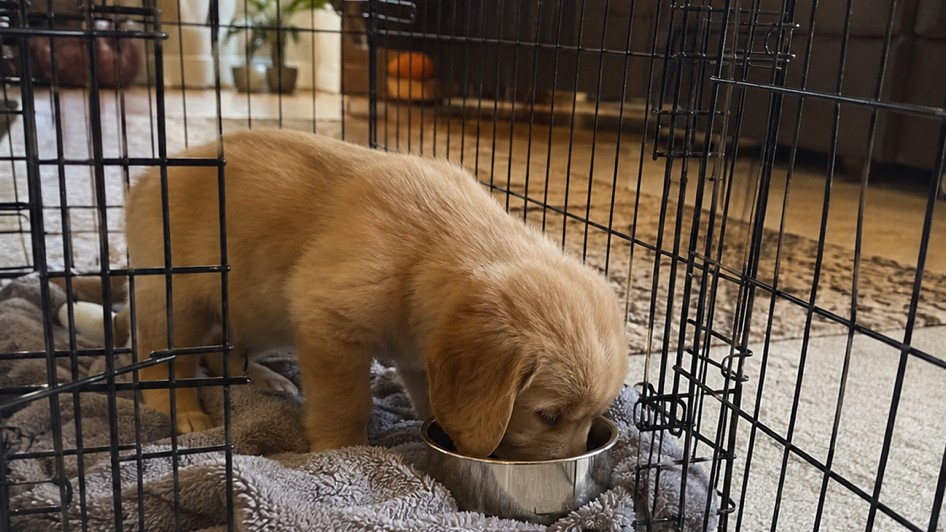
What “supervised” actually means: your eyes on the puppy, not your eyes on the TV while the puppy has the run of the living room. An 8 week puppy who goes unsupervised for more than a few minutes will have an accident, chew something, or get into something that needs managing. This isn’t a criticism, it’s just their developmental reality.
Hour-by-Hour Sample Schedule (8 Weeks)
This is for someone who is home during the day. Working dog parents get the modified version further down.
| Time | Activity |
|---|---|
| 6:00 AM | Wake up, carry outside immediately, potty |
| 6:15 AM | Breakfast in crate (door open), water |
| 6:30 AM | Outside to potty |
| 6:45-7:00 AM | Supervised play or handling practice |
| 7:00 AM | Back in crate, nap begins |
| 9:00 AM | Wake, carry outside immediately |
| 9:15 AM | Second meal, back in crate to eat |
| 9:30 AM | Outside to potty |
| 9:45-10:00 AM | Short training session (2-3 minutes max, name recognition, sit) |
| 10:00 AM | Back in crate, nap |
| 12:00 PM | Wake, outside immediately |
| 12:15 PM | Lunch (third meal if feeding 4x/day) |
| 12:30 PM | Outside to potty |
| 12:45 PM | Supervised play, socialization exposure |
| 1:15 PM | Back in crate, nap |
| 3:00 PM | Wake, outside immediately |
| 3:15 PM | Supervised free time, light training |
| 3:45 PM | Back in crate, nap |
| 5:30 PM | Wake, outside immediately |
| 5:45 PM | Dinner |
| 6:00 PM | Outside to potty |
| 6:15 PM | Family time, socialization, calm handling |
| 7:00 PM | Remove water for the night |
| 7:30 PM | Final potty break |
| 8:00 PM | Crate for the night |
| 11:00 PM | One overnight potty break (set an alarm, don’t wait for crying) |
| 3:00 AM | Second overnight potty break if needed |
Why you set the alarm instead of waiting for crying: once a puppy learns that crying brings you running, you’ve trained a behavior you’ll spend weeks untraining. Setting the alarm and taking them out before they cry keeps the overnight routine calm and quiet. And if you have an older dog in the house who’s also been restless at night lately, that’s a separate issue worth reading about separately. I cover the most common reasons in my post on why dogs pace at night suddenly.
Week-by-Week Schedule Evolution
Weeks 1-2 (Age 8-10 Weeks): Survive and Establish
This is the hardest stretch. You’re running on poor sleep, the puppy has no bladder control to speak of, and everything feels like an emergency. It isn’t, but it feels that way.
Potty breaks: every 2 hours during the day, plus 2 overnight trips for most puppies. Some puppies need one at midnight and one at 3am. Some need more. You’re in discovery mode.
Sleep: 18-20 hours per day is normal and necessary. An overtired 8 week puppy is bitey, frantic, and impossible to manage. If yours is doing the evening zoomies and biting everything in sight, the solution is almost always more sleep, not more exercise or stimulation.
Feeding: 3-4 small meals on a fixed daily schedule. Do not free-feed (leave food out all day). Fixed meals mean predictable potty timing. Predictable potty timing means fewer accidents.
Crate training at this stage: the crate should be associated with meals, rest, and calm. Feed every meal in the crate with the door open. Work up to closing the door briefly while they eat, then longer. Never use the crate as punishment. A puppy who actively goes into the crate is your goal, and it usually takes 7-14 days of consistent, positive association to get there.
When it gets easier: the two-overnight-potty-trips phase typically ends between 10-12 weeks for most puppies, though individual variation is real.
Weeks 3-4 (Age 10-12 Weeks): First Signs of Progress
This is when most dog parents take their first real breath since bringing the puppy home. Bladder control is still limited, but it’s slightly better. The puppy is starting to understand the routine. Potty accidents are still common but should be decreasing.
Potty breaks: extend to every 2.5-3 hours if your puppy is consistently making it. Don’t push this too fast, success rate should be above 80% before you extend the window.
Sleep: still 16-18 hours per day. Don’t cut nap time to get more playtime. Overtired puppies regress in training, their brains literally need the sleep to consolidate what they’re learning.
Crate training at this stage: most puppies are settling into the crate without major fuss by 10-12 weeks if the association-building was consistent in weeks 1-2. If there’s still crying every single time, revisit the basics: is the crate too big? Is there something comforting inside (worn t-shirt with your scent)? Is the crying actually lasting more than 2-3 minutes, or does it stop?
The socialization window is wide open right now, and this is important. More on that in its own section below.
Weeks 5-6 (Age 12-14 Weeks): Settling Into Routine
This is the phase where it starts to feel manageable rather than just survivable. Many puppies drop to one overnight potty trip, or start making it through the night entirely. Accident frequency in the house should be notably lower if the schedule has been consistent.
Potty breaks: every 3-4 hours for most puppies. Still potty immediately after waking, immediately after eating, and immediately after play, those triggers don’t change regardless of the extended windows.
Feeding: transition from 4 meals to 3 meals per day happens for many puppies between 12-16 weeks. Check with your vet at the 12 week vaccine visit, which is also a good time to confirm feeding amounts are appropriate for your puppy’s growth rate.
Training sessions: you can start extending to 5 minute sessions now, though shorter is still fine. Focus on name recognition, sit, come, and leash introduction. Keep it positive and stop before the puppy loses interest.
Crate: most puppies are reliably settling in the crate by this stage. Overnight stretches of 5-6 hours are common for puppies who started crate training at 8 weeks.
Weeks 7-8 (Age 14-16 Weeks): Building Toward Independence
You’re approaching the end of the critical socialization window, which means the last few weeks of it matter. Keep exposing your puppy to new experiences, people, sounds, and environments in a positive, low-pressure way.
Potty breaks: many puppies can go 4 hours between potty trips by 16 weeks, and some make it through the night without an overnight break. Don’t assume this without testing it, set the alarm one night earlier rather than later and confirm they’re actually dry when you go to them.
Feeding: 3 meals per day is standard at this age. Water should stay available throughout the day, though removing it 2 hours before bedtime helps with overnight dryness.
Sleep: dropping slightly to 14-16 hours per day for most puppies. Play sessions can be a bit longer, but the crate should still be the default rest spot.
Crate: a 14-16 week puppy who has been consistently crate trained since 8 weeks should be going in willingly, settling quickly, and sleeping through most of the night. If this isn’t happening, something in the foundation weeks went sideways and it’s worth troubleshooting rather than pushing through.
The Socialization Window: The Thing Most Dog Parents Don’t Prioritize Enough
Puppies go through what researchers call the critical socialization period from roughly 3 to 16 weeks of age. VCA Animal Hospitals describes this as “the sensitive period for socialization,” during which puppies between 3 and 16 weeks are ideal candidates for introducing new experiences, sounds, people, and environments. After about 14-16 weeks, the window narrows significantly. New experiences become progressively more alarming, and what was not introduced early is harder to normalize later.

By the time you bring your puppy home at 8 weeks, you’re already halfway through this window. That doesn’t mean panic, it means urgency.
What to expose your puppy to before 16 weeks:
- Different people: men with beards, children, people in hats, people in uniforms, older adults
- Different surfaces: grass, gravel, tile, hardwood, carpet, metal grates
- Different sounds: traffic, music, appliances, thunder recordings, kids playing
- Different environments: outside your house, a friend’s house, a pet-friendly store
- Other vaccinated, calm, friendly dogs (critical: must be fully vaccinated)
- Being handled: ears checked, paws touched, mouth opened, body examined
The vaccination conflict is real and worth addressing directly. Your vet may tell you not to take your puppy to public places until fully vaccinated at 16 weeks. The American Veterinary Society of Animal Behavior has a position statement recommending that puppy socialization begin before the vaccination series is complete because the behavioral risks of under-socialization outweigh the medical risks when done in safe, controlled environments. Carry your puppy in areas where unknown dog contact is possible. Choose puppy classes that require proof of vaccination for attending dogs. Prioritize controlled socialization over isolation.
A puppy who missed the socialization window doesn’t become untrainable. But fear-based behaviors that could have been prevented in 8 weeks of intentional exposure can take years to manage afterward.
Crate Training Integrated Into the Schedule
Crate training works when the crate is a room, not a jail. The difference is entirely in how you introduce it and what associations you build.
From week 1, use the crate for every meal, every scheduled nap, and overnight. Do not use it only when you need the puppy contained, that’s how crates become punishment and puppies develop aversion.
The first 5 days of crate introduction:
- Day 1: Put meals in the crate with the door open. Don’t close it. Just let them eat inside.
- Day 2-3: Close the door while they eat, open it before they’re done. The crate closes and opens while there’s still food = no panic.
- Day 4-5: Close the door, wait for them to finish, wait another minute, then open. Extend gradually.
- Day 6+: Start using the crate for naps with the door closed. If there’s crying, wait for a pause (even 2 seconds) before opening. Opening to crying teaches that crying opens the crate.
Sizing matters: a crate that’s too large lets a puppy use one end as a bathroom. Use a divider to make the sleeping space just large enough for them to stand, turn around, and lie down. My dog crate size chart shows which size to buy and when to move the divider, and my guide to how much puppies sleep breaks down nap time by age.
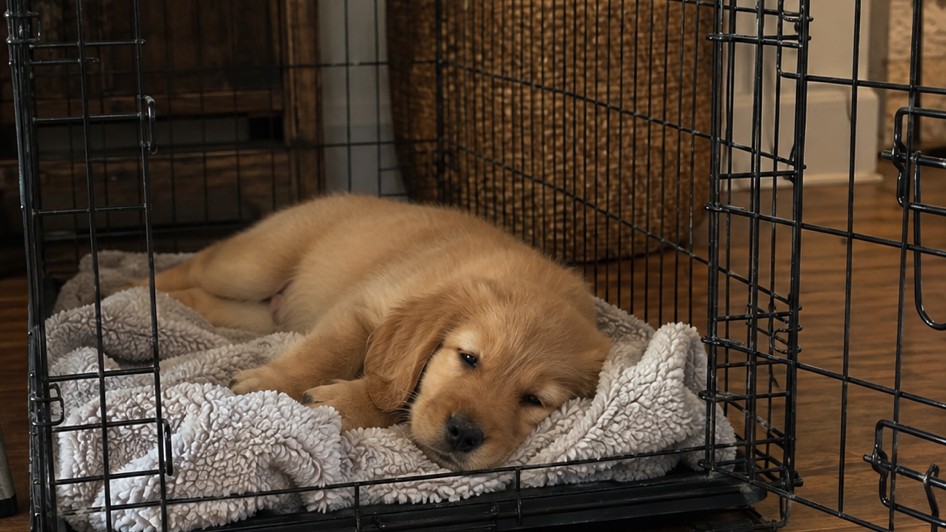
What crying in the crate actually means: in the first week, it almost always means “I’m not used to this yet.” In weeks 2-3, sustained crying (more than 5 minutes after you’ve confirmed they’re not wet and don’t need to potty) may mean the crate is aversive, the space is too large, or the foundation association-building was skipped.
What It Actually Costs: First Month Breakdown
This is missing from almost every puppy schedule article, which strikes me as a significant gap since the first month is when the surprise expenses hit hardest.
Before the puppy comes home (one-time setup costs):
- Crate (appropriately sized with divider): $40-$120
- Puppy food (high-quality, breed and size appropriate): $30-$80/month ongoing
- Food and water bowls: $15-$40
- Collar, ID tag, and leash: $25-$60
- Enzymatic cleaner for accidents: $15-$25 (buy this before the puppy arrives)
- Baby gates to block off sections of the house: $25-$60 per gate
- Basic toys and chews: $30-$60
First month vet costs:
- 8-10 week first exam and vaccines (DHPP first round): $75-$150
- 12 week booster and exam: $50-$100
- Flea, tick, and heartworm prevention: $20-$50/month
First month total (realistic estimate): $400-$700 depending on where you live and what you already have.
Ongoing monthly costs from month 2 onward: food ($30-$80), preventatives ($20-$50), puppy class ($100-$200 for a 6 week course), and miscellaneous ($20-$40 for chews, replacement toys). Budget $150-$350/month on the low end for a medium-sized puppy.
If you don’t have a system for tracking your puppy’s vaccination records and vet visits, the Dog Medical Vault (free download) is worth grabbing now. It’s a fillable PDF designed exactly for this, with space for vaccination dates, medication records, vet contact info, and health notes that you can carry to every appointment. New puppy parents who’ve used it say the biggest benefit is not scrambling to remember what vaccines were given when at the 12 week visit. You can get it at ThePawCompass.com, and it’s free.
The Working Dog Parent Schedule
If you work outside the home and can’t be there for every 2 hour potty break, here’s how to adapt the 8 week puppy schedule to a working household, in order of what actually works.
Option 1: A dog walker or pet sitter for the first 4-8 weeks. This is the most effective solution. Budget $15-$30 per midday visit.
Option 2: A puppy pen instead of a strict crate schedule. For puppies who must be alone for more than 2-3 hours, a puppy pen with a safe potty area (pee pad) inside gives them more space and a legal bathroom spot. This extends house training slightly because the puppy learns they can go inside, but it’s more humane than asking a puppy to hold it beyond their capacity.
Option 3: Work-from-home accommodations. If remote work is possible, the first 4 weeks at home makes an enormous difference to house training success rate and crate comfort.
What doesn’t work: crating an 8 week puppy for 8 hours while you’re at work. It’s not safe physically or developmentally. If this is unavoidable, the puppy pen with pee pad access is the necessary fallback.
The Mistakes That Set House Training Back
Waiting for the puppy to tell you they need to go. At 8 weeks, by the time you notice the sniff-and-circle, it’s already too late. Take them out on the schedule, not on demand.
Free-feeding. Leaving food out all day means you have no control over potty timing. Regular meals = predictable bathroom schedule. This is not optional if you want house training to progress at a reasonable pace.
Punishing accidents in the house. If you didn’t catch them in the act, the moment has passed. Rubbing a puppy’s nose in an accident teaches nothing except that you’re frightening when you’re angry. Clean it up with enzymatic cleaner, take them outside, and add a potty trip to your schedule.
Making the crate only about isolation. If the crate only appears when you’re leaving or you need the puppy out of the way, they’ll dread it. Every meal in the crate, every nap in the crate, changes the association entirely.
Skipping socialization because they aren’t fully vaccinated. The behavioral cost of isolation during the critical window is real and documented. Controlled, careful socialization during this period is not optional for a well-adjusted adult dog.
Skipping naps to get more time with the puppy. An overtired puppy is not a well-behaved puppy. More sleep, not more stimulation, is almost always the answer when behavior falls apart.
Letting the puppy roam the house unsupervised. Until a puppy is reliably house trained (which takes most puppies 4-6 months, not 4-6 weeks), they need either supervision or crate time. There is no safe middle ground.
Age and Week Breakdown Table
| Age | Potty Frequency | Meals/Day | Max Awake Time | Overnight Breaks |
|---|---|---|---|---|
| 8-10 weeks | Every 2 hours | 3-4 | 30-45 minutes | 1-2 trips |
| 10-12 weeks | Every 2.5-3 hours | 3-4 | 45-60 minutes | 1 trip |
| 12-14 weeks | Every 3 hours | 3 | 60-90 minutes | 0-1 trips |
| 14-16 weeks | Every 3-4 hours | 3 | 90-120 minutes | Usually none |
When Does It Actually Get Easier?
This is the question every dog parent is really asking, and the honest answer is: in stages.
Week 3-4 (age 10-12 weeks): the first noticeable improvement. Overnight trips drop from two to one. The puppy starts to understand the routine enough that there are stretches of a few hours where everything goes right. You stop feeling like you’re constantly in crisis management mode.
Week 5-6 (age 12-14 weeks): sleeping through the night starts to happen for most puppies. Accidents in the house become the exception rather than the rule. The puppy settles in the crate without a fight most of the time.
Week 7-8 (age 14-16 weeks): daytime management becomes genuinely manageable. The puppy has a personality you can actually enjoy, not just survive. Training starts feeling like fun rather than an obligation.
Month 3-4 (age 12-16 weeks from arrival): most dog parents report that this is when they feel like they have a dog rather than a full-time unpaid job. House training isn’t complete, accidents still happen occasionally, but the constant vigilance of the first two months has softened into normal pet ownership.
House training is typically considered reliable at around 4-6 months, when the puppy has enough bladder control and enough repetitions of the correct behavior to default to asking to go outside rather than just going wherever they happen to be.
The Schedule Is Not a Convenience
I’ll be honest: I didn’t follow a written schedule with my first dog. I was winging it, reacting to accidents, and wondering why house training seemed to take forever. The difference a schedule makes is not subtle. Not because structure is some magical force, but because at 8 weeks a puppy’s brain is essentially a pattern-recognition machine, and the patterns you build in those first weeks become the default behavior for the next decade or longer.
The dog parents I see struggling most are the ones who are trying to fit the puppy into their existing routine rather than temporarily restructuring their life around the puppy’s biological needs. Six weeks of genuine commitment to the schedule almost always produces a house-trained, crate-settled, socially confident puppy. Six weeks of inconsistency almost always produces a house training process that drags on for months longer than it needs to.
The schedule is not a convenience. It’s the investment that makes the next 14 years easier.
What Happened With My Own Dog
My most humbling puppy parenting moment happened in week two. I was so relieved that my dog hadn’t had an accident in two whole days that I gave her free run of the living room while I made dinner. I was literally in the next room. She had an accident behind the couch in the time it took me to chop an onion.
I’d gotten overconfident exactly one week too early. Two dry days at 8 weeks doesn’t mean house training is done, it means the schedule is working and you need to keep going. That lesson cost me about 20 minutes of cleaning and one bruised ego, which is honestly a cheap price for learning it.
The schedule doesn’t feel natural at first. Nothing about setting an alarm for 3am feels natural. But by week four, we were doing it automatically, and by week eight, the overnight alarm was gone because she’d made it through on her own.
Frequently Asked Questions
-
How long can an 8 week-old puppy hold their bladder?
Roughly 2 hours during the day, and 4-5 hours maximum overnight when they are in a deep sleep. The old months-of-age-plus-one rule is a rough approximation, but 2 hours is the working number for daytime schedule purposes at 8 weeks.
-
Should I wake my puppy up to take them outside?
No. If they are asleep, let them sleep. Bladder control is better during sleep than when they are awake and active. Set your alarm for the intervals in the schedule and check on them, but do not wake a sleeping puppy to take them out.
-
My puppy cries all night in the crate. What do I do?
First, confirm they do not need to go outside. If they have gone recently and are dry, the crying is almost certainly adjustment, not emergency. Put the crate next to your bed so they can hear and smell you. A ticking clock or quiet white noise helps some puppies. Avoid going to them while they are crying, wait for a pause, even 5 seconds, and then check on them. Crying that does not reduce at all after 3-4 nights of consistent crate introduction means revisiting your foundation approach.
-
When should I start puppy classes?
Most veterinary and behavior organizations recommend starting puppy classes as early as 7-8 weeks, even before the full vaccination series is complete, as long as the class requires proof of age-appropriate vaccination for attending dogs. Early classes are primarily about socialization and basic foundation behaviors, not formal training. In the weeks before a class actually starts, or if group classes are not accessible where you live, structured at-home training exercises are a genuinely useful bridge. Brain Training for Dogs is one option worth a look if you want a structured, video-based program to work through at home alongside whatever socialization opportunities you can find.
-
How do I know if my puppy is getting enough sleep?
If your puppy is calm between activities, settles without excessive fuss, and does not have constant manic energy throughout the day, they are probably getting enough. An overtired puppy looks hyperactive, not tired. The biting gets worse, the zooming gets wilder, and nothing you do seems to calm them down. That is almost always a sleep deficit.
-
What if I work full time? Is a puppy realistic?
Yes, but with modifications. A dog walker or pet sitter for midday visits is not optional for an 8 week puppy who will be alone for more than 3 hours. A puppy pen with a designated indoor potty area is the fallback for longer stretches. Plan for 4-6 weeks of modified work arrangements before house training is stable enough to increase their alone time.
-
My puppy is limping or seems reluctant to use one leg. Is that normal?
Occasionally. Brief limping after play in a large-breed puppy can be growing pains (panosteitis). But limping that persists, or reluctance to bear weight on a leg, deserves a vet check rather than a wait-and-see approach. I cover the quieter signs of pain in puppies and dogs in my post on signs your dog is in pain but not limping if you want to know what to look for beyond the obvious limp.
The schedule is not the whole story. It’s the container that everything else happens inside. The relationship you build with your puppy, the confidence they develop, the habits that will define how they interact with the world for the next 12-15 years, all of it grows from the repetition and security of those early weeks.
It’s exhausting. It’s also one of the most formative things you’ll do as a dog parent. Trust the schedule, stay consistent longer than you think you need to, and let the routine do the heavy lifting.
Eight weeks from now, you’ll have a puppy who knows what to expect, trusts you to provide it, and is well on their way to becoming the dog you were picturing when you decided to bring one home.
This article is for informational purposes and is not a substitute for veterinary advice. Consult your veterinarian for guidance specific to your puppy’s breed, size, and health status. This post also contains an affiliate link. If you buy something through it, I may earn a small commission at no extra cost to you, and I only recommend products I would genuinely suggest to a friend.

5 Comments