

 By
To train a dog to stay, teach a release word, then ask for a sit or down, say “stay” with a flat hand signal and reward after a second or two while your dog is still in position. Build time, then distractions, then distance, one at a time, and always walk back to your dog before you release them.
The AKC calls these the three Ds: duration, distance and distraction, and says to build a stay of at least 30 seconds before adding the other two. Below are the 7 steps, a stage by stage plan, what to do when your dog breaks the stay and the mistakes that slow progress, based on guidance from the AKC, Best Friends Animal Society, PetMD and Battersea.
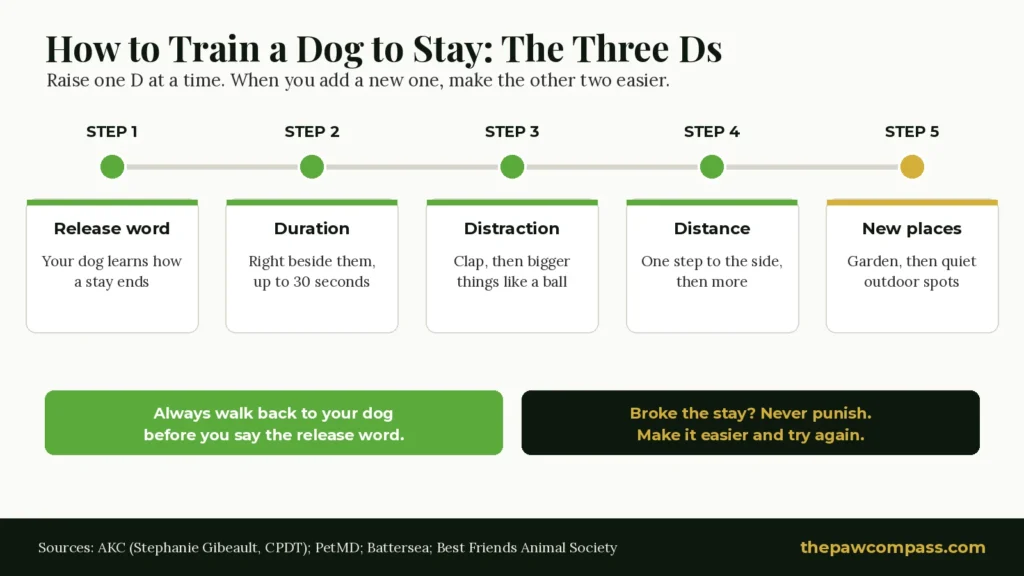
Table of Contents
- Before You Start
- How to Train a Dog to Stay: 7 Steps
- Stay Training Plan: The Three Ds
- What to Do When Your Dog Breaks the Stay
- 7 Stay Training Mistakes
- Stay vs Wait: What’s the Difference?
- Why a Good Stay Matters
- Puppies, Adult Dogs and Rescue Dogs
- How to Train a Dog to Stay: FAQ
- How to Train a Dog to Stay: The Short Version
Before You Start
Your dog needs a sit or down first. Best Friends suggests teaching down first if your dog doesn’t know it yet, since lying down is more comfortable for practicing a stay. Battersea notes that lying down can make some dogs feel vulnerable, so a sit stay or stand stay may suit them better. If sit is still new, here’s how to teach a puppy to sit.
Choose a release word. This word tells your dog the stay is over. The AKC lists “okay”, “free” and “release” as common choices, but warns that “okay” comes up so often in everyday speech that your dog may be released by accident.
Gather your gear:
- Small treats your dog loves, or a favorite toy. Best Friends Animal Society suggests pea sized treats.
- A quiet room with few distractions.
- A mat or bed, if you have one. Best Friends says a mat helps your dog learn that this spot is where they stay.
How to Train a Dog to Stay: 7 Steps
Step 1: Teach the Release Word
Ask for a sit or down, wait one second, give a treat, then say your release word and encourage your dog to get up. Praise them when they move. Repeat until your dog gets up as soon as they hear the word. This is how the AKC starts, because a stay only makes sense once your dog knows how it ends.
Step 2: Add the Stay Cue and Hand Signal
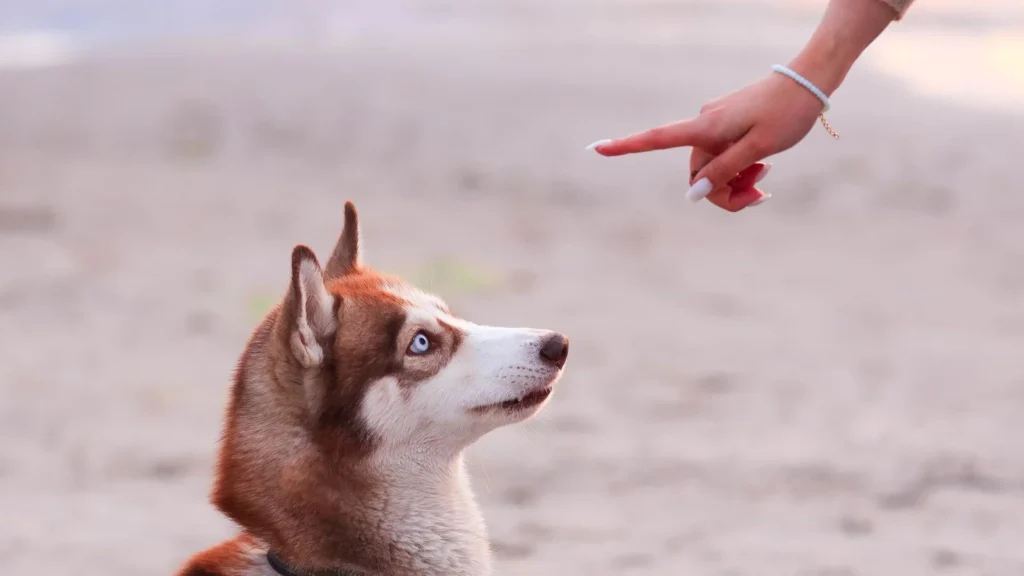
Ask for the position, hold your hand out flat like a stop sign and say “stay” once. Wait a second or two, give a treat while your dog is still in position, then release. Battersea also says to give the cue once rather than repeating it.
Step 3: Build Duration a Few Seconds at a Time
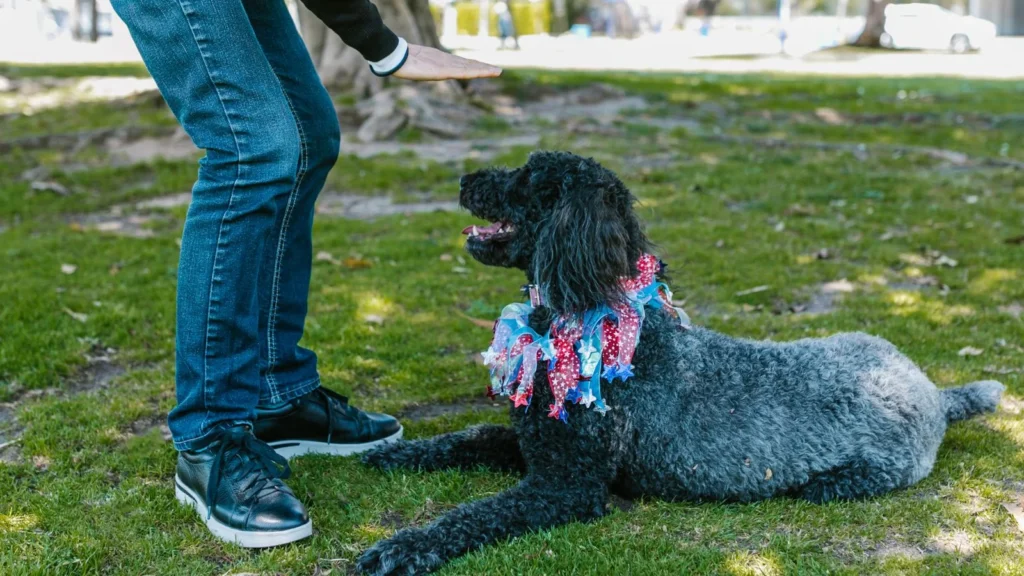
Add a few seconds at a time while you stand right next to your dog. Once the stay reaches 10 seconds or more, the AKC suggests giving several treats during the stay. Reward the stay itself, not the release, so getting up doesn’t become the best part. Aim for at least 30 seconds before you move on.
Step 4: Add Small Distractions
With you still close, add distractions one at a time. The AKC suggests starting small, like clapping your hands, and building up to bigger ones such as throwing a ball. PetMD suggests everyday actions, such as glancing at your mail or opening the front door. Each time you add a new distraction, shorten the stay again.
Step 5: Add Distance One Step at a Time
Take one small step, come straight back, reward and release. PetMD suggests stepping to the side rather than backward in early sessions, since stepping backward can draw your dog after you, then working up to stepping back and walking away. Battersea builds from one foot back, to one step, to two steps. The AKC suggests working up until you can reach the edge of the room.
Step 6: Always Walk Back Before You Release
Return to your dog, reward, then say your release word. The AKC explains that you can’t reward your dog from far away, and your dog may learn that a certain distance means the stay is over. Battersea adds that reaching out or leaning forward can break the stay, so walk all the way back.
Step 7: Practice in New Places
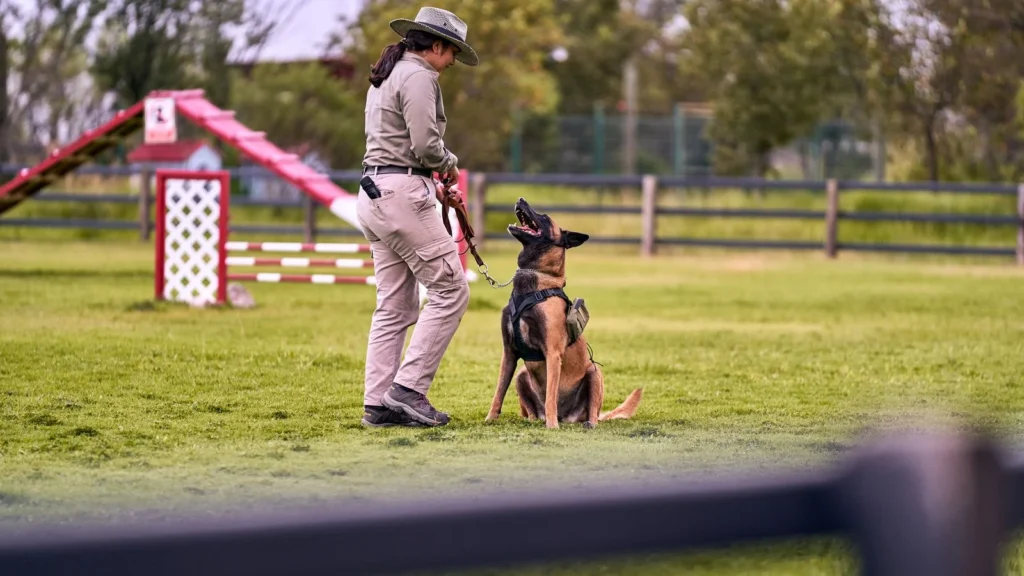
A stay learned in the living room won’t automatically work in the yard. Battersea suggests moving from rooms to the garden to quiet outdoor spaces, and going back a step whenever you need to. Only combine all three Ds, such as stepping out of the room, once your dog can handle each on its own, as the AKC advises.
Stay Training Plan: The Three Ds
| Stage | What you add | Start with | Move on when |
|---|---|---|---|
| Release word | Getting up on cue | A sit or down for 1 second | Your dog gets up as soon as they hear the word |
| Duration | Time | 1 to 2 seconds, right beside your dog | Your dog holds about 30 seconds |
| Distraction | Things happening around them | Clapping your hands | Your dog holds through bigger ones, like a thrown ball |
| Distance | Space between you | One small step to the side | You can reach the edge of the room |
| New places | All three Ds together | The garden, then quiet outdoor spots | The stay is solid in each place |
What to Do When Your Dog Breaks the Stay
Every dog breaks a stay while learning. Battersea says it’s not a failure. Here’s what helps:
- Don’t punish. The AKC says to simply repeat your cues and start over.
- Don’t reward a dog who got up. Best Friends says to ask for the position again and repeat, then treat.
- Make it easier. Go back to a shorter stay, a smaller step or a calmer room, and move on only when your dog succeeds again.
- Watch for restlessness. PetMD says restlessness often shows in the back legs. If you see it, do a few easy repetitions and end the session.
7 Stay Training Mistakes
- Asking for too much, too soon. Raise one D at a time, and lower the other two when you do (AKC, PetMD).
- Stepping backward early on. PetMD says it can draw your dog toward you. Step to the side first.
- Releasing from a distance. Walk back to your dog every time (AKC, Battersea).
- Using “okay” as the release word. It comes up so often in conversation that your dog may be released by accident (AKC).
- Making the release more rewarding than the stay. Give the treats during the stay (AKC).
- Staring at your dog. PetMD suggests avoiding it, so your dog learns to stay calm when you aren’t the focus.
- Long sessions. Best Friends says to keep lessons short, frequent and fun.
Stay vs Wait: What’s the Difference?
The AKC describes “stay” as holding a specific position until you release your dog, while “wait” is a shorter pause before your dog continues. So wait suits a quick pause at a door, and stay suits holding still for longer. Whatever words you choose, use each one the same way every time.
Why a Good Stay Matters
Best Friends calls a reliable stay potentially lifesaving, because it can stop a dog from dashing out of a door, car or gate into danger. Battersea adds that a stay should always be supervised: don’t use it to leave your dog alone in a public place or anywhere unsafe.

A stay pairs well with a reliable recall, so once your dog holds still, you can call them to you on cue. Here’s how to train a dog to come.
Puppies, Adult Dogs and Rescue Dogs
The AKC includes stay among the basic cues for puppies, taught with the same release word first approach. Keep puppy sessions short, as Best Friends advises, and fit them into a daily 8 week puppy schedule. Once your puppy can hold a short stay at home, you can practice it on puppy socialization outings too.
Adult and rescue dogs learn a stay the same way. Start at step 1 in a quiet room, even if your dog seems to know the word already. Our rescue dog nighttime routine covers the first days with a newly adopted dog.
Best Friends suggests short, frequent lessons, and a routine on the fridge makes it easier to fit a few into each day. The Print & Go Pack includes a Fridge Schedule:
How to Train a Dog to Stay: FAQ
-
How do you train a dog to stay?
Teach a release word first. Then ask for a sit or down, say stay once with a flat hand signal, and reward after a second or two while your dog is still in position. Build duration, then distractions, then distance, and always walk back to your dog before you release them.
-
What is a good release word for a dog?
Any word you’ll use the same way every time, such as free or release. The AKC warns that okay comes up so often in everyday speech that your dog may be released by accident.
-
How long should a dog be able to stay?
The AKC suggests building a stay of at least 30 seconds with you close by before adding distractions and distance. Longer stays come later, once each of the three Ds is solid on its own.
-
Why does a dog keep breaking the stay?
Usually the step was too big: too long, too far or too distracting all at once. Don’t punish. Go back to an easier version, reward success and raise one thing at a time, as the AKC and Battersea advise.
-
Should a dog stay in a sit or a down?
Either works. Best Friends says a down is more comfortable for practicing a stay, while Battersea notes that lying down can make some dogs feel vulnerable, so a sit or stand stay may suit them better.
-
What is the difference between stay and wait?
The AKC describes stay as holding a position until you release your dog, and wait as a shorter pause before your dog continues. Use each word the same way every time.
-
How long does it take to teach a dog to stay?
PetMD says most dogs master the first steps within a session or two, and Battersea says most dogs learn it over a few short sessions. A stay that holds in new places and around distractions takes longer, so keep practicing.
How to Train a Dog to Stay: The Short Version
- Start with the release word, and skip okay.
- Say stay once, with a flat hand signal, and reward while your dog is still.
- Build to about 30 seconds before adding distractions or distance.
- Raise one D at a time and make the other two easier.
- Step to the side, then back, and always walk back before you release.
- Never punish a broken stay. Make it easier and try again.
Over to you: what’s the hardest place for your dog to hold a stay? Tell us in the comments.
