


 By
Signs of chocolate poisoning in dogs usually start 6 to 12 hours after eating it, with vomiting, diarrhea, extra thirst, panting and restlessness, and can progress to a racing heart, tremors and seizures. If your dog ate chocolate, call your vet, ASPCA Animal Poison Control at (888) 426-4435 or Pet Poison Helpline at 855-764-7661 (a fee may apply) right away, even if your dog seems fine.
General guidance, not veterinary advice. Below: the 10 signs to watch for, what to do in the first few minutes, why a dog who seems fine can still be in trouble, which chocolate is most dangerous and how vets treat it, based on the Merck Veterinary Manual, the ASPCA and Pet Poison Helpline.
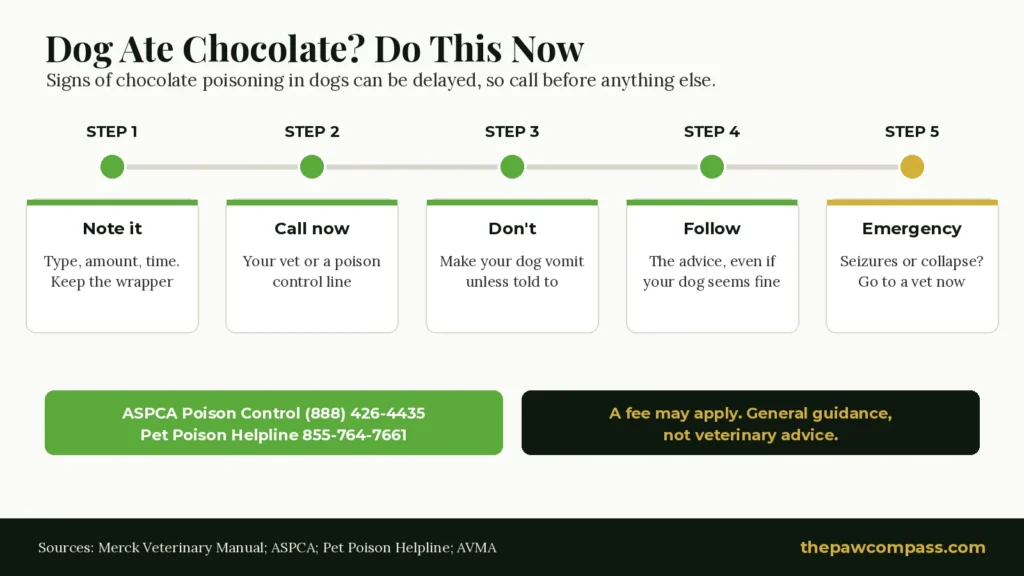
Table of Contents
- Dog Ate Chocolate? Do This Now
- 10 Signs of Chocolate Poisoning in Dogs
- Dog Ate Chocolate but Is Acting Fine?
- Why Chocolate Is Toxic to Dogs
- Which Chocolate Is Most Dangerous for Dogs?
- Other Hidden Dangers in Chocolate Treats
- How Vets Treat Chocolate Poisoning
- Chocolate at Christmas: Keep It Out of Reach
- Signs of Chocolate Poisoning in Dogs: FAQ
- Signs of Chocolate Poisoning in Dogs: The Short Version
Dog Ate Chocolate? Do This Now
The AVMA puts it simply: don’t wait, because time is critical for treating poisoning. Pet Poison Helpline suggests these steps:
- Note what your dog ate. The type of chocolate, how much is missing and roughly when it happened. Keep the wrapper, since the product name and ingredients help the expert judge the risk.
- Call now. Your vet, an emergency clinic, ASPCA Animal Poison Control at (888) 426-4435 (open 24/7) or Pet Poison Helpline at 855-764-7661. A fee may apply. The AVMA says to be ready with your dog’s breed, age, weight and any signs of illness.
- Don’t make your dog vomit at home. Pet Poison Helpline says not to try it without professional guidance. Don’t give any food, drink or medicine unless the vet or poison line tells you to.
- Follow the advice you get. It may be to go to a clinic straight away, or to watch at home. Let the professional decide.
Go straight to an emergency vet if your dog shows any severe sign: an abnormal heart rhythm, severe agitation, a high fever, a seizure or collapse. Pet Poison Helpline says to treat these as an emergency.
10 Signs of Chocolate Poisoning in Dogs
The Merck Veterinary Manual and the ASPCA list these signs. The early signs usually show up before the later ones, which appear as the poisoning gets worse:
- Vomiting
- Diarrhea
- Extra thirst
- Peeing more than usual
- Restlessness or hyperactivity
- Panting or fast breathing
- A fast heartbeat or an abnormal heart rhythm
- Muscle tremors or stiffness, or a wobbly walk
- Seizures
- High body temperature, weakness or collapse

| Stage | What you may see | Timing | What to do |
|---|---|---|---|
| Early | Vomiting, diarrhea, extra thirst, restlessness, a swollen belly | Usually 6 to 12 hours after eating | Call your vet or a poison line now |
| Getting worse | Hyperactivity, peeing more, a wobbly walk, stiffness, a fast heartbeat | As the poisoning progresses | Go to a vet |
| Severe | Tremors, seizures, an abnormal heart rhythm, high temperature, collapse | Signs can last up to 72 hours in severe cases | Emergency vet now |
Dog Ate Chocolate but Is Acting Fine?
That’s common, and it doesn’t mean your dog is safe. Pet Poison Helpline notes that symptoms often don’t appear right away, and Merck says signs usually start 6 to 12 hours after eating. Theobromine, the main toxin, also stays in a dog’s body a long time: Merck gives its half life in dogs as about 17.5 hours, meaning it takes that long for the body to clear half of it.
So call even if your dog looks normal. Pet Poison Helpline advises calling first rather than watching and waiting for symptoms, and says to call right away for puppies, senior dogs, pregnant dogs and dogs with health conditions, whatever the type or amount, because they’re more at risk.
Why Chocolate Is Toxic to Dogs
Chocolate contains theobromine and caffeine, two related compounds called methylxanthines. Merck notes that chocolate has 3 to 10 times more theobromine than caffeine. Dogs process these compounds slowly, which is why a treat that’s harmless to people can make a dog seriously ill.
The fat matters too. Merck says the high fat content of chocolate products may trigger pancreatitis in susceptible animals, which can cause belly pain and vomiting on its own. If your dog seems sore, here’s how to spot signs a dog is in pain.
Which Chocolate Is Most Dangerous for Dogs?
The ASPCA’s rule of thumb: the darker the chocolate (the higher the cacao percentage), the greater the risk. Baking chocolate and cocoa powder are the most concentrated, and white chocolate has the least. Merck’s figures for the combined methylxanthines show how big the gap is:
| Chocolate type | Methylxanthines (mg per gram) | Risk |
|---|---|---|
| Cocoa powder | About 28.5 | Highest |
| Unsweetened baking chocolate | About 15.5 | Very high |
| Semisweet and dark chocolate | About 5.3 to 5.6 | High |
| Milk chocolate | About 2.3 | Moderate |
| White chocolate | Negligible | Low for the toxin, but still fatty and sugary |

How much is too much depends on the type, the amount and your dog’s weight. Merck says mild signs can start at around 20 mg of these compounds per kilogram of body weight, heart effects at 40 to 50 mg/kg, and seizures at 60 mg/kg or more. Don’t try to do the math in an emergency: tell the vet or poison line what your dog ate and let them work it out. For the numbers by dog size, see how much chocolate can kill a dog.

Other Hidden Dangers in Chocolate Treats
- Wrappers and foil. Pet Poison Helpline warns that foil and cellophane wrappers can cause a bowel obstruction, especially in small dogs. Watch for vomiting, a poor appetite, straining or lethargy.
- Raisins. Chocolate covered raisins are a double risk. Pet Poison Helpline says raisins can cause acute kidney failure even in small amounts, and any raisin ingestion should be treated as an emergency. Here are the signs of kidney failure in dogs.
- Fat and sugar. Rich chocolate desserts can also bring on pancreatitis, as Merck notes.
How Vets Treat Chocolate Poisoning
Treatment depends on how much your dog ate, what type and how long ago. Based on the Merck Veterinary Manual, your vet may:
- Make your dog vomit with medication, if the chocolate was eaten recently (about 2 hours or less) and your dog has no signs yet
- Give activated charcoal in some cases, used with care
- Give IV fluids to support the heart and help flush the toxins out
- Give medicines to control vomiting, tremors, seizures or heart rhythm problems
- Monitor the heart with an ECG and keep an eye on body temperature and blood electrolytes
Merck notes that early treatment to remove the chocolate can reduce how severe the effects are. That’s one more reason to call as soon as you know.

The good news: Pet Poison Helpline says chocolate is rarely fatal, though it can cause serious illness. Fast action gives your dog the best chance.
Chocolate at Christmas: Keep It Out of Reach
The holidays bring chocolate into every room: advent calendars, stockings, gift boxes under the tree and trays of baking. A few habits help:
- Keep chocolate gifts off the floor and away from the tree until they’re opened.
- Ask guests to keep candy in closed bags or up high.
- Store cocoa powder and baking chocolate in a closed cupboard.
- Put the poison control numbers on the fridge before the holidays start.
Our guide to Christmas dangers for dogs covers the other holiday foods, plants and decorations to watch, and if a new puppy is joining you this year, here’s our guide to bringing a puppy home at Christmas.

Keep the poison control numbers where everyone in the house can find them, on a sheet made for the fridge:
Signs of Chocolate Poisoning in Dogs: FAQ
-
What are the signs of chocolate poisoning in dogs?
Early signs include vomiting, diarrhea, extra thirst, restlessness and panting. As it gets worse, signs can include peeing more, a fast heartbeat, an abnormal heart rhythm, tremors, seizures, a high temperature and collapse (Merck Veterinary Manual, ASPCA). General guidance, not veterinary advice.
-
How long after eating chocolate will a dog show signs?
The Merck Veterinary Manual says signs usually start within 6 to 12 hours, and in severe cases they can last up to 72 hours. Don’t wait for signs: call your vet or a poison line as soon as you know your dog ate chocolate.
-
What if a dog ate chocolate but is acting fine?
Call anyway. Pet Poison Helpline notes that symptoms often don’t appear right away, and theobromine stays in a dog’s body a long time. Call your vet, ASPCA Animal Poison Control at (888) 426-4435 or Pet Poison Helpline at 855-764-7661 (a fee may apply).
-
What should you do if your dog eats chocolate?
Note the type, the amount and the time, keep the wrapper, and call your vet or a poison line right away. Don’t try to make your dog vomit at home unless a vet or poison expert tells you to, and follow the advice you get.
-
Should you make a dog throw up after eating chocolate?
Not on your own. Pet Poison Helpline says not to induce vomiting without professional guidance. Your vet may make your dog vomit with medication if it’s appropriate, usually when the chocolate was eaten recently.
-
Which chocolate is most dangerous for dogs?
Cocoa powder and unsweetened baking chocolate are the most dangerous, then dark and semisweet chocolate, then milk chocolate. White chocolate has very little of the toxins (Merck Veterinary Manual, ASPCA).
-
Can a dog recover from chocolate poisoning?
Yes, most do with prompt care. Pet Poison Helpline says chocolate is rarely fatal but can cause serious illness, and Merck notes that early treatment can reduce how severe the effects are.
Signs of Chocolate Poisoning in Dogs: The Short Version
- Signs usually start 6 to 12 hours after eating: vomiting, diarrhea, thirst, panting, restlessness.
- Call your vet or a poison line right away, even if your dog seems fine.
- ASPCA (888) 426-4435 or Pet Poison Helpline 855-764-7661. A fee may apply.
- Don’t make your dog vomit at home unless you’re told to.
- Darker chocolate, baking chocolate and cocoa powder are the most dangerous.
- Seizures, collapse or an irregular heartbeat mean an emergency vet now.
General guidance, not veterinary advice. Over to you: where does chocolate hide in your house over the holidays? Tell us in the comments.
