


 By
Thinking about a dog crate with divider for your new puppy? Good call. It’s a full size crate with a removable panel inside. You buy the crate your dog will need as an adult, then use the panel to wall off the extra space, so your puppy only gets room to sit, stand, turn around and lie down. As your puppy grows, you slide the panel back. One day you take it out for good. One crate, zero upgrades, and a lot fewer accidents along the way.
Table of Contents
- Why a Big Crate Without a Divider Backfires
- Which Crates Come With a Divider?
- What to Look For in a Dog Crate With a Divider
- How to Set Up a Crate Divider in 5 Steps
- When to Move the Crate Divider
- Crate Divider Problems and Fixes
- When to Take the Divider Out
- No Divider in the Box? Your Options
- Can You Use a Crate Divider for Two Dogs?
- Crate Divider FAQ
- Dog Crate With Divider: The Short Version
Why a Big Crate Without a Divider Backfires
Picture this. You did the smart thing and bought the 42 inch crate your Lab puppy will need in a year. Night one, your 9 week old curls up by the door like a tiny angel. At 2 am the angel gets up, trots to the far end of all that lovely space, and leaves you a present. Then goes back to bed. On the clean side.
That isn’t a training failure. It’s instinct doing exactly what it’s built to do. MidWest’s crate training guide explains that puppies tend to sleep in one end of the crate and go to the bathroom in the other, because their instinct is to keep their bed clean, not the whole crate. Give a puppy a spare corner and they’ll find a use for it.
A divider takes the spare corner away. With just enough room to rest, your puppy has nowhere comfortable to go, so they stand up and let you know instead. If crate poops are already part of your life, my guide to how often puppies poop covers the timing side of the problem.
Which Crates Come With a Divider?
Not every crate does, and the listing wording matters. Here’s how the main types stack up:
| Crate type | Divider? | Good to know |
|---|---|---|
| Wire | Often in the box | Folds flat, easy airflow, puppy can see out |
| Plastic | Check the listing | Solid walls feel like a den |
| Fabric or mesh | Skip for puppies | Not durable enough for chewers |
| Furniture style | Some have one | Make sure the panel locks in place |
The Cornell University College of Veterinary Medicine notes that wire crates often come with dividers so young dogs can grow into the size they’ll need as adults. It also says fabric or mesh crates are better suited to travel or short term use for small breeds, and that puppies and chewers can destroy them. If a listing says “divider compatible” instead of “includes divider”, expect to buy the panel separately.

What to Look For in a Dog Crate With a Divider
- Sized for the adult dog. Cornell’s vets say to buy the crate your puppy will need as a grown dog. My dog crate size chart has all 8 sizes and sizes by breed.
- The divider is in the box. Look for “includes divider panel” in the listing, not “compatible with”.
- It hooks onto both side walls. A panel that hooks onto the sides stays put when a puppy leans on it. A loose panel becomes a toy.
- It runs the full height of the crate. A determined puppy will test the top.
- Two doors, if your space is tight. A side door makes it easier to fit the crate beside a bed or into a corner.
- A pan that pulls out. You’ll be cleaning it more than you’d like for the first few months.
The Crate With a Divider I Recommend
Heads up: ThePawCompass uses affiliate links. If you buy something through a link on this page, I may earn a small commission at no extra cost to you. I only recommend products I’d genuinely suggest to a friend.
The MidWest 42 inch Double Door iCrate is the one on our Shop page, and it ticks every box above for a dog crate with divider. The listing says it includes a divider panel that lets the crate grow with your dog, from puppy kennel to full size crate. MidWest’s product page says the divider hooks onto the side walls, and the listing describes a leak-proof tray and two doors. It measures 42 x 28 x 30 inches and is made for dogs of 71 to 90 lbs. If you’re torn between 36 and 42 inches for a Lab, the size chart tackles exactly that question. The iCrate also comes in sizes from 18 to 48 inches, so check the chart if your puppy is heading somewhere smaller or bigger.
One honest note: in the reviews, the latches get mixed feedback, and some buyers say the frame can bend. If your puppy is an escape artist, a couple of snap clips on the door latches add peace of mind. See the MidWest 42 inch iCrate on Amazon.
How to Set Up a Crate Divider in 5 Steps
The steps below follow MidWest’s iCrate instructions, plus the measuring rule from my crate size chart. Most wire crates with a hook-on dog crate divider work the same way.
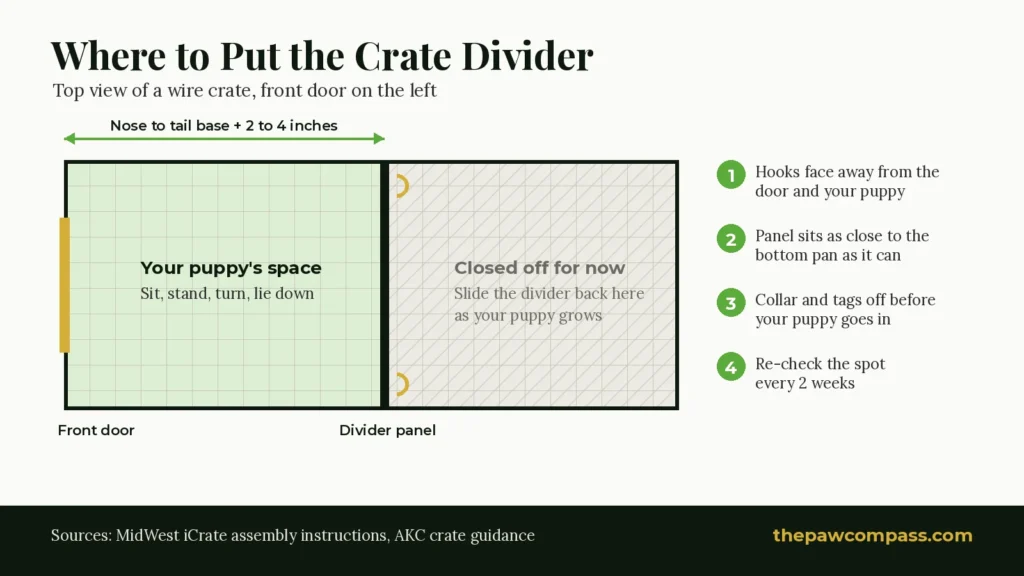
- Measure your puppy. With your puppy standing, measure from the tip of the nose to the base of the tail and add 2 to 4 inches. That’s the length of your puppy’s side of the crate.
- Take off the collar and tags. MidWest’s instructions say to remove collars, tags and leads before your dog goes in, to prevent them getting caught.
- Put the panel in with the hooks facing the back. The hooks should face away from the front door and away from your puppy’s side, so your puppy only meets the smooth side of the panel.
- Drop it low and hook both sides. Sit the panel as close to the bottom pan as it will go, then secure the hooks to each side of the crate.
- Do the comfort test. Your puppy should be able to sit, stand without ducking their head, turn around and lie down comfortably. If they can’t, slide the panel back a notch. If there’s a spare corner, bring it forward.
When to Move the Crate Divider
Puppies grow faster than you’d believe, and a divider set once and forgotten turns into a tight squeeze within weeks. Set a phone reminder to re-check the spot every 2 weeks. For how fast each breed size grows, my crate size chart has a divider timeline by age. Between check-ins, your puppy will tell you when the spot is wrong:
| What you see | What it means | What to do |
|---|---|---|
| A puddle or poop in the crate | Too much room | Move the divider forward a notch for a week |
| Always curled up tight | Too little room | Slide the divider back |
| Head brushes the roof | Crate is too short | A divider can’t fix height. Size up |
| 2 weeks since your last check | Growth you can’t see yet | Re-measure nose to tail base |
| Clean in the crate, near adult size | Ready for the full space | Open it up (see below) |
A divider also can’t fix a crate stretch that’s too long. A puppy who’s been in for longer than they can hold it will have an accident however well the panel is set. My guide to how long a puppy can hold its pee has the limits by age, and in short: about 1 to 2 hours at 8 to 10 weeks, and 3 to 4 hours at 3 to 4 months.
If accidents keep happening, write down when they happen for a few days. A pattern usually shows up fast, like always 3 hours after breakfast. If you use my First 30 Days Puppy OS Notion template, the potty log buttons record each one with a tap, and its weight log pairs nicely with your 2 week divider checks.
Crate Divider Problems and Fixes
| Problem | Likely cause | Fix |
|---|---|---|
| The divider shifts or falls | Hooks not on both sides, or panel sitting high | Re-hook both sides with the panel down by the pan |
| Puppy squeezes past the edge | Panel made for another size or brand | Use the panel made for your exact crate model |
| Accidents behind the bedding | Bedding hides the mess | Take the bedding out for a short time |
| Accidents on your puppy’s side | Too much room, or crated too long | Move the panel forward and shorten crate stretches |
| Chewing the bars or panel | Teething or boredom | Add a safe chew and keep sessions short |
| Crying, pacing, panting or drooling | Crate stress | Stop and go back to short, happy sessions |
Two of those deserve a closer look. The AKC notes that some dogs learn they can soil the crate and cover the mess with their bedding, which is why a short bedding break can help. And Cornell’s vets are clear that a dog who is barking excessively, pacing, panting or drooling should never be forced to stay crated alone. If that’s your puppy, the divider isn’t the problem. The crate needs to become a nicer place, a few minutes at a time, before the divider matters.

When to Take the Divider Out
MidWest’s advice is simple: once your puppy is big enough, and reliable enough about not going in the crate, you can remove the divider altogether. Both parts matter. A big puppy who still has accidents isn’t ready, and neither is a perfectly clean puppy who’s only half grown.
In practice, that lines up with the growth timeline in my crate size chart. Small breeds are close to adult size by about 9 months, so many are done with the divider somewhere between 6 and 12 months. Large breeds keep filling out until 12 to 18 months, and giant breeds can take up to 2 years.
Do it in steps rather than all at once. Slide the panel most of the way back for a week or two. If the crate stays clean, take it out. If an accident shows up, bring the panel forward again for a while. No drama, no starting over.
No Divider in the Box? Your Options
- Buy the maker’s panel. MidWest says replacement divider panels are sold separately for its crates. Get the one made for your crate’s exact model and size so the hooks fit properly.
- Use a smaller crate for now. It works, but you’ll buy a second crate later, which is exactly what a divider saves you.
- DIY, carefully. Skip anything a puppy can chew into pieces: cardboard, foam, cushions and plastic storage bins. Swallowed bits can cause an intestinal blockage, which is an emergency (my puppy poop guide covers the warning signs). If you DIY, it needs to be rigid, fill the full height and width, and stay fixed when leaned on. Check it every day.
Can You Use a Crate Divider for Two Dogs?
You can turn one long crate into two rooms, and some furniture crates are built that way. My take: it only works when each side passes the sit, stand, turn and lie down test for the dog in it, the panel locks in so neither dog can push it, and the dogs already get along. Check the size chart for each dog separately, not their combined weight.
For most homes, I’d go with two crates side by side instead. Each dog gets their own den, you can move one without moving the other, and nobody has to share a wall with a sibling who snores.

Crate Divider FAQ
-
Do I need a divider in my puppy’s crate?
If the crate is sized for your dog as an adult, yes, at least during potty training. MidWest explains that puppies tend to sleep at one end of a big crate and go to the bathroom at the other. A crate that already fits your puppy right now doesn’t need one.
-
How much room should a puppy have with the divider in?
Enough to sit, stand without ducking, turn around and lie down comfortably. For length, measure your puppy from nose to the base of the tail while standing and add 2 to 4 inches.
-
Which way do the crate divider hooks face?
Away from the front door and away from your puppy’s side of the crate, according to MidWest’s iCrate instructions. Sit the panel as close to the bottom pan as you can and hook it to both sides.
-
How often should I move the crate divider?
Re-check every 2 weeks. Slide it back when your puppy can’t lie stretched out comfortably, and bring it forward a notch for a week if accidents show up in the crate.
-
When can I remove the crate divider?
When your puppy is close to adult size and reliably clean in the crate. For small breeds that’s often somewhere between 6 and 12 months. Large breeds can take 12 to 18 months. Slide it most of the way back for a week or two, then remove it if the crate stays clean.
-
Do all wire crates come with a divider?
No. Cornell University’s College of Veterinary Medicine says wire crates often come with dividers, but not always. Check that the listing says the divider panel is included, not just compatible.
-
Can I buy a dog crate divider separately?
Yes. MidWest sells replacement divider panels for its crates. Buy the panel made for your crate’s exact model and size so the hooks fit and there are no gaps a puppy can squeeze through.
Dog Crate With Divider: The Short Version
A dog crate with divider is the one crate your puppy never outgrows. Buy it for the dog your puppy will become, and let the divider handle the in-between. Set it so your puppy can sit, stand, turn around and lie down, with the hooks facing the back and the panel down low. Re-check every 2 weeks, move it forward after accidents and back as they grow, and take it out once your dog is near adult size and clean in the crate.
Now tell me: how did your puppy greet the divider the first time? Polite sniff, full investigation, or an immediate attempt to dismantle it? Let me know in the comments.
