


 By
By Before you bring your new puppy home, you need these 27 essentials: a properly sized crate, puppy food matched to their breed and age, food and water bowls, collar and ID tag, leash, enzymatic cleaner, baby gates, and a scheduled vet appointment within the first week. The full list below breaks everything down by category, with cost ranges, what you actually need versus what looks good in a shopping cart, and the one record-keeping tool that will save you more than once in the first year.
This new puppy checklist covers the 27 things worth having ready before pickup day.
I have watched dog parents arrive home with a puppy and no enzymatic cleaner, no crate divider, and a bag of adult dog food from the gas station. It is a chaotic start to what should be a really good day. None of this is hard to get right. You just need the list before the puppy arrives, not after.
Table of Contents
Before We Start: The Rule That Saves Money
Every item on this list gets its own honest note. Some things are genuinely non-negotiable. Others are sold as essential but are actually nice-to-have. I will tell you which is which, because puppy supply shopping is one of the most effectively marketed experiences in retail and new dog parents are a reliable target.
The non-negotiables are the ones your puppy needs for safety, health, and house training from day one. Everything else can wait until you know your specific puppy’s preferences, which you will not know until they’re living with you.
The 27 Essentials, by Category
Safety and Containment
1. A crate (appropriately sized)
This is the single most important purchase on this list. The crate should be large enough for your puppy to stand, turn around, and lie down, and no larger. A crate that’s too large lets a puppy use one end as a bathroom, which defeats the purpose entirely.
Most puppies will grow, so buy the adult size with a divider panel that you move as they grow. Expect to spend $40-$120 depending on size and material.
2. A crate divider
If your crate doesn’t come with one, buy it separately. Non-negotiable if you’re buying an adult-sized crate for a small puppy.
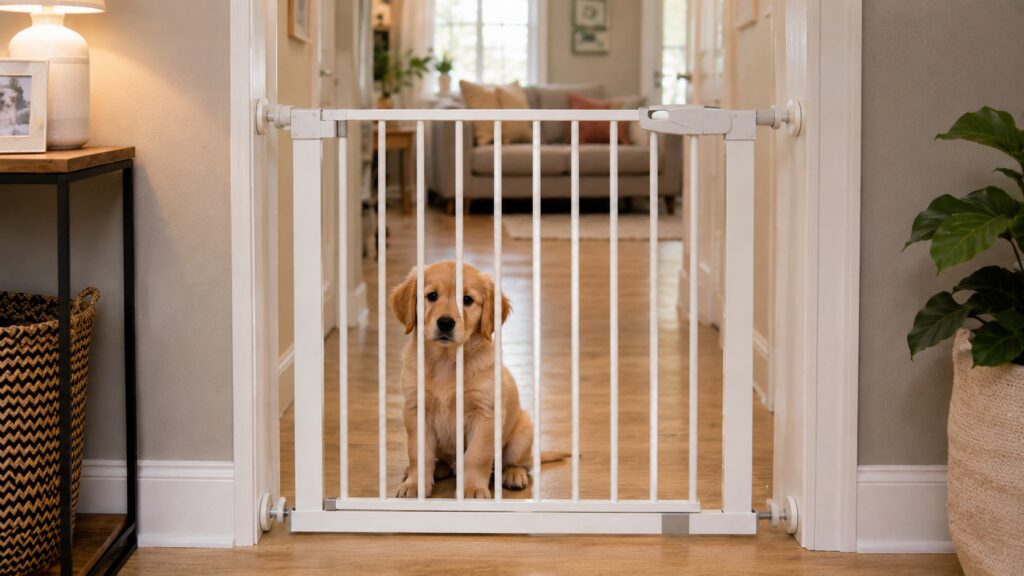
3. Baby gates (at least 2)
You need to control which rooms your puppy has access to before they’re house trained. An unsupervised puppy in a bedroom or on carpeted stairs is an accident waiting to happen. $25-$60 per gate.
4. An exercise pen (puppy pen)
For times when you need to give your puppy more space than a crate but can’t directly supervise. Particularly useful for working dog parents who need a safe zone during video calls. $40-$100.
5. Puppy-proofing supplies
Before the puppy arrives, walk through your home at puppy height. Move electrical cords, secure cabinet latches in the kitchen and bathroom, remove toxic houseplants, and block access to anything small enough to be a choking hazard. Check the ASPCA’s toxic plant list before assuming your plants are safe.
Food and Water
6. Puppy food appropriate for their size and breed
Not adult dog food. Not whatever was on sale. Puppy formulas are specifically balanced for the growth rates and nutritional needs of puppies, and large breed puppies have different requirements than small breed puppies. Ask your vet or the breeder what the puppy has been eating and transition gradually over 7-10 days to avoid GI upset. $30-$80/month depending on size and brand.
7. Food and water bowls
Stainless steel or ceramic, not plastic. Plastic bowls harbor bacteria in scratches and can cause contact dermatitis around the muzzle in some dogs. Two bowls minimum. $15-$40.
8. A slow feeder or puzzle bowl (optional but genuinely useful)
Puppies who eat too fast are more prone to vomiting and discomfort. A slow feeder adds 3-4 minutes to mealtime and costs $10-$25. Not essential but earns its place fast.
Health and Vet Care
9. A vet appointment scheduled before pickup day
Book it before the puppy arrives. Most vets recommend a first exam within the first 7 days. Your puppy likely needs vaccines at 8 weeks, 12 weeks, and 16 weeks, plus flea, tick, and heartworm prevention. Budget $75-$150 for the first visit.
10. Vaccination records from the breeder or shelter
Whatever was given before you got the puppy needs to follow the puppy home. Don’t leave without this paperwork.
11. Flea, tick, and heartworm prevention
Ask your vet which products they recommend at the first visit. Don’t use over-the-counter products without vet guidance since some contain ingredients unsafe for puppies under a certain age or weight. $20-$50/month.
12. A pet first aid kit
Gauze, antiseptic wipes, saline solution, a rectal thermometer, and your vet’s emergency number. Kits are available pre-assembled for $20-$40, or you can build one. This is a non-negotiable item that most dog parents don’t think about until they need it. If you’re bringing a puppy home in warm weather, also read up on the early warning signs of dog heatstroke now. Puppies overheat faster than adult dogs and the signs can escalate quickly.
13. A record-keeping system for health documentation
Here’s the one most people skip and then regret at the 12 week vet visit when they can’t remember what vaccines were given at 8 weeks. The Dog Medical Vault is a free fillable PDF you can download from ThePawCompass that was designed for exactly this, with dedicated pages for vaccination dates, medication records, vet contacts, and health history you can bring to every appointment. Get it before the puppy comes home, not after. It’s free.
House Training Supplies
14. Enzymatic cleaner (buy two bottles)
Non-negotiable. Regular cleaners do not fully break down the urine compounds that dogs can still smell and that draw them back to the same spot. Enzymatic cleaners break them down completely. Nature’s Miracle and Rocco & Roxie are the most commonly recommended. $12-$20 per bottle. Buy it before the puppy arrives.
15. Puppy pads (optional depending on your setup)
If you live in a high-rise, have a working dog parent situation, or have a puppy under 12 weeks who physically cannot make it outside in time, pads are a useful tool. If you’re going straight to outdoor training, skip them entirely. Pads can create a habit of going indoors that takes weeks to unlearn. $20-$40 for a starter pack.
Collar, Leash, and ID
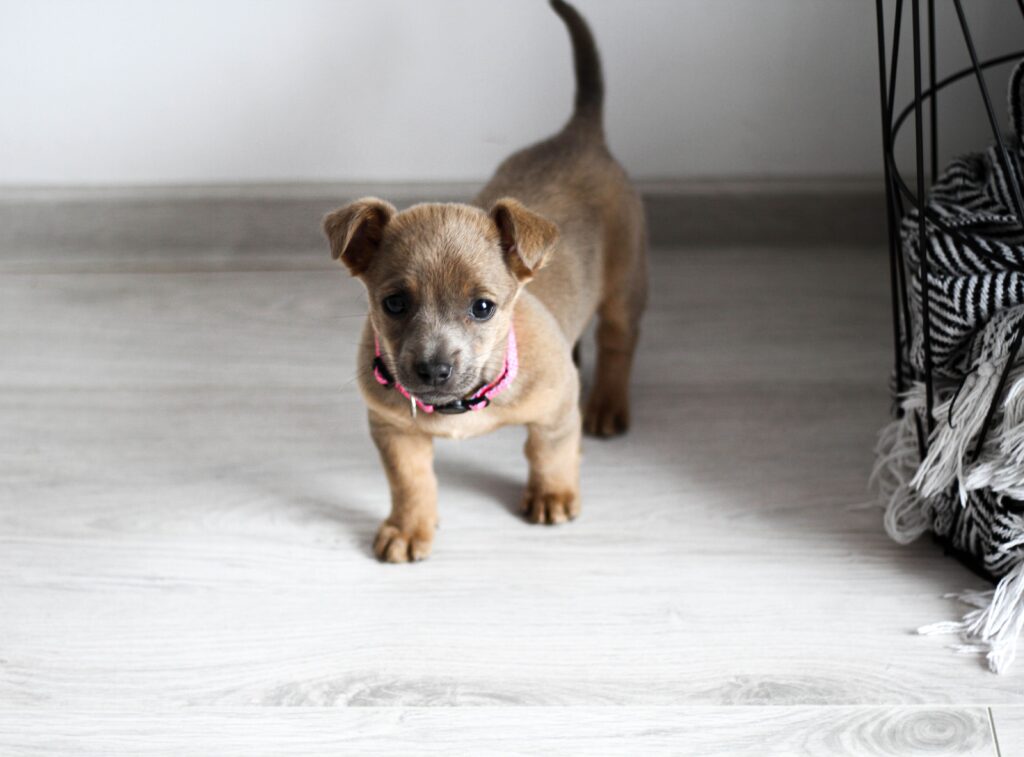
16. A collar with ID tag
The tag should have your phone number on it from day one. Even a puppy who isn’t going outside yet should wear a collar with ID inside, because doors open and puppies are fast. $15-$30.
17. A leash (4-6 feet, non-retractable)
Retractable leashes are not appropriate for puppies. They teach pulling, offer no control, and have caused injuries. A standard 4-6 foot leash for training and a separate 15-20 foot long line for recall practice are the two you’ll actually use. $10-$25.
18. A harness (optional at first, useful later)
Some puppies are easier to manage on a harness than a collar, especially during early leash training. Not essential on day one but worth having by week 2. $20-$45.

Sleep and Comfort
19. A puppy bed or blanket for inside the crate
Something washable. Puppies have accidents in their crates in the early weeks, and anything you can’t put in the washing machine is a problem. Avoid thick plush bedding that a young puppy can burrow under and overheat. $15-$40. Use my dog crate size chart to pick the right crate, and see how much puppies sleep for what a normal night looks like.
20. A worn item of your clothing for the crate
Free, and genuinely effective. A t-shirt you’ve worn recently, placed in the crate, provides your scent and helps a puppy feel less alone overnight. Use this from night one.
Chews, Toys, and Mental Stimulation
21. Safe chew toys
Puppies are going to chew. You can either provide appropriate outlets or sacrifice your furniture. KONG rubber toys, Nylabone puppy chews, and Benebone puppy chews are the most commonly vet-recommended options. Avoid rawhide, antlers, hard nylon, and anything that can splinter or that is harder than your thumbnail. $10-$30 to start.
22. A KONG or puzzle toy for crate settling
Stuffing a KONG with wet food or peanut butter (check it’s xylitol-free) and freezing it creates a high-value occupier that helps puppies settle in the crate. This is one of the most effective crate-training tools available and costs $10-$15.
23. Tug and fetch toys
After chews, these are the two categories of toy that get the most use. Start with 2-3 basics and let your puppy tell you what they actually play with before spending more. $15-$30.
Training
24. High-value training treats (small, soft, smelly)
Training treats need to be small (pea-sized maximum), soft enough to eat quickly, and motivating enough to compete with distractions. Freeze-dried liver, small pieces of string cheese, and commercial training treats like Zuke’s Mini Naturals all work. $8-$20.
25. A clicker (optional but useful)
For dog parents who want to use marker training, a clicker creates a precise signal for “that was the right behavior.” Not essential, but it speeds up early training for many puppies. $3-$8.
26. A 6 week puppy class booked in advance
The AKC recommends starting puppy classes as early as 7-8 weeks, even before full vaccination, in environments that require proof of age-appropriate vaccination for attending dogs. Early classes are primarily about socialization and foundation behaviors, not formal training. $100-$200 for a 6 week course. Book before the puppy arrives since good puppy classes fill fast.
Once you have the checklist sorted, the next thing to build is the actual daily routine. My post on the complete 8 week puppy schedule maps out exactly how feeding, potty trips, sleep, and crate time fit together through the first two months.
Grooming Basics
27. A basic grooming kit
Breed-appropriate brush or comb, nail clippers or a grinder, ear cleaning solution, and dog-safe shampoo. The specific tools depend on your puppy’s coat type, but starting grooming handling early makes a significant difference to how cooperative your dog is for grooming as an adult. Budget $30-$60 for a starter kit.
What You Don’t Need on Day One
Puppy cologne or deodorizing spray. This is a marketing product, not a care product.
A camera collar or GPS tracker. Useful eventually, but not before you’ve sorted the basics.
Matching bowl and leash sets in matching colors. Not criticizing the impulse. Just not a week one purchase.
A dog stroller. There are situations where these are genuinely useful. Week one is not one of them.
Every toy in the store. Puppies are often most entertained by the cheapest objects in the house. Start with 3-4 toys and let your specific puppy tell you what they like.
Mistakes That Set the First Week Back
Don’t set up the puppy area and then rearrange it on arrival day. Puppies are sensitive to environmental change. Pick a spot for the crate and the feeding area and keep it consistent from day one.
Don’t let everyone in the family greet the puppy at the front door simultaneously. This is overwhelming for an 8 week old puppy who has never been in your home. One calm person, a quiet space, and some time to sniff around is a much better introduction.
Don’t skip the vet appointment because the puppy “seems healthy.” Breeders and shelters do their best, but parasites, infections, and developmental issues are not always visible to the naked eye. A first exam within the first week is not optional.
Don’t let the puppy sleep in your bed from night one if you’re not prepared for that to be a permanent arrangement. Not a moral judgment. Just a practical one. Whatever sleeping arrangement you establish in week one becomes the expectation. Decide intentionally.
Don’t introduce the puppy to every person and other pet in your life in the first 48 hours. Give them 2-3 days to acclimate to your home and the people who live in it before introducing the extended network.
The Real First Week Cost
Nobody talks about this number honestly, so here it is.
If you’re starting from scratch with no existing supplies:
- Setup costs (crate, gates, pen, bowls, bed, starter toys, grooming kit): $250-$500
- First week food and treats: $50-$80
- First vet visit (exam and vaccines): $75-$150
- Flea, tick, heartworm prevention: $25-$50
- Miscellaneous (cleaner, collar, leash, ID tag): $50-$80
Realistic first week total: $450-$860.
Ongoing monthly costs from month 2: food ($30-$80), preventatives ($20-$50), puppy class ($100-$200 for the 6 week course spread across weeks), and miscellaneous chews and supplies ($20-$40). Budget $170-$370 per month for the first 6 months.
The Puppy Industry Is Very Good at Selling Anxiety
The puppy industry is very good at selling anxiety. “Does your puppy have a calming bed? A calming spray? A calming collar? An anxiety wrap?” Most of these products have limited evidence behind them, and many are not something an 8 week old puppy needs at all.
What an 8 week old puppy actually needs is a crate that feels safe, a consistent schedule, a few appropriate chews, and your presence. Most of the genuinely useful tools on this list cost under $30. The things that look the most impressive in the shopping cart are usually the least important. Spend on the food, the vet, and the training class. The rest can wait until you know what your specific dog actually needs.
The Collar That Did Not Fit on Day One
We brought our dog home on a Tuesday afternoon after months of planning. I had the checklist, the crate, the enzymatic cleaner, the KONG, all of it. What I had forgotten was to check whether the collar I’d bought was actually adjustable to small enough for an 8 week old puppy neck. It wasn’t.
She spent the first 3 hours of her life with us wearing a collar that fit like a loose necklace. We had an ID tag with no collar to attach it to that could actually stay on her.
This is a small and very fixable story. The lesson is: run through the checklist before pickup day, not as you’re loading supplies into the car. Buy the ID tag in advance and have it ready to go on when you pick up the puppy, not 3 days later.
Frequently Asked Questions
-
What is the most important thing to have before bringing a puppy home?
A properly sized crate and enzymatic cleaner are the two most practically important. The crate is the foundation of house training and safe overnight rest. The cleaner is necessary the first time there is an accident, which is often within hours of arriving home.
-
Do I need a puppy pen and a crate?
Not necessarily both from day one. If someone is home most of the time, a crate is sufficient. If your puppy will regularly be alone for more than 2-3 hours, a pen with a designated indoor potty area is more humane for a young puppy who cannot yet hold their bladder.
-
When should I schedule the first vet visit?
Within the first 7 days. Sooner if your puppy came without vaccination records or if you notice anything concerning. Book the appointment before the puppy arrives, not after.
-
What food should I feed my new puppy?
Whatever your vet or the breeder recommends for your puppy’s specific breed, size, and age. If you’re changing from what they were eating before, do it gradually over 7-10 days to avoid diarrhea.
-
How much does the first month with a puppy really cost?
Between $450 and $860 for setup plus the first week, then $170-$370 per month in ongoing costs for food, prevention, and a puppy class. It’s more than most people expect.
-
Can I use human cleaning products to clean up puppy accidents?
No. Regular cleaners don’t break down the urine compounds dogs can still smell even when the area looks clean to you. Enzymatic cleaners are specifically designed for this. This is one of the most common house training mistakes and it matters.
The checklist is not the goal. The goal is a puppy who feels safe in your home from the first hour and a dog parent who isn’t running to the store at 10pm. Get the list right before pickup day, and the first week is genuinely manageable instead of genuinely overwhelming.
This article is for informational purposes and is not a substitute for veterinary advice. Consult your veterinarian for guidance specific to your puppy’s breed, size, and health status.

6 Comments